Adenosine and sleep pressure: why you crash in the afternoon
The molecule that builds up the longer you're awake, makes you tired, and explains why mornings are so hard.
Visana Studios
5 min read
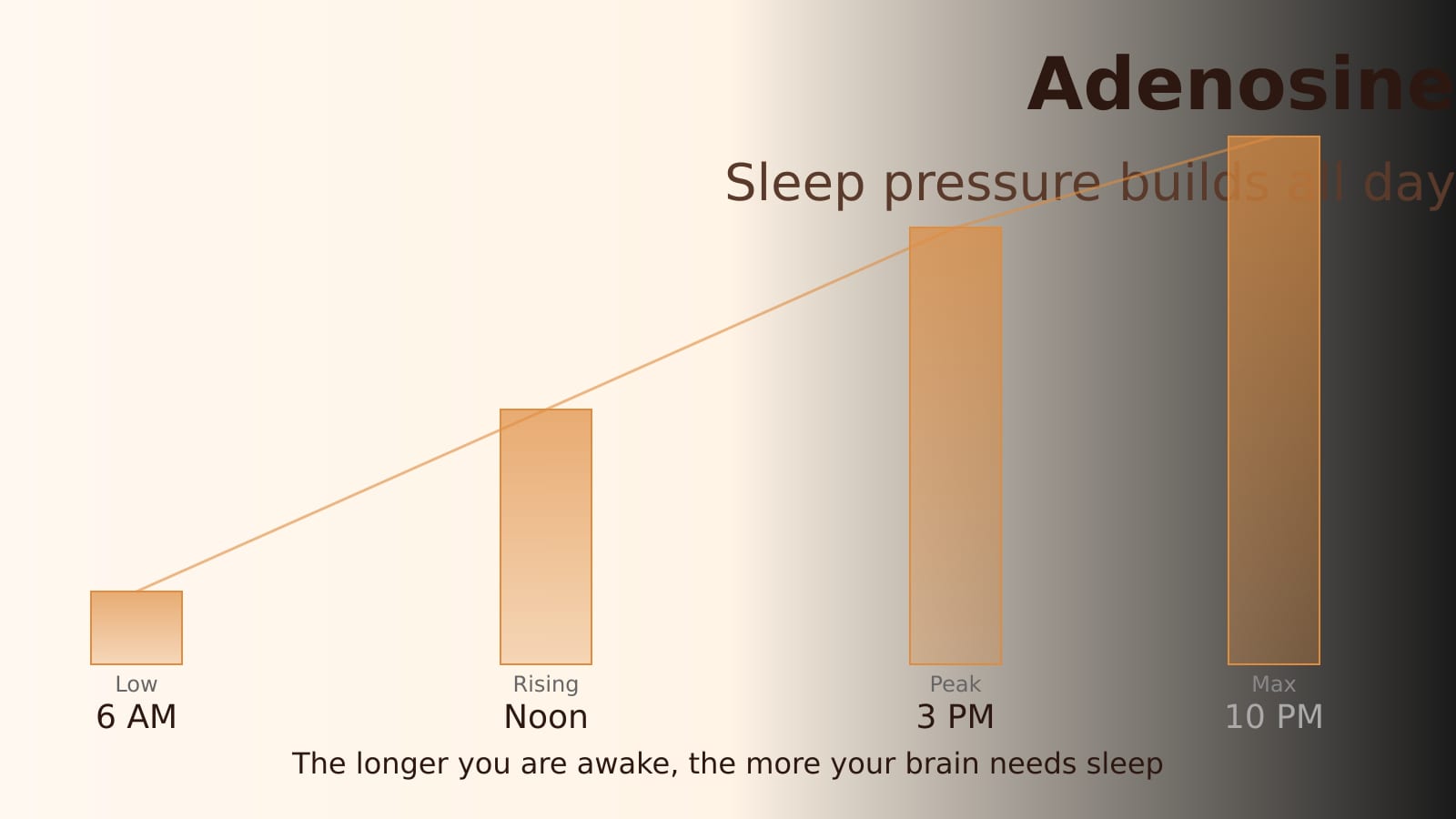
Your brain keeps time by measuring how long you have been awake, and it does this with a single molecule: adenosine. Every hour you stay conscious, adenosine accumulates. By afternoon, that buildup reaches a peak. The longer you stay awake, the heavier that pressure becomes, until sleep is the only relief. Understanding how adenosine works explains why mornings are so hard, why coffee stops working by evening, and why fighting sleep gets harder as the day goes on.
The brain's clock
Adenosine is a byproduct of cellular metabolism. The harder your brain works and the more alert you are, the more adenosine builds up. Unlike a normal clock that measures minutes and hours, the brain measures time awake by the amount of adenosine sitting in your brain at any moment. More adenosine means more time conscious, and more time conscious means more pressure to sleep.
This system is so fundamental that it is one of two processes that control whether you wake or sleep. The other is your circadian rhythm, the internal 24-hour clock that keeps you alert during the day and ready to sleep at night. These two systems work together: your circadian rhythm tries to keep you awake, while adenosine tries to put you to sleep. Sleep happens when adenosine peaks and your circadian drive drops.
How it builds
Adenosine is not dangerous at normal levels, but it is relentless. The longer you are awake, the more it accumulates in the brain. Around six hours of sustained wakefulness, the level of adenosine in your basal forebrain (the region most involved in sleep regulation) roughly doubles. You do not feel this happening. Most of the afternoon passes before you consciously register the pressure as drowsiness.
For anyone awake sixteen hours, clearing all that adenosine takes roughly eight hours of sleep. This is why you cannot simply sleep one extra hour on the weekend and catch up on six nights of poor sleep. Adenosine accumulates through the week, and one long sleep session does not clear all of it. Sleep debt builds.
Why coffee wears off
Caffeine does not remove adenosine. It blocks it. Caffeine is a molecule that fits into the same receptors as adenosine (adenosine A1 and A2A receptors) and stops adenosine from binding. When adenosine cannot reach its receptors, your brain does not feel the drowsiness, so you feel more alert.
But adenosine is still there, still accumulating. As the afternoon goes on and you remain awake, more and more adenosine builds up. By evening, the amount of adenosine is so high that caffeine, even a strong dose, cannot block all of it. Some adenosine gets through anyway. That is why an afternoon coffee energises you but a morning coffee wears off by bedtime, and why chasing drowsiness with more coffee becomes futile.
Sleep clears it
Sleep, especially deep slow-wave sleep, is when the brain clears adenosine. The longer you sleep, the more adenosine gets removed. This is why eight hours of sleep is restorative: enough time to clear the adenosine that built up over a sixteen-hour day. Short sleep leaves some adenosine behind. The next day, you start with a partial load already in your brain, so you reach that drowsy afternoon state even faster.
This explains sleep debt. One bad night is recoverable. A week of five-hour nights leaves adenosine residue every morning. By Friday, your brain is drowsy before lunch. One long sleep on Saturday helps, but it takes more than one night to clear a week of accumulated pressure.
Why mornings are hard
If you sleep poorly or not long enough, you wake with adenosine still in your brain. That adenosine makes you groggy, slow and unmotivated. The first thirty minutes after waking are hardest because adenosine levels are highest. This grogginess is also called sleep inertia.
A key detail: adenosine makes your brain less responsive to light. Exposure to bright light normally signals your body to wake up and keep you alert. But when adenosine levels are high, that wake signal is weaker. Morning light does not fight through the adenosine fog as well as it would if you were rested. Your circadian rhythm tries to wake you, but adenosine is pulling the other way. The groggier you are, the harder morning light has to work.
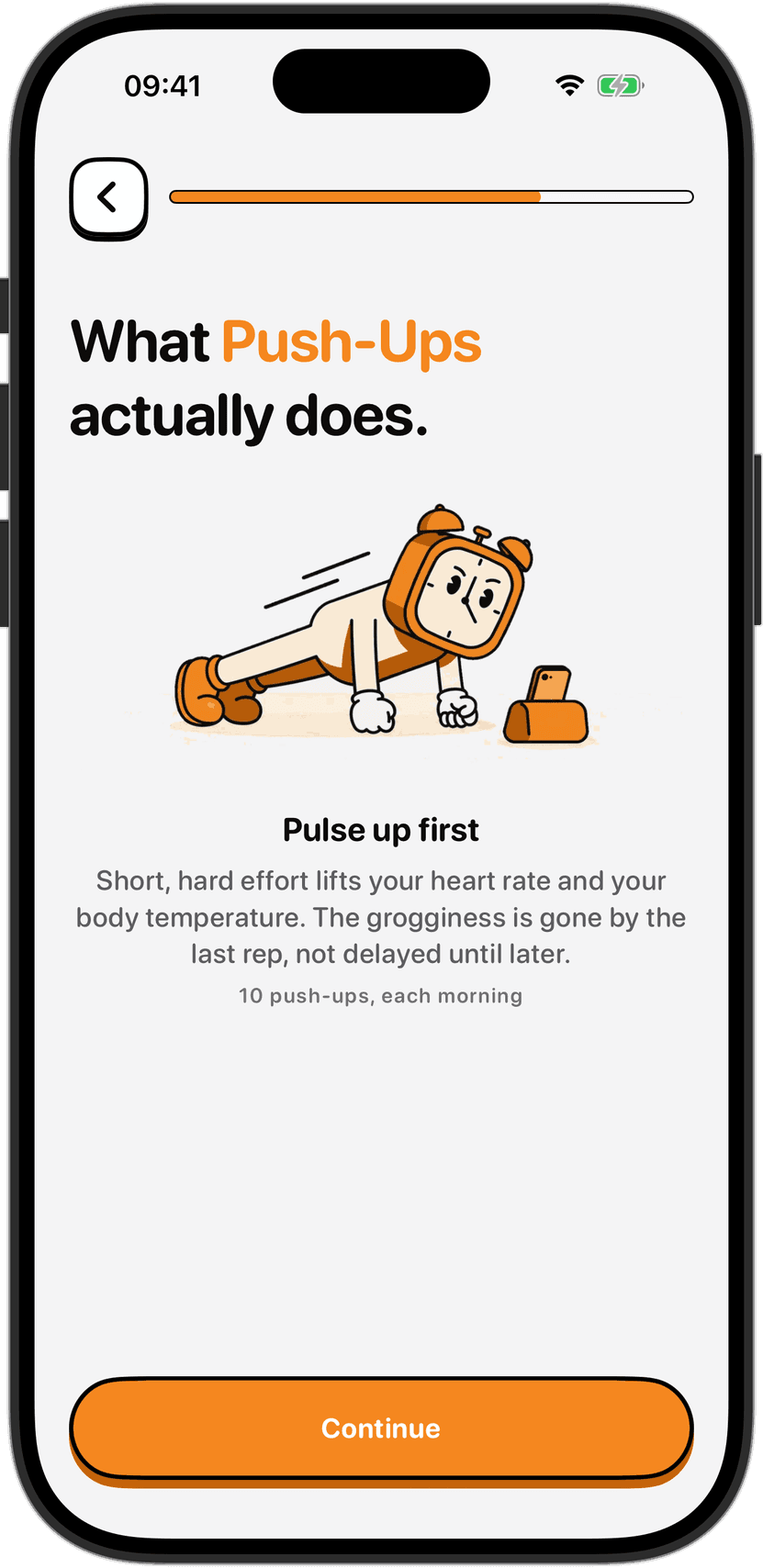
Physical activity is one of the few things that cuts through adenosine-induced grogginess immediately. Movement burns energy, shifts metabolism and activates neural systems that push back against drowsiness. This is why wake tasks that require physical effort, like push-ups or squats, are so effective at clearing sleep inertia. They do not remove the adenosine, but they overcome it.
The interaction with circadian rhythm
Adenosine buildup and circadian rhythm are not separate. They interact. Your circadian rhythm is highest in late morning and early evening, when the urge to sleep is naturally low. Adenosine is lowest in the morning (if you slept well) and highest at night. Sleep happens when high adenosine meets low circadian drive.
If you are sleep deprived, adenosine stays high even into the morning. Your circadian rhythm is trying to keep you alert, but the adenosine is still there, fighting back. That is why someone who is severely sleep deprived can be drowsy even at times when they are normally most alert. The adenosine signal is too strong.
Why adenosine matters
Adenosine explains the mechanics of tiredness and sleep debt in a way that makes the solutions obvious. You cannot avoid adenosine buildup; it is how the brain counts time awake. You can get enough sleep to clear it, you can avoid caffeine late in the day so adenosine can be felt and respected, and you can use physical activity in the morning to overcome whatever adenosine is still there after sleep.
NoNap's wake tasks work with this system rather than against it. A task that requires movement in those first thirty minutes after waking is fighting adenosine at its peak, when your brain is slowest and groggiest. Finishing that task proves you are awake enough to act, not just conscious.
Sources
Yale Medicine: Good Sleep Recipe. Internal Medicine, Pulmonary, Critical Care and Sleep Medicine.
Sleep Foundation: Adenosine and Sleep: Understanding Your Sleep Drive.