Why Tonight's Bedtime Decides Tomorrow's Wake-Up
Your morning success is determined by when you go to bed. Here's the science of how bedtime affects sleep inertia, circadian rhythm, and morning alertness.
Visana Studios
6 min read

You set your alarm for 6 a.m. and go to bed at midnight. The alarm sounds six hours later and you feel like you have been hit with a hammer. Your eyes are heavy, your thinking is foggy, and the only thing that makes sense is crawling back under the blankets. You tell yourself you just are not a morning person. What actually happened was decided the night before, not at 6 a.m., and it was not about your personality. It was about sleep.
When you go to bed matters as much as when you wake up. The timing of your sleep, not just the duration, determines how alert you are in the morning and how well your body handles the wake-up signal. Tomorrow morning's success starts with tonight's decision to go to bed on time.
Sleep inertia is worst when sleep is short
Sleep inertia is the grogginess and mental fog that hits you when you first wake up. It is a real neurological state, not weakness or laziness. When you first open your eyes, your brain is transitioning from sleep to wakefulness, and that transition does not happen instantly. Researchers find that sleep inertia typically lasts 15 to 60 minutes but can extend for several hours depending on how deep your sleep was and how abruptly you woke.
The problem is that short sleep makes sleep inertia worse. When you spend only six hours in bed instead of seven or eight, your brain does not progress as far through the sleep cycles that prepare it for waking. You wake while your brain is still in deep sleep, which intensifies the grogginess. A person who slept six hours wakes more confused and disoriented than someone who slept eight, even if both wake at the same clock time. That difference is entirely determined by when the first person went to bed.
Your body runs on two clocks
Your ability to wake up alert depends on two biological systems working together. The first is your circadian rhythm, your internal 24-hour clock that makes you feel alert during the day and sleepy at night. The second is sleep pressure, the buildup of a chemical called adenosine that increases as you stay awake and drops as you sleep.
When you go to bed at midnight instead of 1 a.m., you are giving your body an extra hour to complete the sleep cycles it needs. That extra sleep increases how much of your sleep pressure is cleared. When you wake at 6 a.m., you have recovered more fully. Your adenosine levels are lower, your sleep stages have cycled more completely, and your brain is more ready to be awake.
Consistently going to bed at the same time also anchors your circadian rhythm to the evening. Your body learns to expect that it is time to wind down when 11 p.m. arrives, because it has experienced that signal hundreds of times before. Irregular bedtimes send contradictory signals to your internal clock. One night you sleep at 10 p.m., the next at midnight. Your circadian rhythm cannot lock onto a moving target, so it drifts. When your clock is drifting, waking up is harder because your body was not expecting to be awake.
Sleep debt makes morning decisions impossible
The science is even more pointed when you zoom out. If you go to bed an hour too late night after night, you accumulate sleep debt. You might feel like you have adapted, that six hours feels normal now. That feeling is an illusion. Research shows that people who chronically sleep too little underestimate how impaired they are. Your brain adjusts its baseline and you stop noticing the damage, but the damage is real.
One study found that people who slept only six hours for two weeks showed cognitive impairment equivalent to someone who had stayed awake for a full day. They could not tell they were impaired. Their judgment was worse, their reaction time was slower, their attention wandered more. Yet they felt fine, just tired. This matters in the morning because your worst decisions happen when you are sleep-deprived and do not realize it. You misjudge how tired you are. You hit snooze and think you will get up after one more alarm. You accept invitations you regret later. You skip the workout. The pattern starts with the night before, when you went to bed too late and told yourself you could handle less sleep.
The night-before decision
This is why planning your wake-up time the night before works. When you set your alarm and think about what time you need to be in bed to sleep enough, you are making that decision while your brain is relatively rested and capable of good judgment. You know how much sleep you need. You know what time you need to wake. You can do the math: if I need to wake at 6 a.m. and I need eight hours of sleep, I need to be asleep by 10 p.m., which means I need to start getting ready for bed at 9 p.m.
The morning self, the sleep-deprived and inertia-fogged version of you, will not make this decision well. The morning self will negotiate. The morning self will think one more hour of sleep is possible, that you can catch up later, that today is different. The morning self is also neurologically impaired and does not know it.
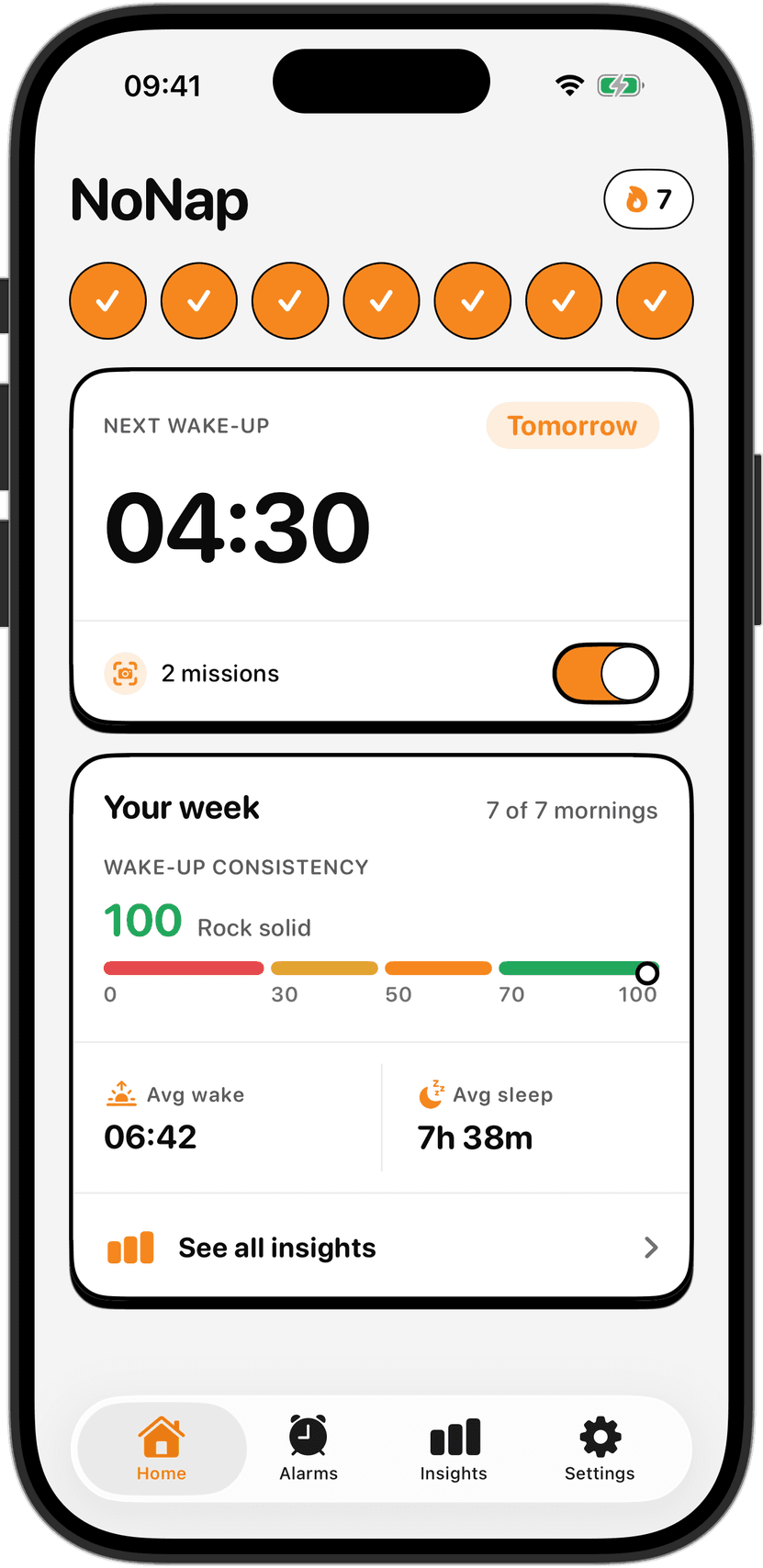
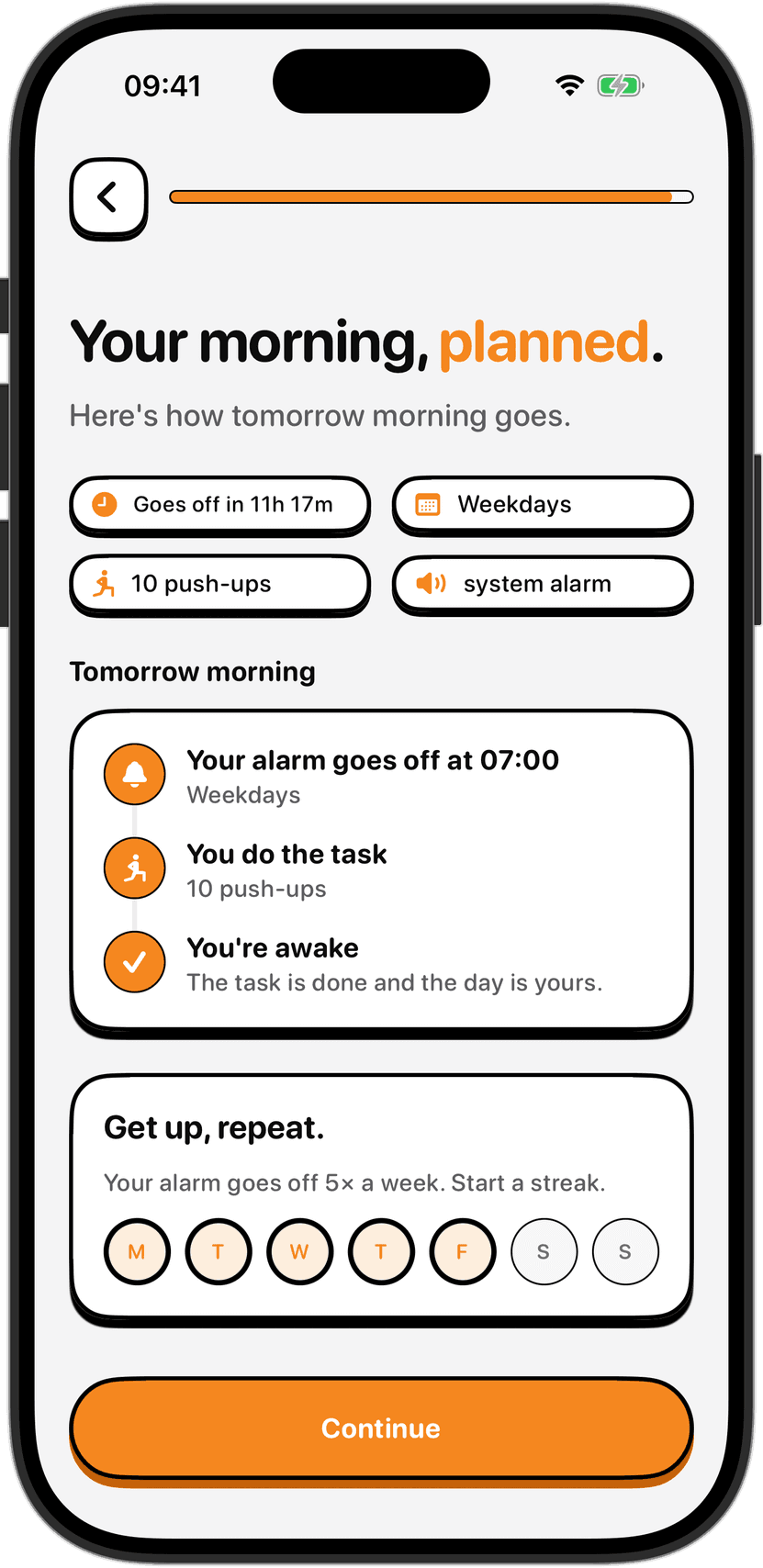
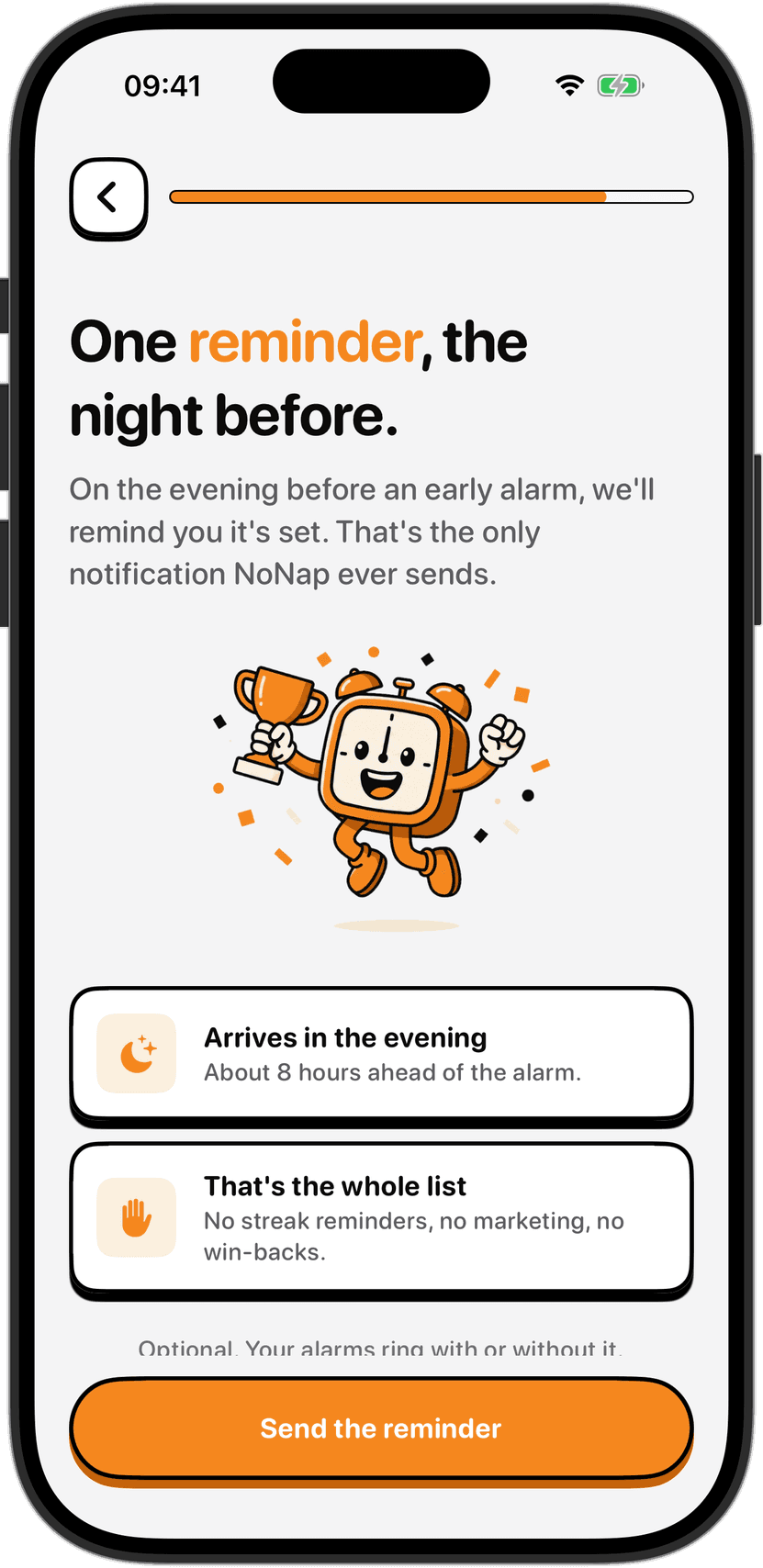
This is exactly what the NoNap night-before reminder does. It pings you at an evening time you choose and reminds you that tomorrow's wake-up is already planned. It turns the decision, which is hardest in the morning, into a prompt in the evening when your judgment is sharper. You see the reminder and you know: if I wake at 6 a.m., I need to be in bed by 10 p.m. You can choose to act on that knowledge or not. But you are choosing with a rested, alert brain, not with sleep inertia and sleep debt impairing your judgment.
The compounding effect
A single night of good sleep and good timing helps. You will wake less groggy. Your morning will be easier. But the real effect comes from consistency. When you go to bed at the same time and wake at the same time day after day, your circadian rhythm locks in. Your sleep cycles align to your schedule. Your adenosine clears more predictably. The sleep you get is higher quality because your body knows what to expect.
Within a few days of keeping a consistent bedtime, waking up starts to feel less like climbing out of a well. Within two weeks, mornings feel fundamentally different. You still might not be a "morning person" in the sense of loving early mornings. But you will be awake. Alert. Capable of making good decisions right away. That person was created the night before, by a simpler version of yourself who went to bed on time.
Sources
Sleep Inertia: How to Combat Morning Grogginess - Sleep Foundation
How Sleep Affects Decision Making - eachnight
How to Build a Sleep Routine That Actually Works - GW Cancer Center