When you and your partner wake up at different times
Why partners have different sleep schedules, how shared sleep affects you both, and how alarm etiquette protects the one still sleeping.
Visana Studios
6 min read
One partner wakes at 6 a.m. for a gym session. The other doesn't surface until 8. They share a bedroom. Every morning is a small negotiation between light, sound, and the person still trying to sleep.
Mismatched wake times rank among the most common sources of bedroom friction. Not because either person is wrong to sleep differently, but because sleep is a shared ecosystem. The same bed that gives you comfort has to sustain two people with different rhythms.
Why sleep schedules diverge in the first place
Chronotype is not a choice. The trait appears to be mostly genetic, and it determines whether you naturally tend toward early mornings or late nights. Morning people and night owls have measurable differences in body temperature curves, melatonin timing, and when their core alertness peaks. A 2021 review in Chronobiology International documented that chronotypes are moderately heritable and stable over most of adult life. If you want to understand your own chronotype, read about night owls and early birds.
Work schedules can override chronotype for a while, but they create a cost. Misalignment between your natural chronotype and your actual schedule is sometimes called "social jetlag." A person who is naturally nocturnal but wakes at 6 a.m. for work is living in a form of permanent mild jetlag, experiencing cognitive impairment and mood effects that can persist for years.
Couples often land at different points on this spectrum. One partner might be a genetic early riser while the other's ideal sleep window is midnight to 8 a.m. If both need to share the same bedroom, one will almost certainly be woken before their body is ready to wake.
The research on shared sleep and its costs
Couples who sleep in the same bed are physically entangled in each other's sleep architecture. Movement, breathing changes, and arousal cycles are not private events. A 2019 study in Sleep by Walters, Phillips, and colleagues including Drummond found that sleep and wake patterns are literally transmitted between partners who share a bed. One person's arousal can trigger the other's arousal.
More recent research has begun to untangle the effects. A 2025 observational study protocol described in Sleep Advances by Troxel, Baucom, and colleagues examined how sleep and biobehavioral rhythms align in older couples. The work addresses a gap: most sleep research treats individuals in isolation, yet for millions of people, sleep is fundamentally a partnered activity.
The precise payoffs of shared sleep are complex. Some research suggests couples who sleep together report higher relationship satisfaction, and some show that synchronized sleep patterns are associated with better mood and relationship quality. But the same research also finds that poor sleep in one partner can degrade the other's mood and perception of support. Shared sleep is not automatically restorative. It depends on the fit.
What actually wakes the sleeping partner
The obvious culprits are snoring and movement. Snoring alone disrupts sleep in approximately 30 percent of partners who share a bedroom, according to data cited in sleep medicine literature. That number rises sharply in people with sleep apnea. Movement during the night, especially if a partner is restless or working irregular schedules, creates a similar burden.
Then there is the alarm. If one partner has a 6 a.m. wake time and the other sleeps until 8, an alarm clock is unavoidable. The question is not whether to use one but how. A quiet alarm that stays on the sleeping partner's side of the bed might not fully work, because sound carries. Worse, many phones and alarm clocks are designed to be loud enough to cut through deep sleep. Some people reach for alarms that grow louder over time to avoid the sudden jolt, but even a gradual climb wakes the partner.
Here is the part that matters most: if your phone or alarm uses the system alarm on iOS, an alarm going off will ring through the Ring/Silent switch and through Do Not Disturb. It will not be muted by Focus modes either. If you are the partner who hears it, that alarm is going to wake you, regardless of whether your own phone is silenced. This is not a technical failure but by design, to ensure alarms are reliable. But it means the person who wants to sleep has no escape unless they live in a different room.
Separate beds and bedrooms
The term "sleep divorce" describes couples who choose to sleep in separate beds or rooms. Surveys of sleeping arrangements have found that somewhere between 20 and 30 percent of couples in long-term relationships do this at some point, often out of necessity rather than preference. A partner's snoring, shift work, or a condition like restless legs syndrome can make shared sleeping untenable.
The research on sleep divorce is less conclusive than the name suggests. Some studies find that couples who sleep separately get better sleep, while others find that separation harms relationship satisfaction or intimacy. The personal fit matters more than the blanket advice.
Practical alarm etiquette
If you are the person waking early, your main control over the disruption is how you wake. Loud alarms are loud for everyone. Here are steps that reduce harm to the other person.
Use the gentlest alarm sound possible. Some phones let you set different alarm sounds for different times. If you have to wake at 5 a.m., accept that some sound will leak. But if your wake time is flexible, setting it to 6:30 or 7 a.m. means fewer mornings when you are waking a partner in the middle of their sleep cycle.
Consider vibration. Some people use a vibrating alarm on a smartwatch or under their pillow. A partner across the bed will not hear it. This only works if the vibration wakes you reliably, which it does for some people but not others.
If you work an early shift, try to sleep and wake on a schedule that clusters your disruption. Waking your partner every morning at 5 for a week is better than waking them at different times each morning, because the brain starts to expect it and sleep deepens less.
Have an explicit conversation with your partner about the wake time before building a routine around it. Some people can sleep through an alarm in the background. Others cannot. Some partners would prefer separate rooms if it meant better sleep. Others view that as a loss. The mismatched wake time is a logistics problem, not a character problem, and it deserves an explicit plan.
One alarm that cannot wake you further
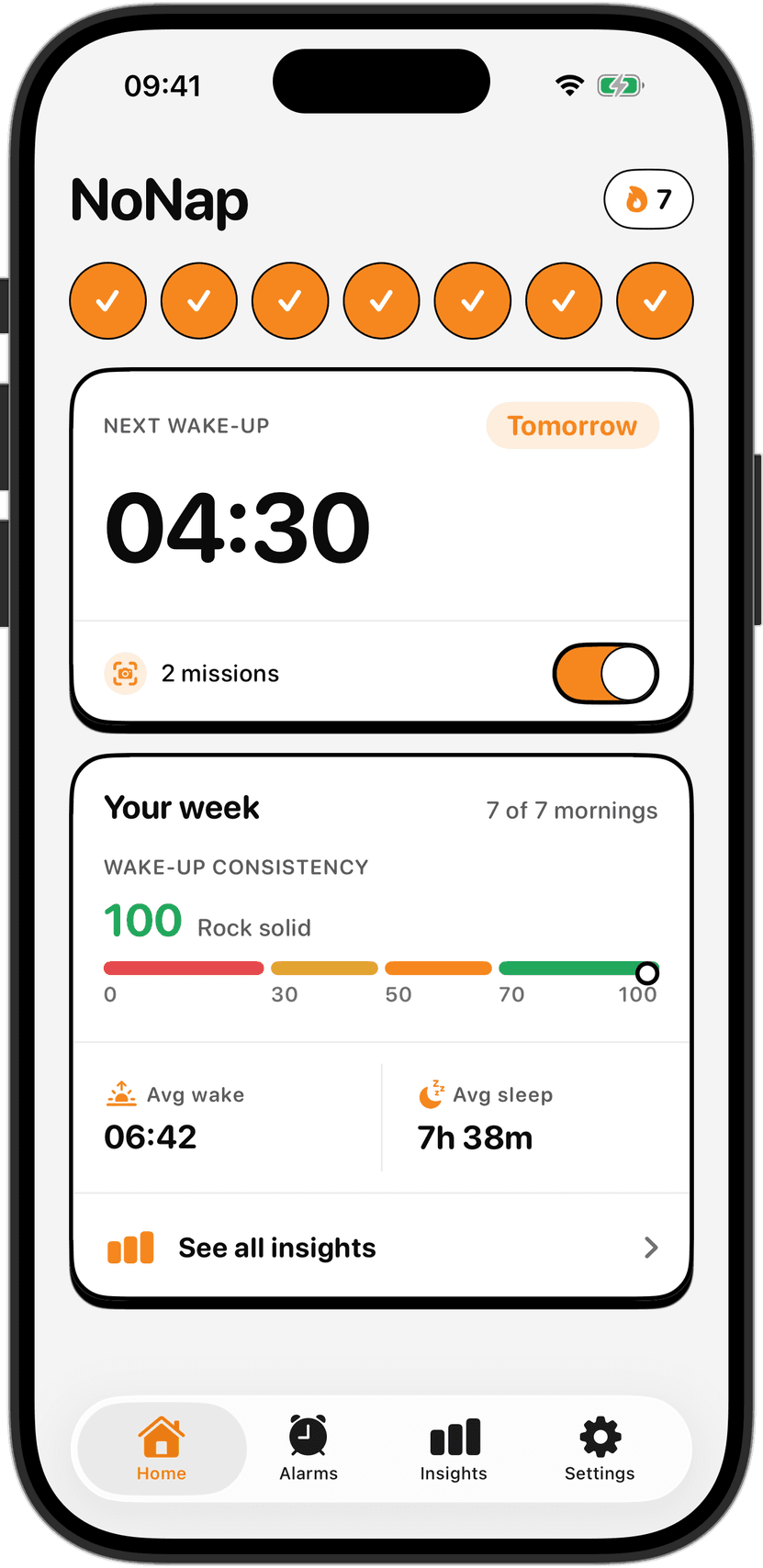
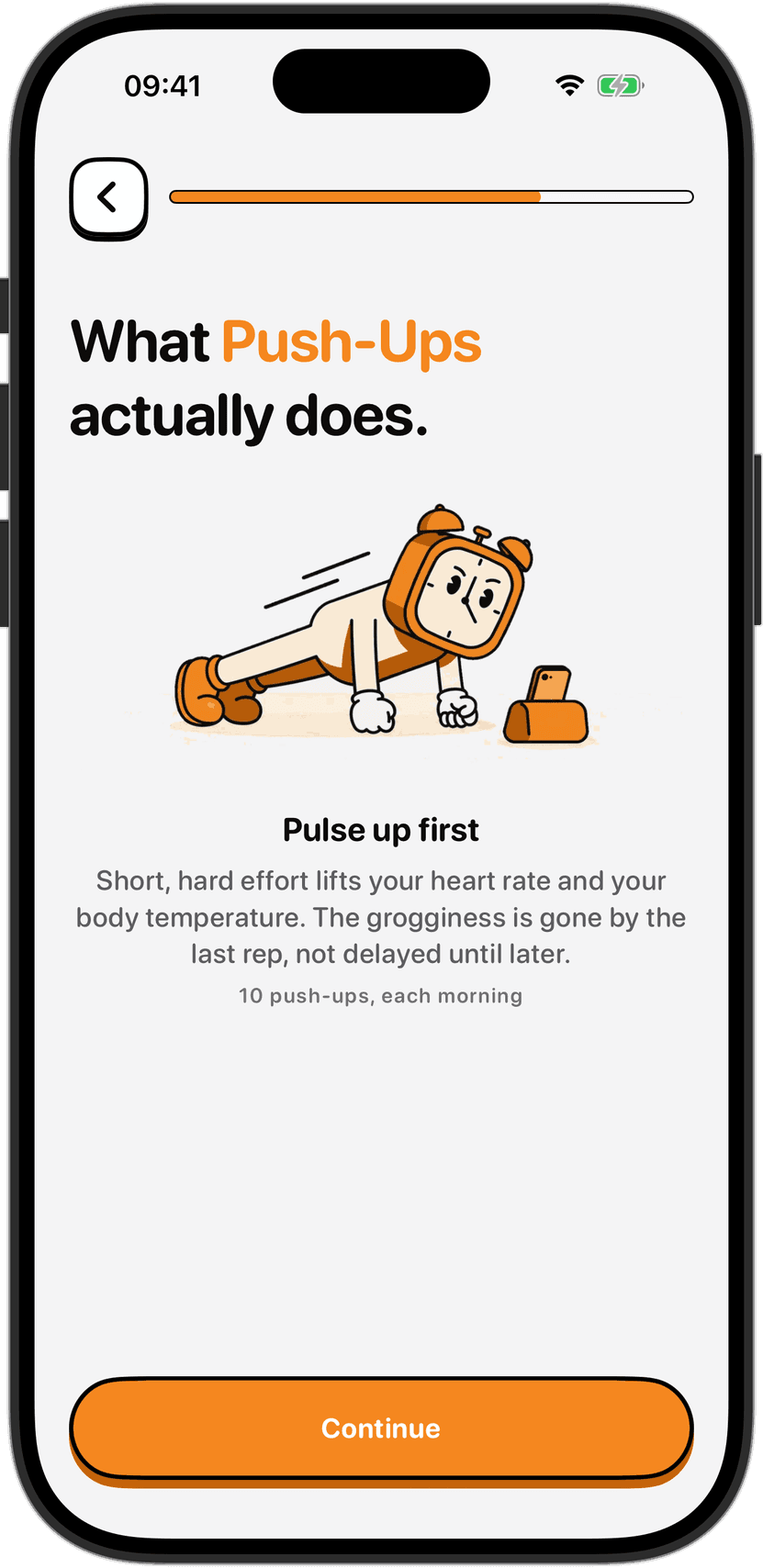
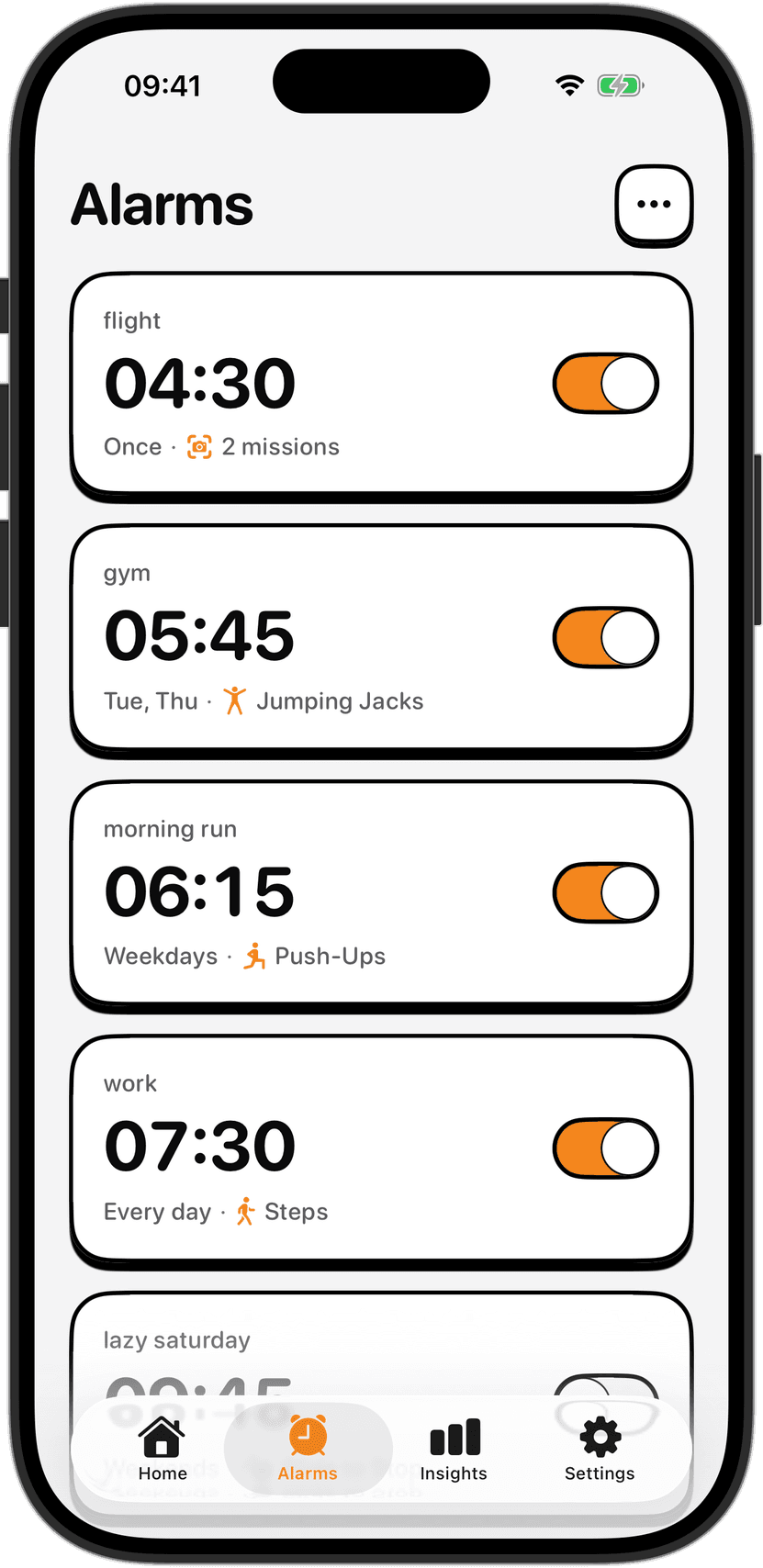
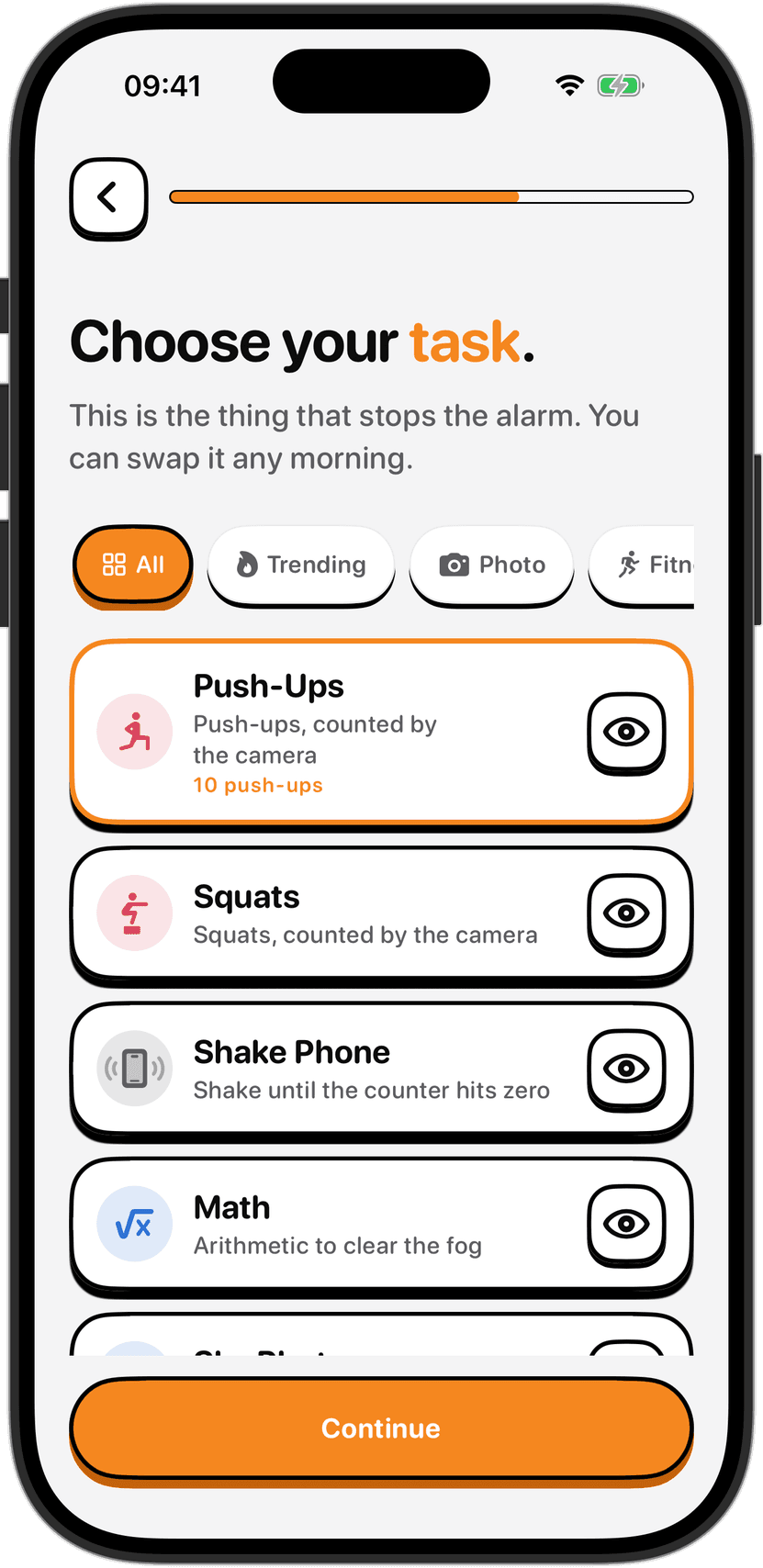
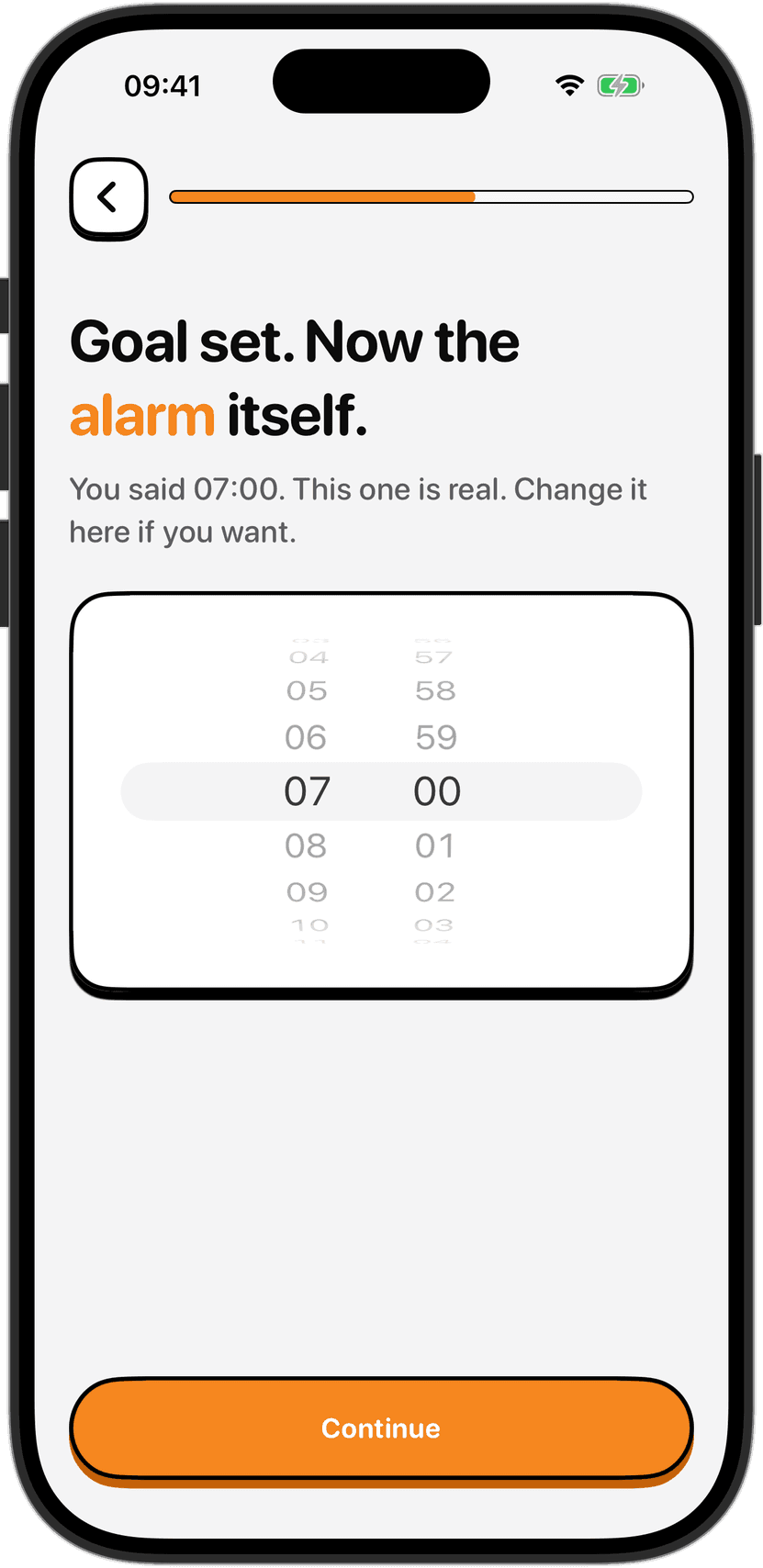
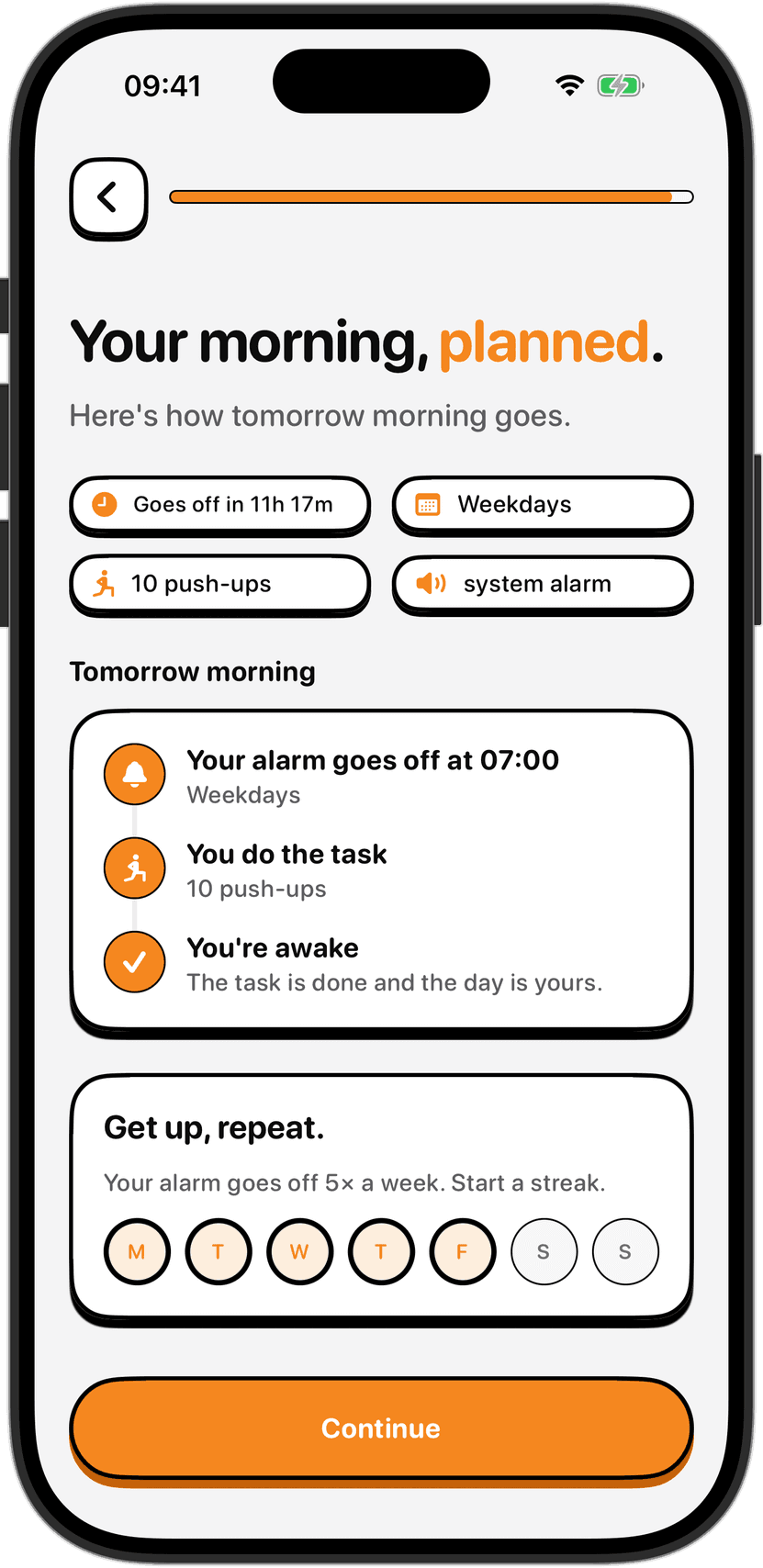
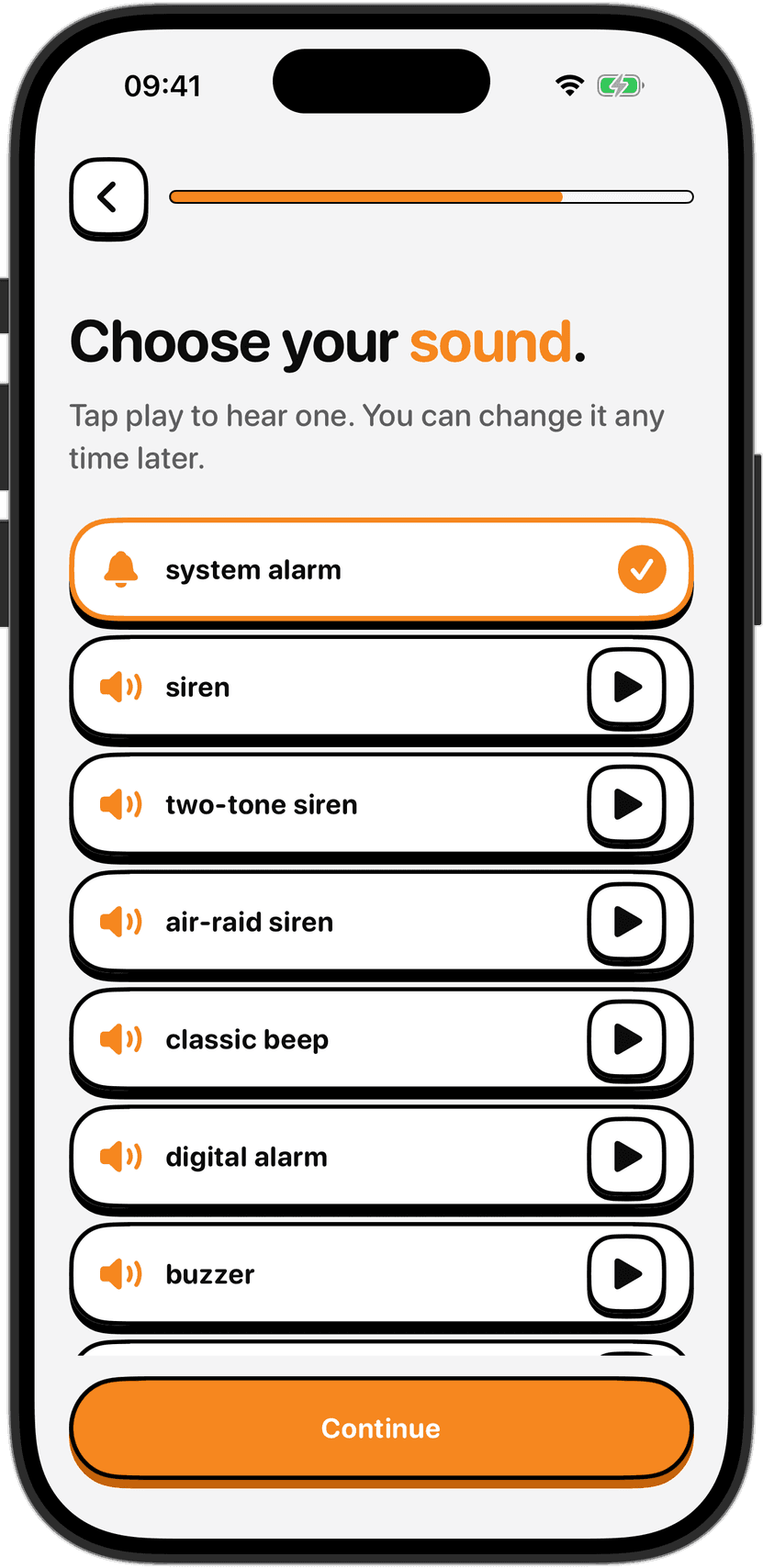
NoNap is built for one specific challenge: the person who struggles to wake reliably. It is a single alarm that uses Apple's system alarm, meaning the Ring/Silent switch does not silence it and it cannot be dismissed from the lock screen. Stopping it means finishing a wake task you chose the night before: push-ups or squats counted by the camera, shaking your phone, a math problem, taking a photo, or getting out of bed.
For a partner in the same bed, the alarm is still audible. That is part of the system's design to be reliable. If exercise first thing feels risky for you, you can pick Shake Phone or Math instead. What NoNap does differently is ensure that once the alarm rings, you actually wake up and stay awake, not by volume but by giving your half-awake brain a task to focus on. That means you are less likely to keep hitting snooze, which in turn means fewer alarms and less total disruption to your partner across the week.
A night-before reminder nudges you to wind down and set your wake time for the next morning. That moment is a good time to check in with your partner about their sleep. If you know their ideal wake time, setting yours with that in mind is a small thing that compounds over time.
Sources
Troxel, W.M., Baucom, B.R., Euler, M.J., Bermudez, B., and Baron, K.G. (2025). The CHARMS study: rationale and study protocol for an observational study of sleep and biobehavioral rhythms in older adult couples. Sleep Advances, 1(1), zpaf043. academic.oup.com/sleepadvances/article/1/1/zpaf043/7866341
Walters, E.M., Phillips, A.J.K., Mellor, A., Hamill, K., Jenkins, M.M., Norton, P.J., Baucom, D.H., and Drummond, S.P.A. (2019). Sleep and wake are shared and transmitted between individuals with insomnia and their bed-sharing partners. Sleep, 43(1), zsz206. doi.org/10.1093/sleep/zsz206
Image credits
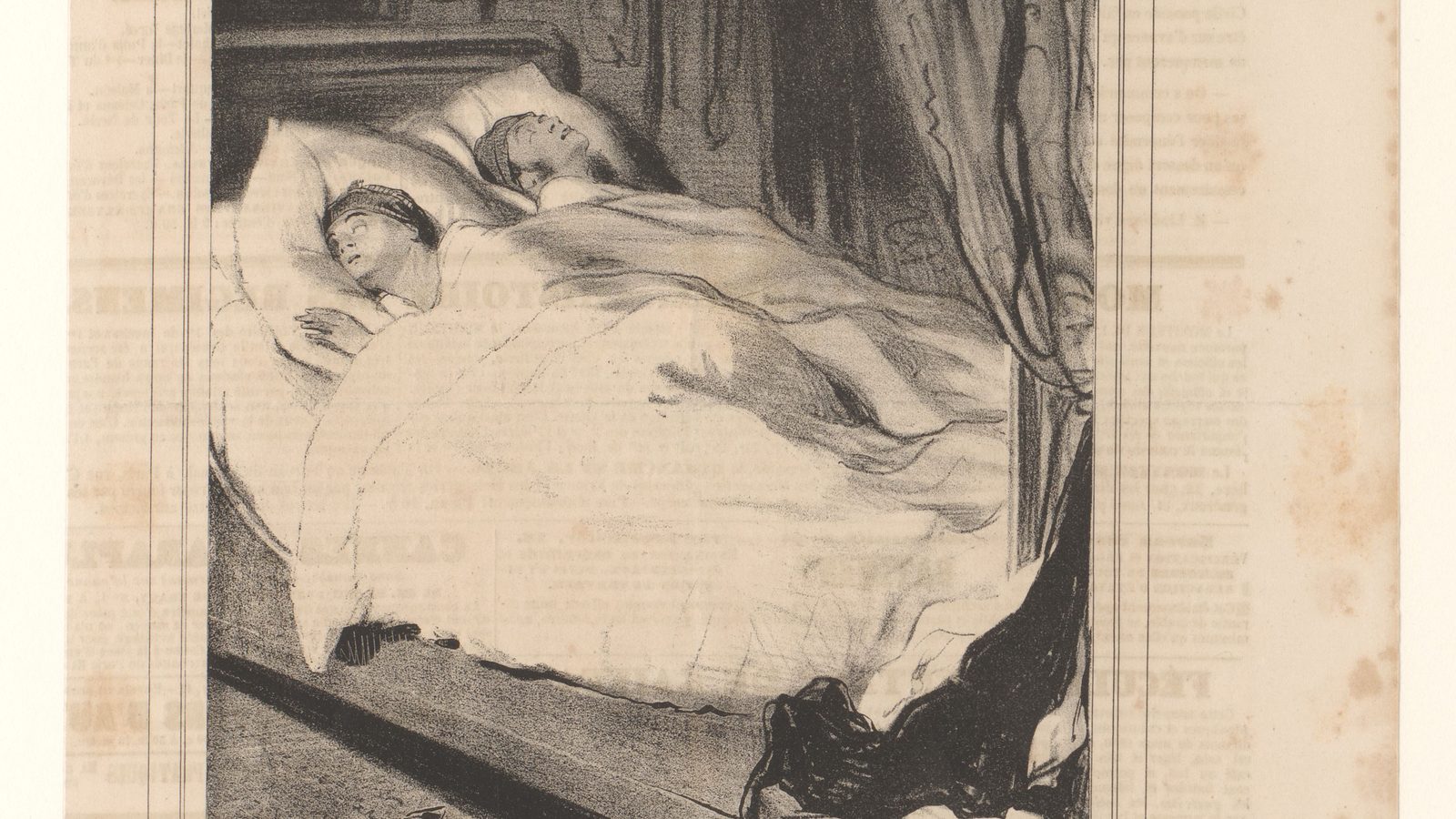
Cover image: a historical drawing of a couple sleeping in bed together, from Wikimedia Commons (upload.wikimedia.org/wikipedia/commons/1/1e/Echtpaar_naast_elkaar_slapend_in_bed%2C_RP-P-OB-40.796.jpg), in the public domain.