Do Sleep Cycle Calculators Actually Work?
Sleep cycle calculators assume a fixed 90 minute cycle. Real cycles run from about 70 to over 100 minutes, and here is what the research says instead.
Visana Studios
5 min read
Type "sleep cycle calculator" into a search bar and you get a tool that asks for your wake-up time, then counts backward in neat 90 minute blocks to tell you when to fall asleep. Enter 7:00 and it hands you 9:15pm, 10:45pm, 12:15am, all times when you'd supposedly surface between cycles instead of in the middle of one. It's a tidy idea. The problem is that your brain doesn't run on 90 minute blocks, not exactly, and not every night.
How a sleep cycle actually works
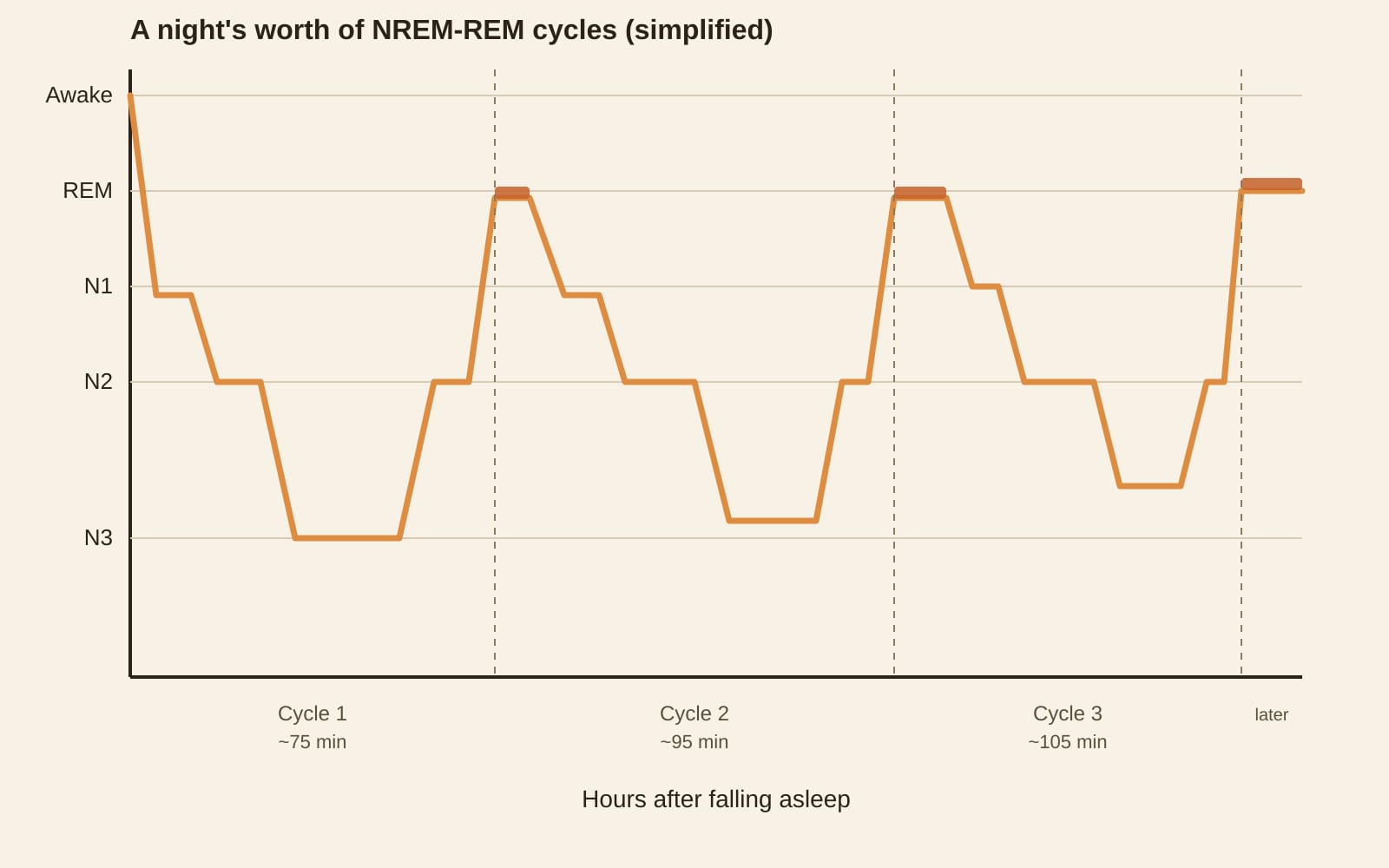
A night of sleep isn't one long slide into unconsciousness. It's a loop. You move from light sleep (N1) into deeper non-REM sleep (N2, then N3, the slow-wave stage where the body does most of its physical repair), back up through N2, and then into REM, the stage where most vivid dreaming happens. Then the loop starts again.
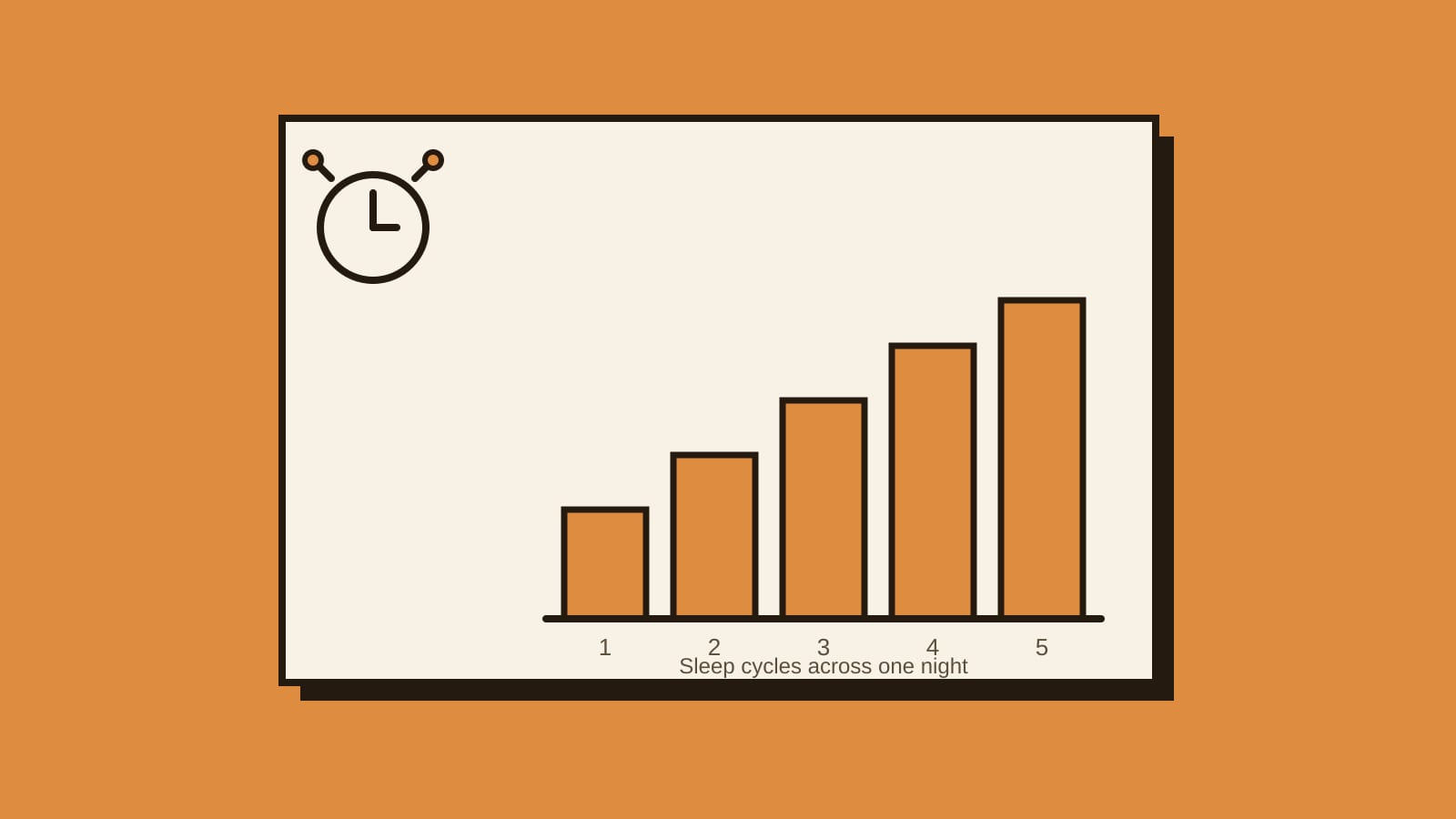
According to a 2024 overview of sleep stage research published on the NCBI Bookshelf by Patel and colleagues, a healthy adult cycles through this sequence roughly four to six times a night, with each cycle averaging somewhere between 90 and 110 minutes. The cycles aren't identical in shape, either. Early in the night, N3 dominates, and REM periods are short, sometimes under ten minutes. As the night goes on, deep sleep shrinks and REM periods stretch out, with the last one of the night sometimes running close to an hour. That's the actual pattern a calculator is trying to approximate with a single repeating number.
The 90 minutes is an average, not a rule
Here's where the arithmetic falls apart. In 2024, a team led by Christian Cajochen at the Centre for Chronobiology in Basel published a retrospective analysis in the journal Sleep Health, covering 369 healthy participants and 6,064 individually recorded sleep cycles gathered from laboratory studies between 1994 and 2020. The median cycle length came out to 96 minutes, close enough to the popular figure. But the word that matters in that paper is variability. Cycle length wasn't normally distributed, individual cycles ranged well outside the average, and the first cycle of the night was consistently shorter than the ones that followed it. Age and sex shifted things further: older participants tended to have longer non-REM stretches and shorter REM later in the night, and women had longer non-REM episodes than men.
Stack five or six of those cycles end to end and a small per-cycle error becomes a large one by 3am. A calculator working from a fixed 90 minutes has no way to know that your first cycle ran short, or that tonight's third cycle is stretching toward two hours because you're catching up on sleep debt. It also has no idea when you actually fell asleep, since it works from your intended bedtime, not the fifteen or twenty minutes most people spend lying there first.
Why the stage matters more than the count
The reason anyone built these calculators in the first place is a real finding, not a myth. A widely cited 2000 review by Tassi and Muzet in Sleep Medicine Reviews found that waking abruptly out of slow-wave sleep produces noticeably more grogginess than waking from light non-REM sleep, with REM sleep landing somewhere in between. That's sleep inertia, and it's the reasoning behind trying to time an alarm for a lighter stage.
The trouble is that a calculator built on population averages can't see what stage you're actually in. It's guessing at your architecture from a single input, your target wake time, when the thing that predicts grogginess is which stage your brain is in at the moment the alarm goes off, and that shifts with how much you slept the night before, how much caffeine is still in your system, and plain individual variation. A tool that got this right would need to measure your brain activity in real time, which is what a sleep lab does and a countdown timer does not.
What to do instead
None of this means the underlying idea is worthless, just that a fixed number can't deliver on it. Consumer wearables try to estimate sleep stage from movement and heart rate rather than brain waves, and we've written before about how accurate those trackers actually are, which is a useful read if you're relying on one to time a wake-up. Short of a research-grade EEG headband, the more reliable lever is the one sleep researchers keep coming back to: a consistent sleep and wake schedule. Going to bed and getting up at close to the same time every day trains your circadian rhythm to line up your lightest sleep with the window near your usual wake time, on its own, without a calculator doing the counting.
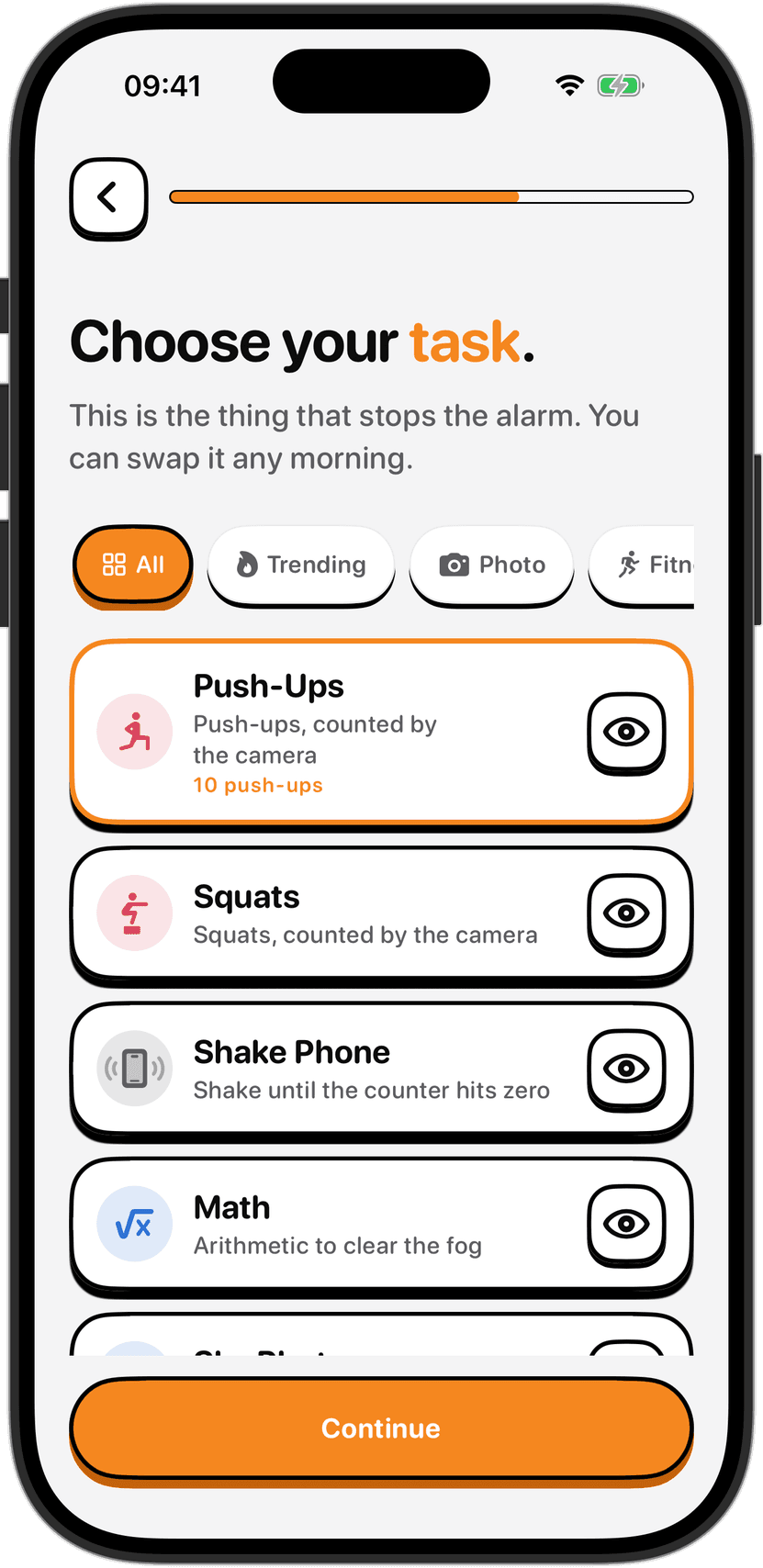
There's also a more basic fix. If timing the alarm to a specific cycle is unreliable, what happens in the first minutes after it goes off can matter more than the timing itself. That's the whole premise behind NoNap: instead of trying to catch you in a lighter stage, it gives you one alarm and a short wake task, like a few camera-counted push-ups or a math problem, so getting out of bed doesn't depend on guessing your sleep architecture correctly. You can read more about how the wake tasks work, or check the FAQ for how it handles a bad morning.
The 90 minute figure isn't wrong so much as it's a rough average dressed up as a precise instruction. Sleep is closer to weather than to a metronome: broadly predictable, individually variable, and never quite the same twice.
Sources
Patel, A. K., Reddy, V., Shumway, K. R., and Araujo, J. F. (2024). Physiology, Sleep Stages. StatPearls Publishing, NCBI Bookshelf.
Cajochen, C., Reichert, C. F., Münch, M., Gabel, V., Stefani, O., Chellappa, S. L., and Schmidt, C. (2024). Ultradian sleep cycles: Frequency, duration, and associations with individual and environmental factors, a retrospective study. Sleep Health, 10(1S), S52-S62.
Tassi, P., and Muzet, A. (2000). Sleep inertia. Sleep Medicine Reviews, 4(4), 341-353.