Does your brain clean itself during sleep?
Mouse and human brain studies suggest fluid flows through the brain during sleep and may clear waste. Here is what the evidence shows and where it is unsettled.
Visana Studios
5 min read
Every night, while you sleep, fluid moves through the brain in a slow rhythm. Some researchers think that flow sweeps away waste that builds up during the day, including amyloid-beta, a protein linked to Alzheimer's disease. The idea is usually called the glymphatic system, and it would give sleep a concrete cleaning job. It is still argued over. Below are the studies behind it, what each one measured, and what none of them has shown yet.
What the mouse studies found
The idea gained traction after a 2013 paper in Science from Maiken Nedergaard's group. Xie and colleagues used two-photon imaging in live mice and tracked how fluid moved through the brain's interstitial space, the thin gaps between brain cells. Natural sleep and anesthesia were both associated with a 60 percent increase in that space. More space meant more exchange between cerebrospinal fluid (CSF), the clear fluid that surrounds the brain, and the fluid bathing the cells. Amyloid-beta was cleared faster during sleep. A commentary on the paper, published the same year in Frontiers in Neurology, put the amyloid result as clearance "twice as fast" in sleeping and anesthetized mice compared with awake mice.
Two caveats apply. Mice are not people, and a clearance rate in a mouse brain says little about a human one on its own. The study also compared sleep with anesthesia. Anesthesia is not sleep, although the two produced similar changes in the mice. The result is suggestive. It is a mechanistic study in animals, not a measure of how much waste leaves a human brain in a night.
Human brains: slow waves, blood and fluid
The clearest human data comes from a 2019 Science paper by Nina Fultz, Laura Lewis and colleagues. They recorded EEG, functional MRI and CSF flow at the same time while people slept in the scanner, so the timing between the three signals comes from one session. The sample was small. Thirteen participants had all three recordings, and some comparisons used 11.
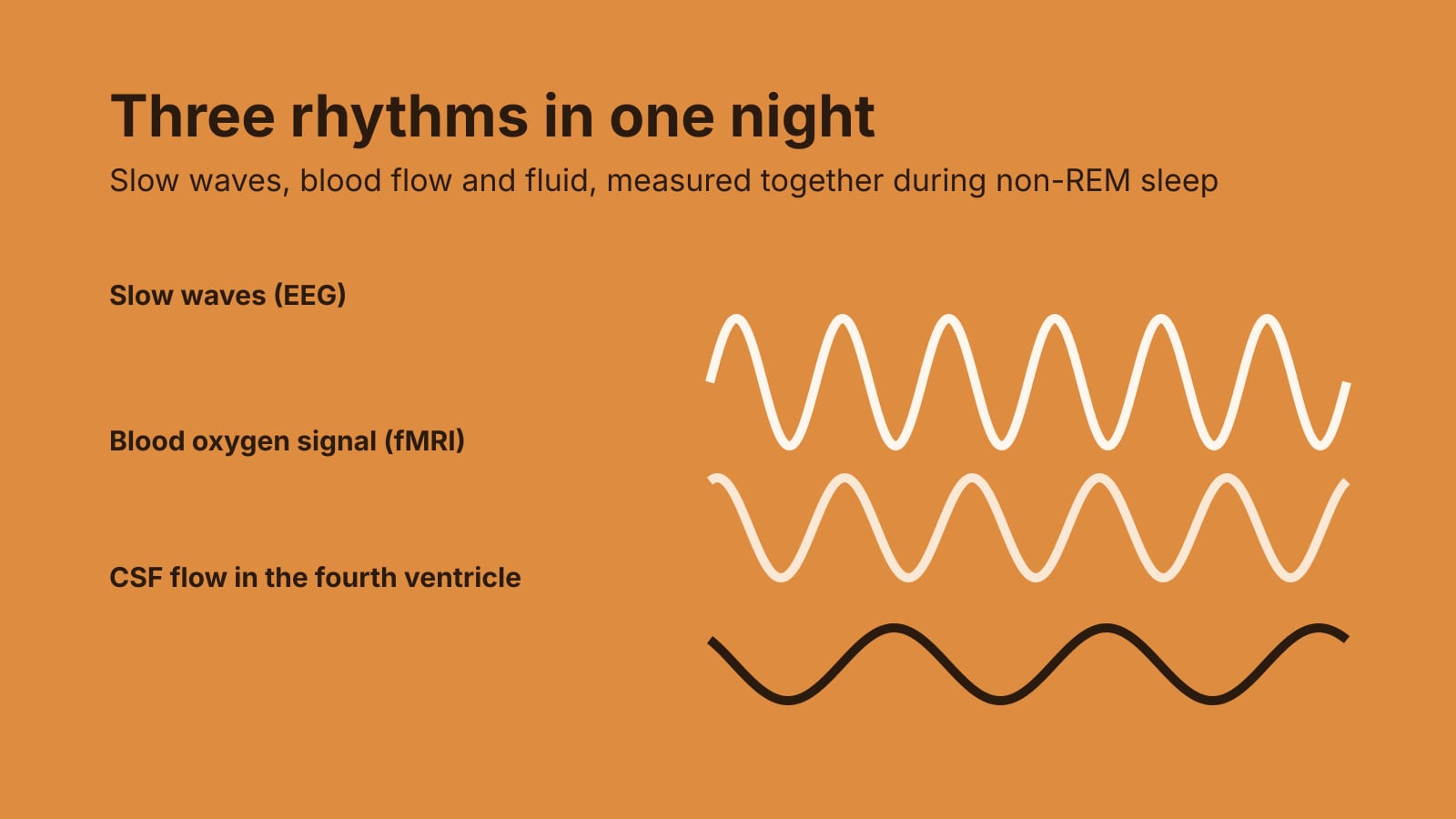
During non-REM sleep, the researchers saw a repeating sequence. Slow delta activity in the EEG came first. About 6.4 seconds later, the blood oxygen signal rose and fell in the brain. CSF pulsed through the fourth ventricle, a cavity near the base of the brain, about once every 20 seconds, and that rhythm was absent during wakefulness. When blood volume dropped, CSF inflow tended to rise. That pattern fits the idea that fluid enters as blood leaves, although the authors describe the findings as correlations.
The diagram below sets out that sequence. It shows the order of events and the lag, not measured traces.
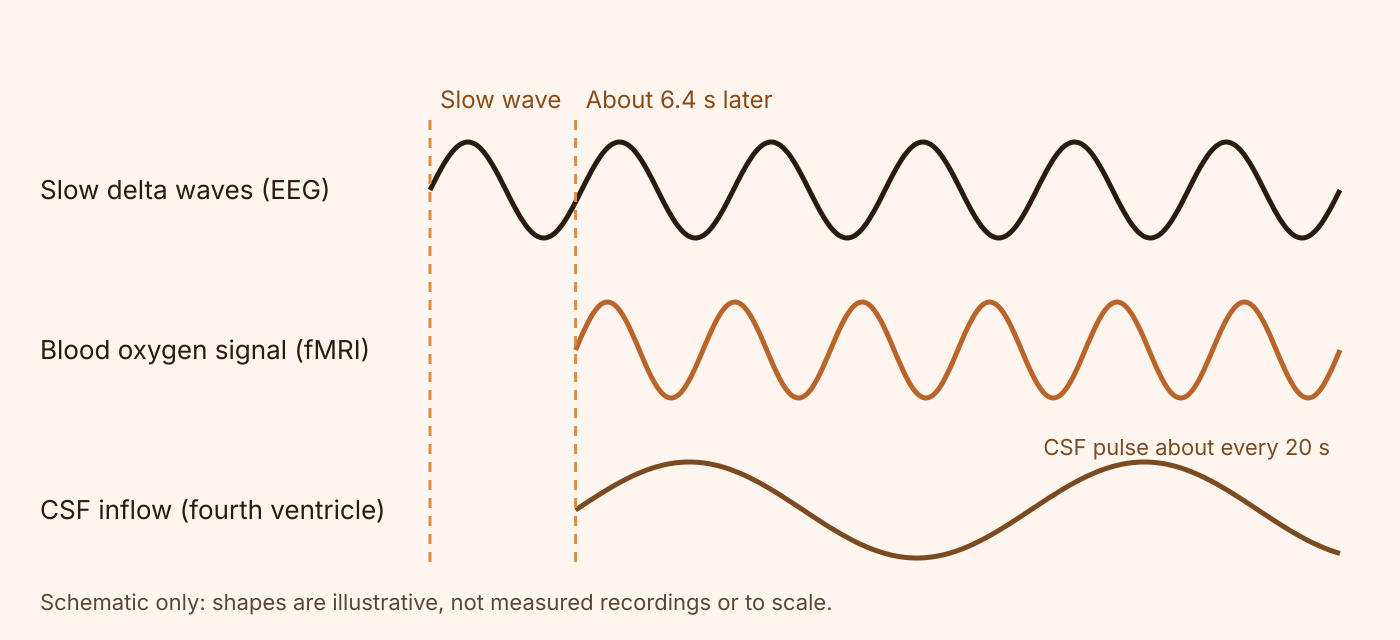
The study showed that this rhythm exists in people. It did not measure waste leaving the brain. The analysis used stable stretches of non-REM sleep and wakefulness with little head movement, and it does not address REM sleep. The authors suggested that CSF flow could one day serve as a biomarker in conditions linked to sleep disturbance, but they did not test that idea. They noted that animal work could test causation next.
Why the human picture is still unsettled
A 2022 systematic review in Sleep Medicine Reviews, by Chong and colleagues, pulled together 190 articles with 19,129 participants in total. The authors linked sleep problems with CSF levels of amyloid-beta, orexin and tau, and with CSF volume and pressure. They also stressed that these relations were "not universal," and that the patterns differed a great deal between conditions. Their conclusion was that carefully designed studies and better ways of measuring glymphatic exchange are still needed.
Measurement is the main obstacle. A 2025 mini review on brain injury, by Miettinen and colleagues in Frontiers in Neuroscience, reports that human findings conflict. Some studies found reduced glymphatic activity after mild injury, and others found increased activity. The review also says that the non-invasive imaging used in most human studies measures the system only indirectly. The most direct method, intrathecal contrast MRI, requires injecting contrast into the spinal fluid, which makes it hard to use routinely. The review says the system is 90 percent more active during sleep, and that claim draws partly on a study in rats.
The sources read for this post do not report a measured amyloid clearance rate in people during sleep. That gap is the central problem. Clearance has to be measured in people before it can be claimed for people.
What this means for your night
The honest summary is that sleep does change how fluid moves through the brain, and that the movement can be measured in people. Whether it clears a meaningful amount of waste, and how much that matters for disease, is still open. Nothing in the current evidence offers a personal tip, such as a sleeping position or a bedtime trick, that would speed up the process.
The slow waves in the 2019 study belong to non-REM sleep, the stages described in sleep stages: what REM and deep sleep actually do. Until the human evidence firms up, the practical advice stays familiar. Keep a regular schedule, give yourself enough hours, and see a doctor if you snore loudly, stop breathing during sleep, or feel unrefreshed for weeks. A theory about brain clearance is not a substitute for checking those signs.
Sources
Xie L, Kang H, Xu Q, et al. Sleep drives metabolite clearance from the adult brain. Science. 2013;342(6156):373-377. The mouse study behind the 60 percent increase in interstitial space and the faster amyloid-beta clearance during sleep and anesthesia. https://pubmed.ncbi.nlm.nih.gov/24136970/ (DOI 10.1126/science.1241224)
McKinley J, McCarthy A, Lynch T. Don't lose sleep over neurodegeneration: it helps clear amyloid beta. Frontiers in Neurology. 2013;4:206. The commentary reporting amyloid-beta clearance as "twice as fast" in sleeping and anesthetized mice, and interstitial volume increased by "over 60%". https://doi.org/10.3389/fneur.2013.00206
Fultz NE, Bonmassar G, Setsompop K, Stickgold RA, Rosen BR, Polimeni JR, Lewis LD. Coupled electrophysiological, hemodynamic, and cerebrospinal fluid oscillations in human sleep. Science. 2019;366(6465):628-631. The source for the 13 participants, the CSF oscillation of about 0.05 Hz absent in wakefulness, and the slow-delta activity preceding the blood and CSF waves by about 6.4 seconds. https://pmc.ncbi.nlm.nih.gov/articles/PMC7309589/ (DOI 10.1126/science.aax5440)
Chong PLH, Garic D, Shen MD, Lundgaard I, Schwichtenberg AJ. Sleep, cerebrospinal fluid, and the glymphatic system: a systematic review. Sleep Medicine Reviews. 2022;61:101572. The source for 190 articles and 19,129 participants, the note that relations were "not universal", and the call for carefully designed studies. https://pubmed.ncbi.nlm.nih.gov/34902819/ (DOI 10.1016/j.smrv.2021.101572)
Miettinen P, Utz B, Bañuelos-Cabrera I, Golanov E, Lenzner Z, Lara-Valderrábano L, Välimaa L, Harel A. Glymphatic system and mild traumatic brain injury: a mini review. Frontiers in Neuroscience. 2025. The source for conflicting human findings, the indirect nature of non-invasive imaging, and the invasiveness of intrathecal contrast MRI. https://www.frontiersin.org/journals/neuroscience/articles/10.3389/fnins.2025.1705690/full (DOI 10.3389/fnins.2025.1705690)
Image credits
Both images were made for this post from plain shapes and text, so they contain no outside material.