How to choose an alarm sound that actually wakes you up
Research shows certain frequencies and sounds wake you more reliably than others. Here's what the science found about alarm tones, sleep inertia, and why you sleep through some alarms.
Visana Studios
5 min read
Your phone goes off at 07:00 with a high-pitched beep. You sleep through it. A friend's identical phone five feet away sounds like a siren. The difference is not just how deep you slept that night. The alarm sound itself matters enormously to whether you actually wake up, and decades of sleep research have found that some sounds work better than others.
Why some alarms don't reach you
Your arousal threshold is the amount of sensory input your brain needs to rouse you from sleep. It is not the same as being a heavy sleeper. A heavy sleeper is not sleeping deeper than anyone else, they simply have a higher threshold: their brain requires a stronger signal to wake up. That threshold changes with the sleep stage, the time of night, how much sleep debt you are carrying, and the sound itself.
The frequency of a sound is critical. In 2009, researchers at Victoria University tested 39 young adults to see which sounds would wake them at the lowest volume. The results were clear: low-frequency square waves at 400 and 520 Hz woke sleepers reliably at quieter levels than any other signal tested, including pure tones, whoops and white noise. Yet the alarm most people assume is a standard for waking the hearing impaired, a high-pitched smoke alarm signal above 3000 Hz, was the least effective at any age. In a study of people with hearing loss, 16 percent still slept through the smoke alarm sound at 95 decibels, while none slept through the 520 Hz square wave at the same volume.
That gap widens with age. Hearing for sounds above 2000 Hz starts to decline in people over 40, especially men. A high-pitched alarm gets quieter to your ears each year, even if the phone is set to the same volume. You are not sleeping harder. The alarm is just getting weaker.
Melody changes how you wake
A separate line of research looks at what happens after the alarm wakes you. Sleep inertia is the cloudiness and reduced alertness that follows waking, that period where you are awake in body but your brain is still negotiating with sleep. A 2020 study at RMIT University asked 50 people to report their alarm sounds and how groggy they felt on waking. Those who woke to melodic sounds, like music or nature sounds, reported less sleep inertia than those who woke to harsh, unmelodic alarms like beeps or electronic tones.
The researchers suspect that a sharp beep might disrupt or confuse your brain activity during the transition from sleep to waking, while a melody eases the shift. You wake faster to a beep, but you spend the first few minutes after waking more groggy. That is a real trade-off. A melodic alarm takes slightly longer to pull you conscious, but you are more alert once you are up.
The study was small and based on self-report rather than lab measurement, so the effect size is not known. Larger replications have not yet confirmed it. But the finding is consistent with a related result: people in sleep labs who woke to intense noise did show reduced sleep inertia, suggesting that a high-intensity stimulus, even one you dislike, can cut through the grogginess. What matters is reaching your brain with something strong enough.
What actually works
The science points to a few rules. A low-frequency sound wakes you more reliably than a high-pitched one, because it reaches your arousal threshold at lower volumes. Once awake, a sound with some melodic or musical character may leave you less groggy than a harsh beep. But you need the beep to work first.
The most practical approach is to choose a sound that is loud enough to pull you from sleep, whatever your arousal threshold, and then track how groggy you feel. If your standard iPhone alarm is not waking you, the problem is usually not laziness or a character flaw. It might be that the default tone is too high-pitched to cut through, especially if you are over 40 or have any hearing loss, or that it is not loud enough for your arousal threshold on the nights you are running sleep debt.
Switch to a lower-pitched alarm sound, or one that builds in volume gradually rather than blasting at full intensity. If you sleep through it anyway, it is time to add another factor. Caffeine is one: a cup of coffee waiting by the bed, drunk before you do anything else, shifts your chemistry in about 15 minutes. Light exposure works too: pulling back the curtains floods your brain with the signal that it is morning. Moving your phone across the room so you have to get up to turn off the alarm is not elegant, but it works. The person who has to physically move is harder to ignore than the person still half in bed.
The role of familiarity
One finding that recurs in the research is that your own music, or a sound you like, can be more effective than a generic alarm tone. One study found that high-preference music reduced sleep inertia after a nap. Familiarity might matter because a sound you recognize does not trigger the startle response that a jarring beep does. You wake with less of a jolt, which paradoxically might make the transition smoother and leave you more alert.
This is one area where you are the expert. A sound that wakes you reliably is one that reaches your specific arousal threshold and your specific ears. If the standard high-pitched alarm tone fails night after night, it is not stubbornness or a sleep disorder. It is physics and neuroscience. A lower frequency, a more gradual volume increase, or a familiar melody are all more likely to land.
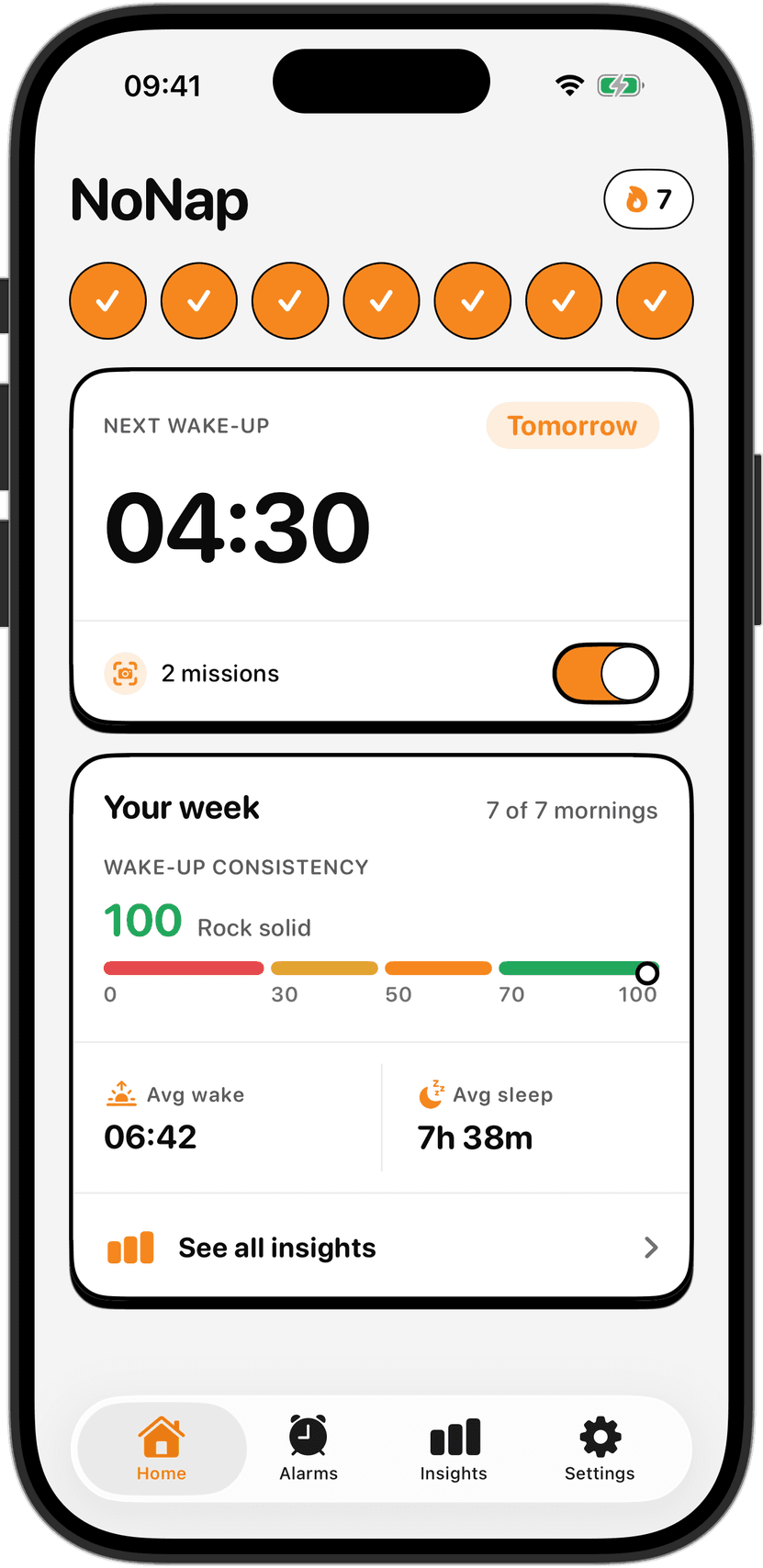
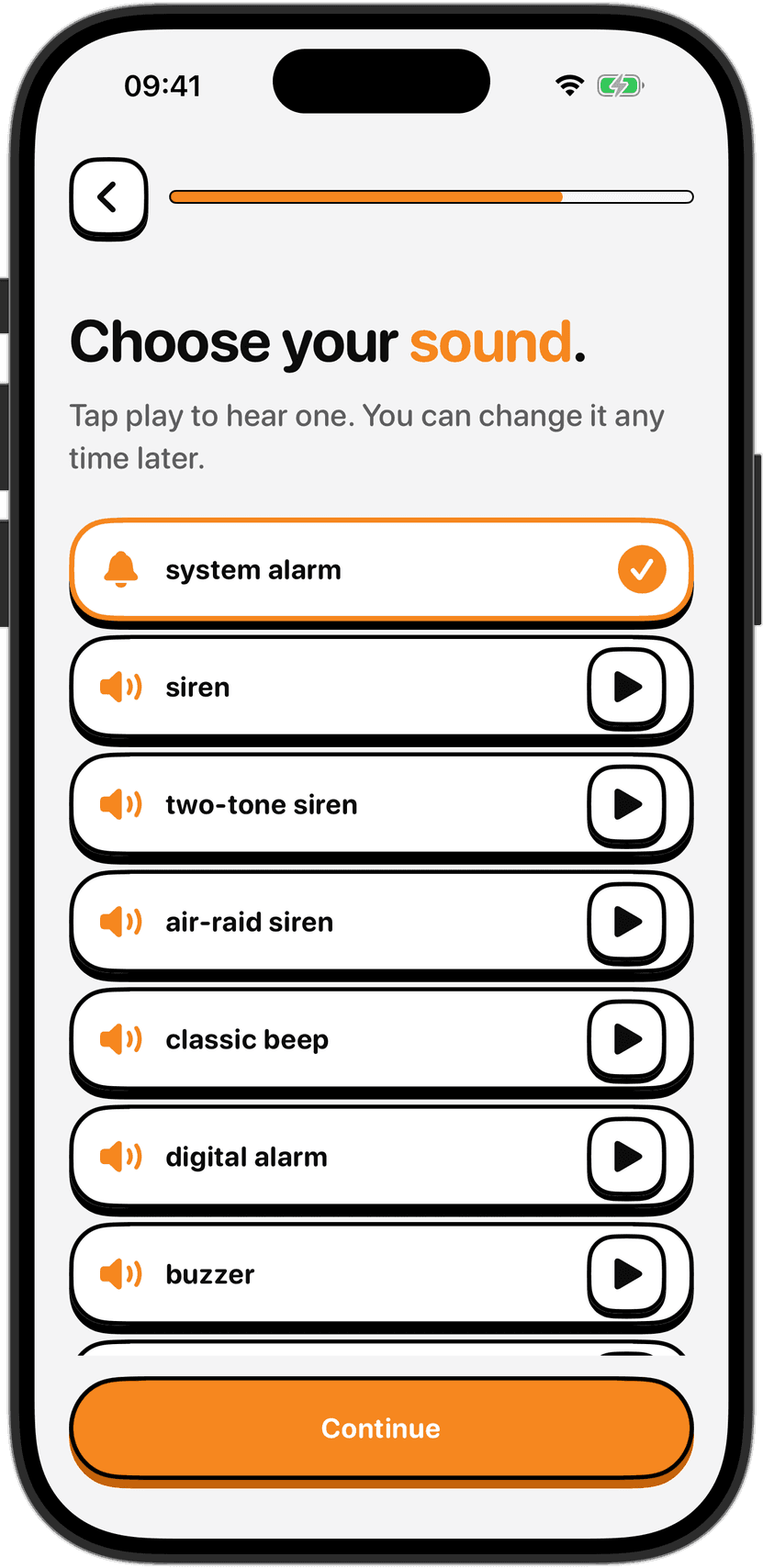
NoNap's alarm uses the system alarm, the same one the built-in Clock app uses, so it gets through when everything else is silenced. What sound it makes is up to you: most of the app's built-in tones are lower-frequency or melodic options that research suggests are more likely to reach you. You can change the sound any time a tone is not working for you, and test it without waiting for morning to know whether it makes a difference.
Sources
Bruck, David, et al. "How does the pitch and pattern of a signal affect auditory arousal thresholds?" Journal of Sleep Research, vol. 18, no. 1, 2009, pp. 96-103. https://onlinelibrary.wiley.com/doi/abs/10.1111/j.1365-2869.2008.00710.x
McFarlane, Stuart, et al. "Alarm tones, music and their elements: A mixed methods analysis of reported waking sounds for the prevention of sleep inertia." Frontiers in Neuroscience, vol. 14, 2020, p. 567231. https://www.ncbi.nlm.nih.gov/pmc/articles/PMC6986749/
Hilditch, Christopher J., and Tina McHill. "The potential consequences of sleep inertia and its modulation." Nature and Science of Sleep, vol. 11, 2019, pp. 1-10. https://www.ncbi.nlm.nih.gov/pmc/articles/PMC6325564/
Busby, Keith A., and Thomas R. Pivik. "The effects of perinatal cocaine exposure on sleep and arousal in the newborn." Pediatric Research, vol. 14, no. 12, 1980, pp. 1163-1172.
American Academy of Sleep Medicine. Arousal threshold assessment: An underutilized metric in sleep medicine. Journal of Clinical Sleep Medicine, vol. 19, no. S1, 2023.