Choose a Realistic Wake Time, Not an Aspirational One
Your circadian rhythm and sleep need are individual. Setting an alarm for the time you'll actually wake up beats chasing an aspirational time you never reach.
Visana Studios
8 min read

You know the time you are supposed to wake up. It's written somewhere. Maybe it's 6 a.m. because that's when you need to be at work. Maybe it's 7 a.m. because that sounds like a morning person's wake time. The real question is whether that time matches your body. Most people set alarms for times they want to wake up, not times they will actually wake up. That gap between intention and biology is where the snooze button lives.
Circadian rhythms, sleep need and individual chronotype all vary. Your realistic wake time is not a matter of willpower or discipline. It is a calculation based on how much sleep your body requires, when your circadian clock naturally wants you awake, and how much sleep debt you are carrying. Setting an alarm for a time you cannot actually achieve teaches your brain that the alarm is negotiable. Setting one for a time you can defend, even on a bad morning, works.
How much sleep your body actually needs
The standard guidance is seven to nine hours per night for adults. That number comes from a 2015 joint statement by the American Academy of Sleep Medicine and Sleep Research Society, based on decades of studies. It is also almost useless as personal advice, because individuals vary wildly around that average.
A foundational study published in Science found that sleep need ranges from less than six hours to more than nine hours per night, and people at all points along that spectrum show no noticeable differences in health and waking performance. This is not a myth. Genetic variation in sleep need is real. Some people genuinely need nine hours. Others genuinely need six. Most cluster around seven to eight, but the actual number for you cannot be guessed from the number for anyone else.
How do you find out what you actually need? The definitive way is an extended-sleep experiment. For four to nine nights, you sleep with no alarm clock, in a safe and quiet environment where you can sleep as much as you want. At first, you catch up on accumulated sleep debt. After a few nights, your sleep stabilizes at a new duration. That duration is close to your sleep need. Research from the lab that developed this protocol found participants settling around 8.4 hours on average, but the individual range was wide.
If you cannot take a week off to sleep in a lab, a practical home version takes two weeks. The first week, sleep without an alarm and without caffeine after noon. That is your catch-up phase, when you are repaying debt. After a few nights of catch-up, look at the nights where your sleep duration stops changing significantly. That plateau is your estimate of sleep need. Some people reach it by night four. Others take a full week.
If you want to know only whether you are getting enough, the practical test is simpler. Wake at the same time every morning for one to two weeks. Bedtime should be whenever you naturally feel sleepy, without forcing an early bedtime. Then count the nights: are you waking up feeling rested most mornings, or are you hitting snooze or sleeping in when you can? If you are consistently tired, you are probably not getting enough. If you are waking naturally near your alarm time and feeling alert, you probably are.
Your circadian rhythm has a preference
Even if you knew you needed exactly seven and a half hours, your wake time is not just a math problem. Your circadian rhythm, the internal clock that controls when you feel alert and sleepy, has a preferred schedule. Some people naturally want to wake around 5 a.m. Others need until 8 a.m. These preferences are called chronotypes, and they are not habits or excuses. They are largely genetic.
The two strongest preferences are called morning types and evening types, with most people falling somewhere in between. Morning types find it easy to wake early and feel groggy late at night. Evening types struggle to wake early and feel alert until late. Teenagers and young adults tend toward evening types, middle-aged people are more intermediate, and older adults shift back toward morning types. Individual circadian rhythms also run at slightly different speeds, with some people's clocks naturally running slightly shorter or longer than 24 hours, which affects how they adjust to a fixed wake-wake cycle.
This variation matters because your circadian system has strong control over when you can actually stay awake and when you will be most alert. If you are an evening type and your natural circadian rhythm wants to wake at 7 a.m., setting an alarm for 5:30 a.m. every morning creates a form of chronic circadian misalignment. You can do it. It just means working against your biology for hours every morning, and paying a cost in alertness and mood.
If your work or family schedule forces a wake time that does not match your chronotype, that is real. But if you have any flexibility in your wake time, and you are a night person, setting it later than you think you should often works better than forcing an earlier time.
Sleep debt is cumulative
Here is what happens when your alarm is set for 6 a.m. but your body needs to wake at 7 a.m. On night one, you are tired. You go to bed earlier or just accept the early wake and deal with the grogginess. On night two, you are more tired. On night three, you start asking yourself whether 6 a.m. is actually necessary. On night five, you hit snooze. On night ten, you have accumulated about ten hours of sleep debt. Your brain stops working properly in the morning. Your attention wanders. You make mistakes. You get sick more easily. And every night, you are more likely to convince yourself that tonight is the night you will go to bed at 10 p.m. instead of 11:30 p.m., which almost never happens.
This is why aspirational wake times fail. They do not account for accumulated sleep debt. The first alarm at an unrealistic time feels motivational. It feels like the choice of a person taking control. But if that time is incompatible with your sleep need and your work schedule, the debt starts accumulating immediately. Within days or weeks, the alarm time becomes something you resent and negotiate with every morning.
Sleep debt is not paid back by one good night or one good weekend. Research on chronic sleep restriction shows that waking up tired produces a cascading failure of morning attention. The only reliable way to repay it is consistent sleep. That means a wake time you can actually sustain, every day, without accumulating more debt.
Setting your realistic wake time
Here is how to calculate it. Take the time you need to leave your house. Subtract your sleep need in hours. That is when your realistic wake time should be.
If you need to leave at 8 a.m. and you need seven hours of sleep, your realistic wake time is 1 a.m. That is not going to work. So go back to the first step: when do you actually need to leave? Can you shift that earlier by going to bed earlier? Or can you shift your wake time later and find a different way to make the later start work? The constraint is real, but it is usually more flexible than it feels.
Once you know your realistic wake time, it should be non-negotiable on weekdays and weekends. Waking at the same time every day does two things. It anchors your circadian rhythm through morning light exposure. It also rebuilds your sleep drive more predictably than a fixed bedtime does. If you slept poorly one night, waking at your usual time means you will have strong sleep drive the following night. If you sleep in on weekends, you disrupt both signals at once.
Set your alarm for the time you can defend to a groggy future version of yourself. Not the time you want to wake up. Not the time you think you should wake up. The time you will actually wake up and get out of bed most mornings, even after a difficult night.
How NoNap helps you commit to a realistic time
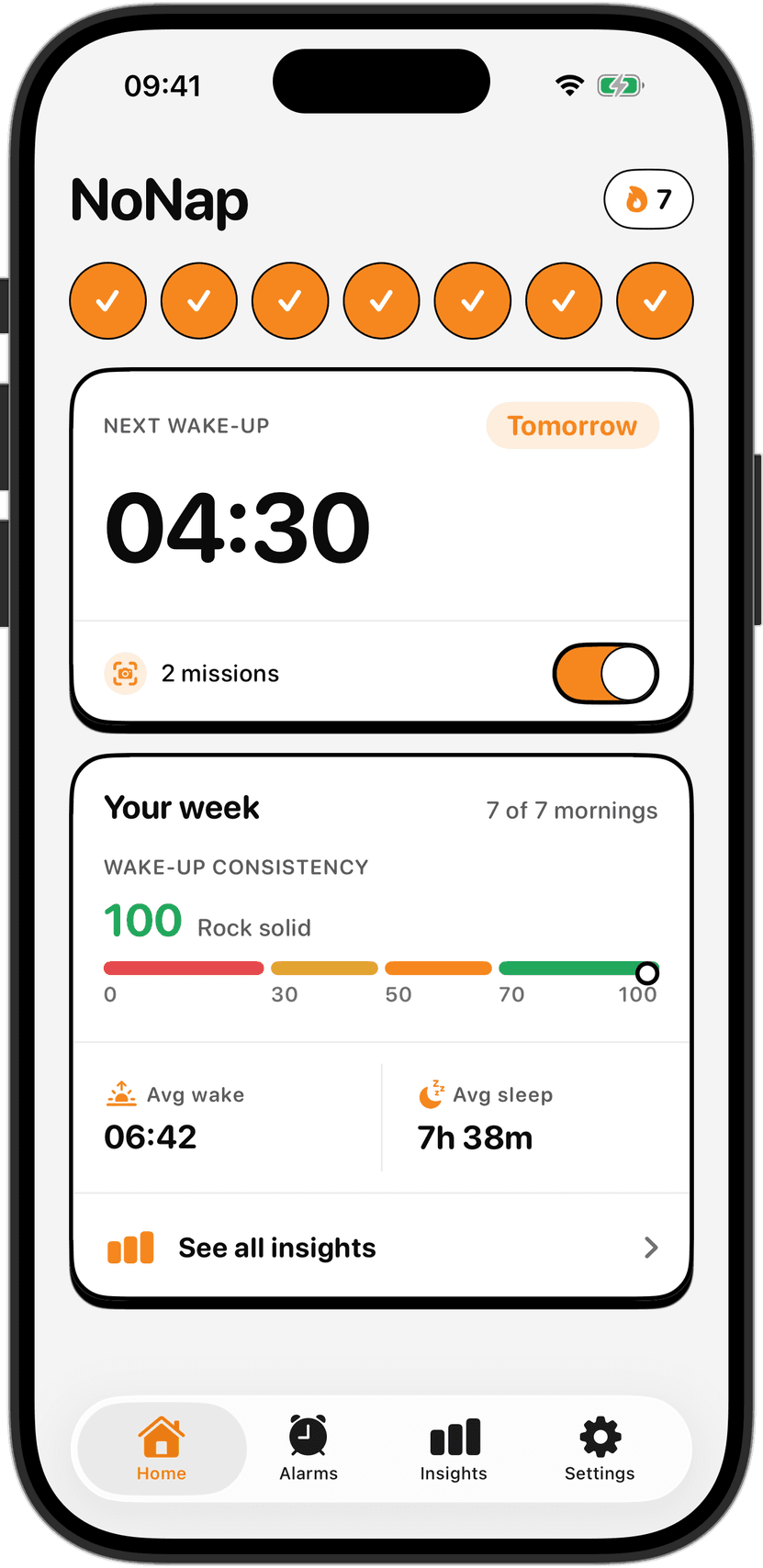
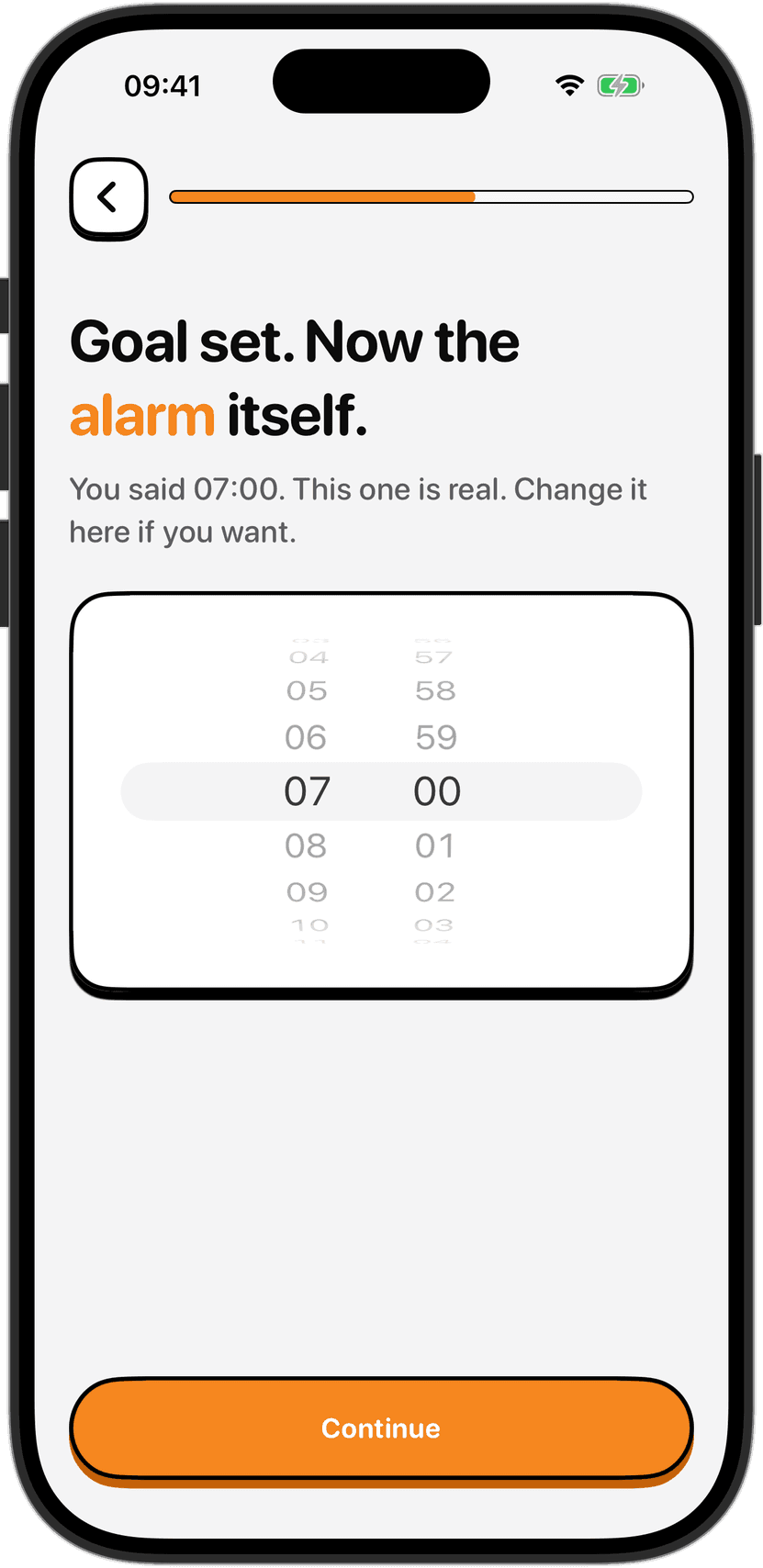
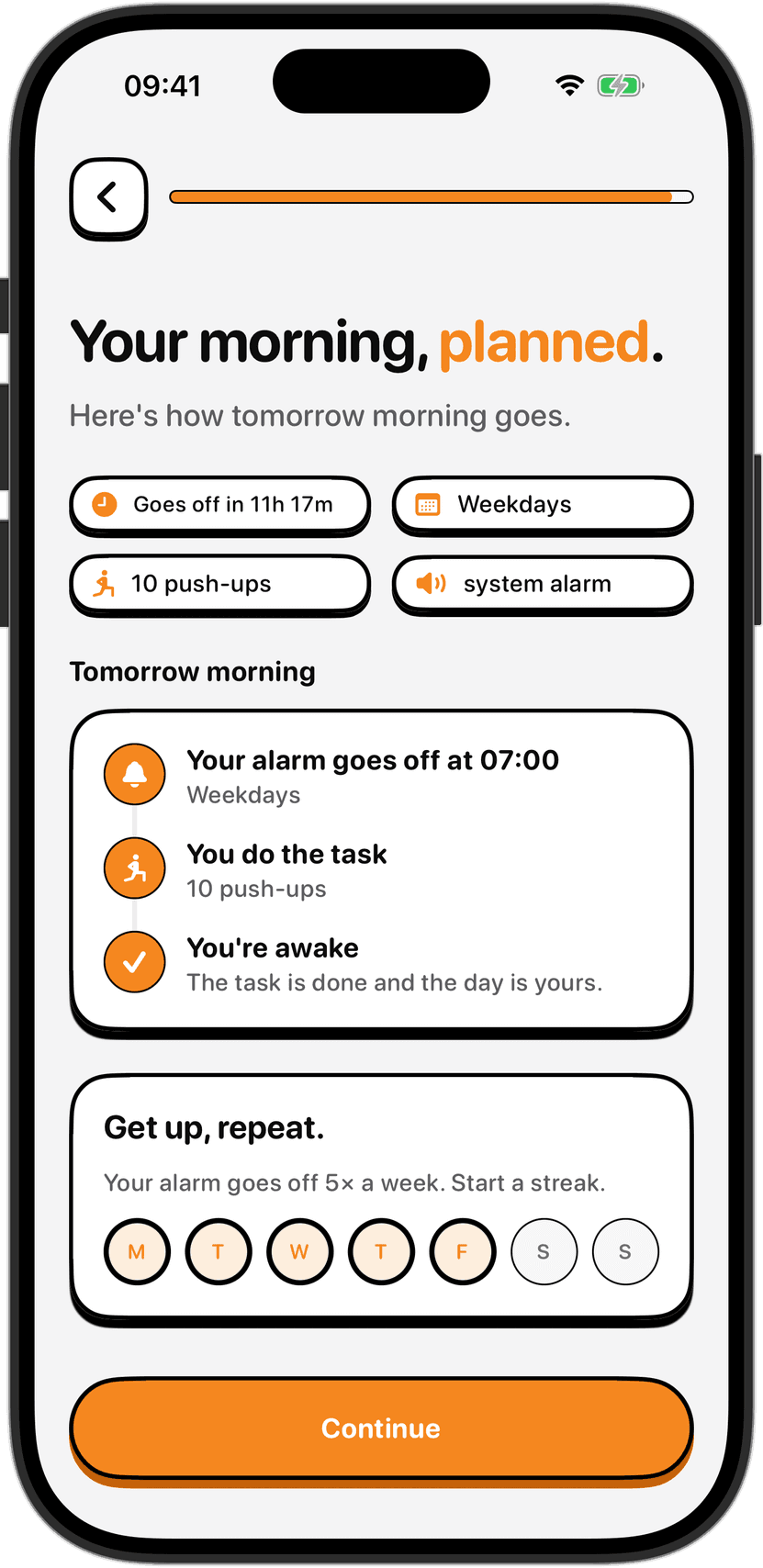
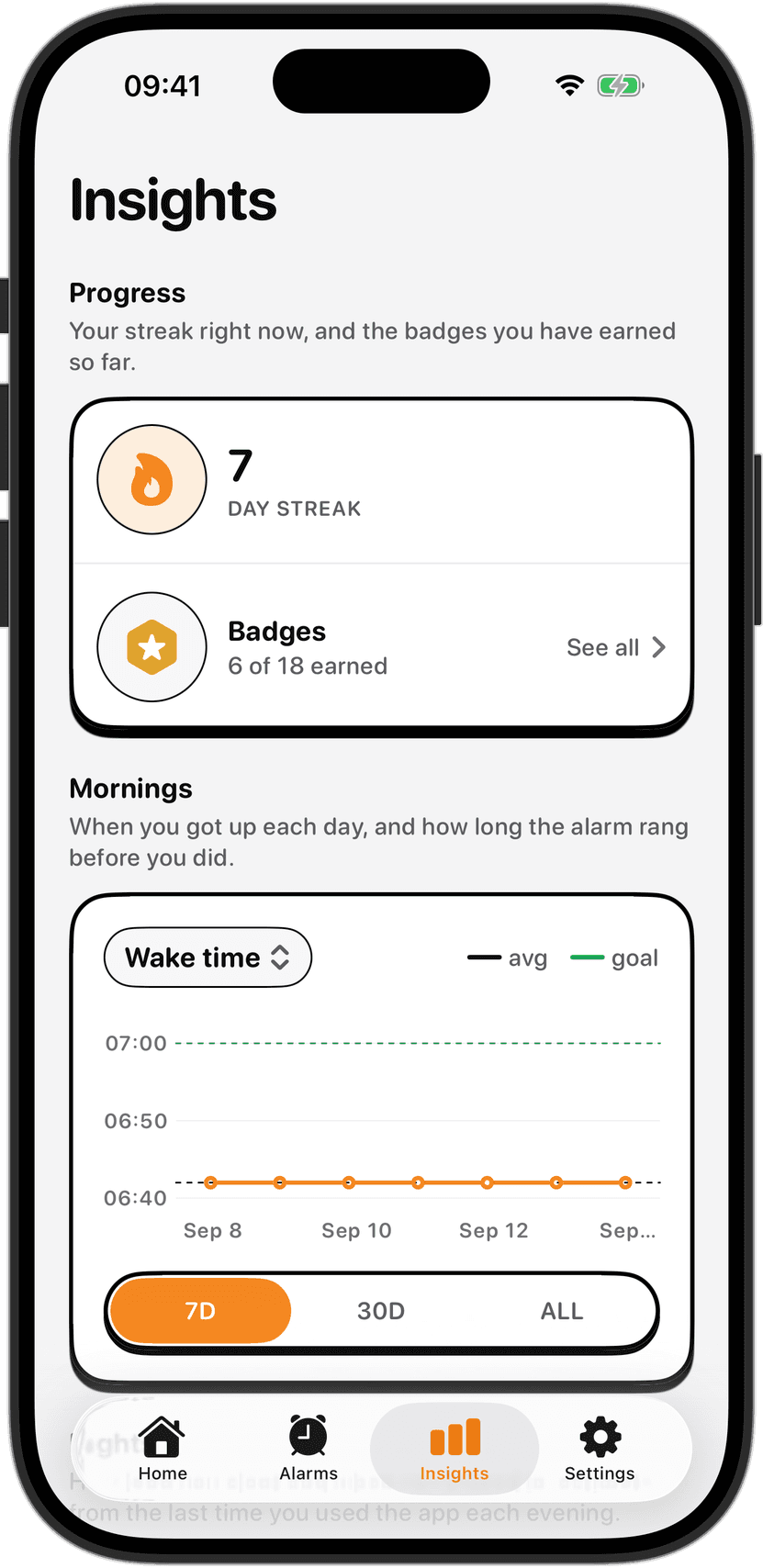
NoNap shows your realistic wake-time goal when you set up your first alarm. It is not magic. The science is straightforward: picking a goal that matches your actual biology, rather than an aspirational one, means you follow through on it. Then, day after day, you build the pattern. Your body learns to expect the alarm at that time. Your circadian rhythm anchors to it. And after a few weeks, a wake time that once felt impossible starts to feel inevitable.
The insight is simple but often missing from the way we talk about mornings. Discipline matters. So does willpower. But they matter much more once you have aligned your alarm with your actual circadian rhythm and your actual sleep need. When the time matches your biology, the morning is not a daily negotiation. It is just what happens.
Sources
Watson, N. F., Badr, M. S., Belenky, G., et al. (2015). "Recommended Amount of Sleep for a Healthy Adult: A Joint Consensus Statement of the American Academy of Sleep Medicine and Sleep Research Society." Sleep, 38(6), 843-844. https://doi.org/10.5665/sleep.4716
Hirshkowitz, M., Whiton, K., Albert, S. M., et al. (2015). "National Sleep Foundation's Sleep Time Duration Recommendations: Methodology and Results Summary." Sleep Health, 1(1), 40-43.
Koskenvuo, M., Hublin, C., Partinen, M., Heikkila, K., and Kaprio, J. (2007). "Heritability of diurnal type: a nationwide study of 8,753 adult twin pairs." Journal of Sleep Research, 16(2), 156-162. https://doi.org/10.1111/j.1365-2869.2007.00580.x
Jones, S. E., Lane, J. M., Wood, A. R., et al. (2019). "Genome-wide association analyses of chronotype in 697,828 individuals provides insights into circadian rhythms." Nature Communications, 10, 343. https://doi.org/10.1038/s41467-018-08259-7
Roenneberg, T., Wirz-Justice, A., and Merrow, M. (2003). "Life between clocks: daily temporal patterns of human chronotypes." Journal of Biological Rhythms, 18(1), 80-90. https://doi.org/10.1177/0748730402239679
Balkin, T. J., Braun, A. R., Wesensten, N. J., et al. (2002). "The process of awakening: a PET study of regional brain activity patterns mediating the re-establishment of alertness and consciousness." Brain, 125(10), 2308-2319. https://doi.org/10.1093/brain/awf232
Hilditch, C. J., and McHill, A. W. (2019). "Sleep inertia: current insights." Nature and Science of Sleep, 11, 155-165.
Van Dongen, H. P., Maislin, G., Mullington, J. M., and Dinges, D. F. (2003). "The Cumulative Cost of Additional Wakefulness: Dose-Response Effects on Neurobehavioral Functions and Sleep Physiology from Chronic Sleep Restriction and Total Sleep Deprivation." Sleep, 26(2), 117-126.
Depner, C. M., Melanson, E. L., Eckel, R. H., et al. (2019). "Ad libitum weekend recovery sleep fails to prevent metabolic dysregulation during a repeating pattern of insufficient sleep and weekend recovery sleep." Current Biology, 29(6), 957-967.e4. https://doi.org/10.1016/j.cub.2019.01.069