How one bad night of sleep ruins your next morning
A single night of poor sleep impairs alertness, reaction time and decision-making the next day. Here's what the science shows and how to recover.
Visana Studios
4 min read
You've had that night. The one where you fell asleep late, woke up early, or simply couldn't drift off no matter what. The next morning, everything feels different. Your alarm seems louder and more hostile. Getting out of bed takes superhuman effort. Your thoughts move like wading through water.
That's not just how it feels. It's measurable. A single night of poor sleep rewires your brain in ways that slow you down, dull your mind and make even simple tasks harder than they should be.
How sleep loss slows your brain
When you lose a night of sleep, your reaction times slow down noticeably. Research from 2025 published in Frontiers in Neuroscience studied what happens after 24 hours without sleep. The results were stark: reaction time increased by almost 84 milliseconds in healthy young adults who don't usually lose sleep. For perspective, that's about the time it takes to blink twice. For someone driving, that's the difference between hitting the brakes and hitting a car.
The delay isn't just about reflexes. Sleep deprivation specifically impairs the brain's ability to detect important information and respond to it. A measure called P300 latency, which shows how quickly your brain processes information, extended by almost 19 milliseconds after one sleepless night. Your brain was working, but it was working slowly.
Attention networks suffer most. The brain regions responsible for staying focused and alert take the biggest hit when you've missed sleep. You can still do hard physical work (muscle strength doesn't disappear overnight), but fine motor tasks, decision-making and sustained attention all crater.
The chemistry of sleep pressure
The reason is adenosine. While you're awake, adenosine accumulates in your brain, building what's called sleep pressure. Adenosine is a byproduct of neural activity, and it signals your brain that energy is being used up and rest is needed. After a night of normal sleep, adenosine clears out. But when you skip sleep, it keeps building.
By the morning after a sleepless night, your adenosine levels are high. They don't normalise until you get a full recovery night. That's why the morning after a bad night feels so impossibly heavy. Your brain is literally screaming for sleep.
The adenosine system doesn't just make you feel tired. It shuts down the brain regions responsible for executive function: planning, impulse control, decision-making. It's why you're more likely to skip exercise, eat poorly, and make bad choices the day after a sleepless night. It's not weakness. It's neurochemistry.
Who suffers most
Not everyone is equally affected. Interestingly, people who regularly work night shifts show less cognitive decline after sleep loss than those who don't. Their brains have adapted to irregular sleep. But if you sleep normally most nights, one sleepless night hits hard. Your brain hasn't learned to compensate.
The effects vary by individual, but the trends are consistent. After 24 hours of sleep deprivation, the average person shows measurable slowing in reaction time, increased errors on attention tasks and impaired working memory. Your subjective experience (feeling groggy, slow, frustrated) matches what the data shows.
Recovery takes one full night
The good news is recovery is fast. One full recovery night appears to be enough to restore baseline cognitive performance and clear adenosine from your brain. The neurochemistry resets. By the next morning, most of the impairment is gone.
But only if you actually sleep that night. If you try to power through with coffee and willpower, adenosine keeps building. The sleep pressure gets worse. By the second sleepless night, your cognitive impairment is as bad as having only 4 to 5 hours of sleep for eight days straight. Your brain doesn't distinguish between acute and chronic sleep loss. It just knows it's exhausted.
What you can do tomorrow morning
If you're facing a morning after a sleepless night, you're going to feel it. That's unavoidable. But you have a few small levers to pull.
Bright light, especially from the sun, can temporarily increase alertness by stimulating your circadian system. Get outside in the morning if you can. Caffeine helps, though it works best if you wait 30 minutes after waking so your adenosine pressure peaks first, making the caffeine boost more effective.
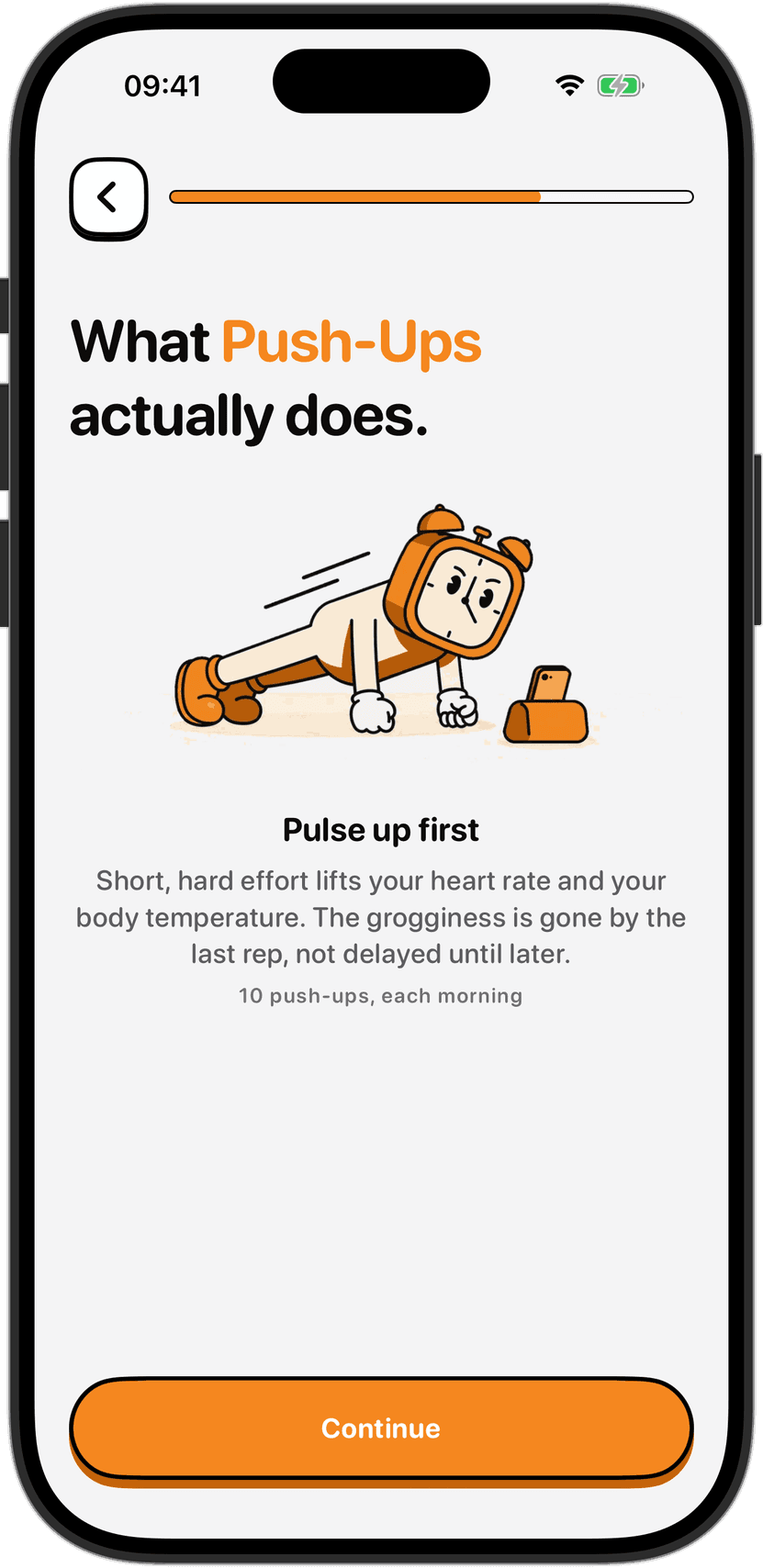
Movement helps. The same physical effort that feels impossible becomes slightly less impossible once your body is in motion. A cold shower is unpleasant but does jolt your nervous system awake temporarily.
None of these fix the underlying problem. Your brain still needs sleep. But they can buy you enough function to get through the day so you can actually sleep that night and recover.
Why consistency matters
The harder lesson is that one bad night is rarely just one bad night. Sleep loss piles up. A night or two per week of short sleep adds up to chronic sleep deprivation, and chronic sleep deprivation causes the same cognitive impairment as a full sleepless night, just spread across days.
This is where a consistent wake time becomes powerful. When you have a fixed alarm that you actually have to complete a task to dismiss (not just tap away half-asleep), you're committing to consistency. Night after night, the same time. That regularity anchors your circadian rhythm, deepens your sleep, and makes bad nights less likely.
One sleepless night still happens sometimes. Life happens. But when your foundation is solid (consistent wake times, good sleep hygiene, an actual routine), one bad night becomes an outlier, not the new normal.
Sources
Frontiers in Neuroscience (2025): The impact of sleep deprivation on cognitive function in healthy adults: insights from auditory P300 and reaction time analysis. https://www.frontiersin.org/journals/neuroscience/articles/10.3389/fnins.2025.1559969/full
PNAS (National Academy of Sciences): Recovery sleep after extended wakefulness restores elevated A1 adenosine receptor availability in the human brain. https://www.pnas.org/doi/10.1073/pnas.1614677114
PLOS Computational Biology: Modeling the adenosine system as a modulator of cognitive performance and sleep patterns during sleep restriction and recovery. https://journals.plos.org/ploscompbiol/article?id=10.1371%2Fjournal.pcbi.1005759