How to wake up on time when you work shifts
Practical strategies to wake reliably during night and rotating shifts, from light timing to melatonin to nap scheduling.
Visana Studios
6 min read
Waking up at 2 am for a night shift, or at 10 am after a late evening, fights your body's biology. Your alarm goes off when your circadian rhythm is actively pushing you back to sleep, not when it's naturally rising toward wakefulness the way a 7 am alarm does for most day workers. Between ten and forty percent of shift workers struggle enough with this to develop shift work sleep disorder, where the misalignment between work schedule and body clock causes chronic insomnia or excessive daytime sleepiness. Waking up reliably is the first step, and it's harder than it should be.
Why shift work makes waking harder
The body's circadian rhythm, your internal biological clock, drives a sleep-wake cycle tied to light and darkness. Near your natural wake window, cortisol rises, body temperature climbs, and sleep pressure falls. An alarm at 7 am usually rings into this ascending phase, when you're already partway toward wakefulness. But a 2 am alarm during a night shift rings when your body thinks it's the depths of sleep, and when melatonin production is at its peak. Night shift workers produce 34 to 54 percent less melatonin than day workers across a full 24-hour period, yet the melatonin they still produce is poorly timed, making deep sleep feels heavier and waking feels harder.
The problem compounds for rotating shifts. When work times change every few days or weeks, the circadian rhythm cannot adapt. The body never settles into a shifted schedule because before it can, the schedule changes again. Sleep stays shallow and fragmented, and the alarm always rings at the wrong point in the sleep cycle.
Light exposure is the body's strongest signal for adjusting the circadian rhythm, and shift work scrambles it completely. Bright daylight while you are trying to sleep and darkness during your intended wake window teach your body clock to work backward. Getting the timing of light exposure wrong can actually make circadian adjustment slower, not faster.
Preparing the sleep environment
The foundation of waking reliably on a shifted schedule is making sure your daytime sleep is deep enough to need an alarm at all. Shallow sleep means the alarm struggles to break through, and grogginess can last hours after you wake.
Blackout your sleeping space completely. Blackout curtains, eye masks, and blocking the light under doors all matter. Your bedroom should be as dark at noon as it is at midnight. Earplugs or white noise machines muffle the daytime sounds that interrupt light sleep. Temperature matters too: a cool room, around 65 to 68 degrees Fahrenheit, supports sleep better than a warm one.
Consistency in sleep timing is harder with shifts but worth the effort. Keeping the same sleep and wake schedule even on days off, rather than sleeping at a different time when you are not working, speeds circadian adaptation. Your body clock drifts less if it learns one rhythm instead of two.
Tell household members when you are sleeping and why waking you matters. If an alarm fails to rouse you, a person shaking your shoulder can do what sound cannot. Some shift workers ask a partner to confirm they are actually awake and getting up, not just pushing snooze in a half-asleep state.
Light exposure and timing
Light exposure accounts for 71 percent of how much an individual's circadian rhythm shifts in response to night work. Timing matters far more than intensity. The circadian system is most sensitive to light in the hour after waking and in the hour before sleep. Getting light at the right times speeds adaptation to a shifted schedule; getting it at the wrong times delays it.
For night shift work, the strategy reverses the usual one. Avoid bright light immediately after your shift ends and on your drive home if you work through the early morning. Wear dark wraparound glasses when leaving work in daylight to block circadian disruption. Let that light exposure happen later, in the evening before your sleep period, to help reinforce the night shift as your new "morning."
Light therapy boxes, which produce 10,000 lux of bright light, can reinforce your shifted schedule. Use them in the evening, a few hours before your intended sleep, to tell your body clock it is still "daytime" on your new schedule. Some shift workers benefit from blue-enriched light during their work hours and dimmer, blue-depleted light before sleep.
Whether you are a natural morning person or evening person affects how quickly you adapt. True night owls, whose circadian rhythm naturally runs later, may adapt to night shift work in three to four weeks. Morning people can take months. Individual differences matter, so if a strategy is not working after a month, trying another is more productive than persisting.
Napping before your shift
A 30 to 60 minute nap timed right before you start work can be more effective than trying to sleep longer. The nap does not have to be deep sleep to restore alertness. Even light sleep helps. If you have flexibility, sleeping shortly before your shift gives you a shorter window to fight through before work begins.
Napping during a break in the middle of your shift carries risk: waking from deep sleep mid-shift, especially during a night shift, produces heavy sleep inertia and can leave you groggy for the first half of your working hours. A shorter break nap of 10 to 20 minutes, or shifting the nap to earlier in your work period before sleep pressure builds, can help without triggering deep sleep.
Avoid caffeine after the midpoint of your shift if you want to sleep before the next shift starts. Caffeine has a half-life of five to six hours, meaning half of what you consume is still circulating six hours later. Coffee drunk at 2 am can still impair sleep at 8 am when you try to rest.
Melatonin timing
Melatonin supplements can help shift workers sleep during the day, but timing is critical. Taking 1 to 3 milligrams 30 to 60 minutes before you want to fall asleep helps initiate sleep but does not keep you asleep through noise and light. On rotating shifts, taking low-dose melatonin on your days off can gradually help your circadian rhythm adapt, though the benefit is modest compared to light exposure.
Individual variation in how quickly your body clears melatonin matters. Some people metabolize it in two hours and get no benefit from a dose taken too far before sleep. Others need six hours to clear it and may feel residual grogginess if they take it too close to a work shift. Starting with a dose at 1 mg and shifting the timing based on what you notice over a few days helps find what works for you.
Melatonin reduces how long it takes to fall asleep by 10 to 20 minutes on average, and increases total sleep by 30 to 45 minutes. It helps sleep initiation more than sleep maintenance, so it is most useful if getting to sleep is your main problem rather than waking too early or sleeping too lightly.
When you work shifts
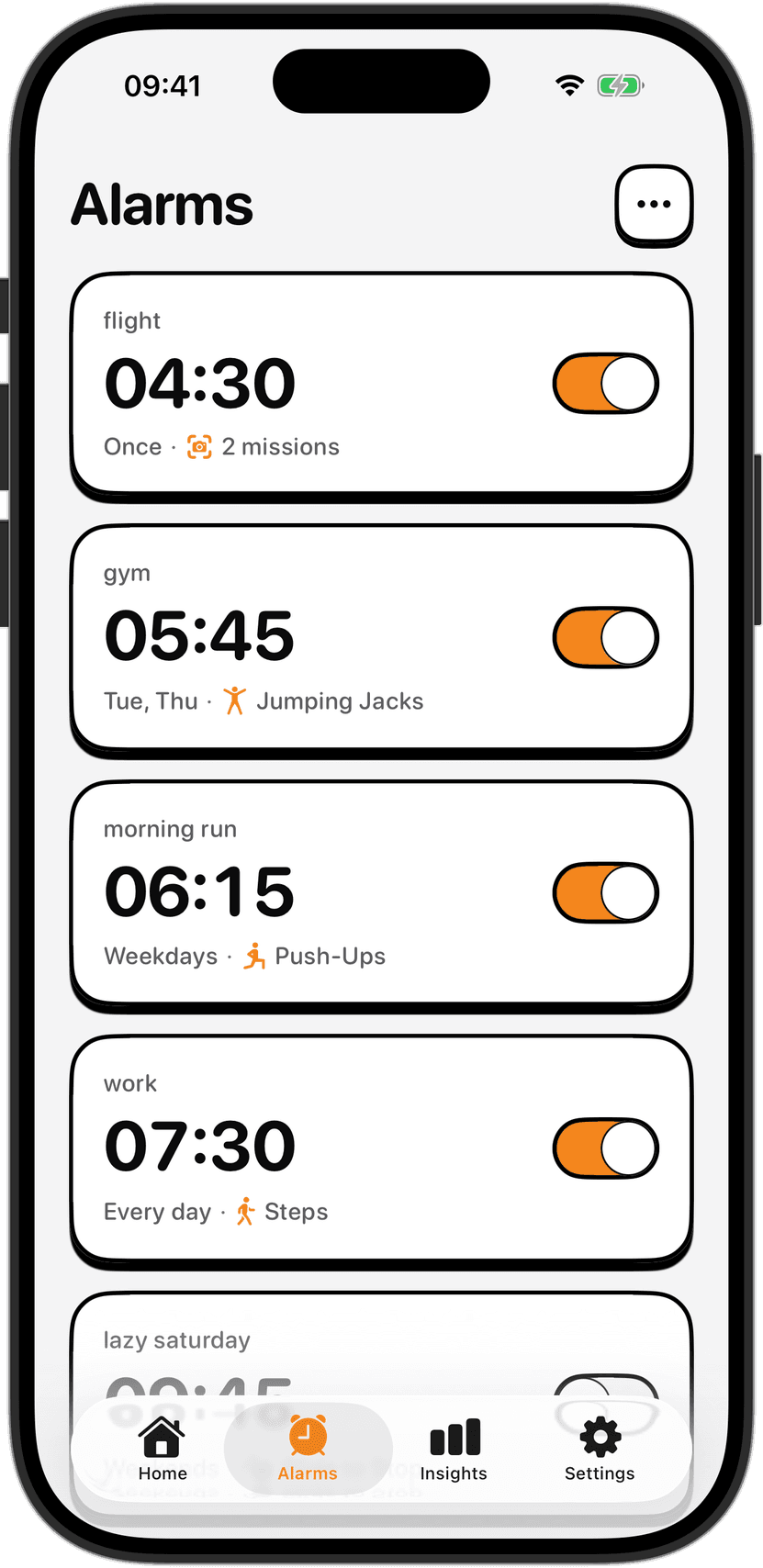
Your alarm becomes more important when your body clock is working against you. One reliable, attention-grabbing alarm is better than multiple alarms that train your brain to ignore sound. A single strong alarm that you have actually tested, not one you assume will work, is the foundation of waking on time when sleep is fighting back.
Shift work is hard on the body and on sleep. Your circadian rhythm evolved to follow the sun, and swing shifts and rotating schedules ask it to do something it resists. The strategies that work are those that work with your biology: consistent darkness and quiet for sleep, properly timed light exposure to guide your body clock, and allowing weeks for adaptation rather than expecting immediate results. Most shift workers benefit from trying one or two changes at a time and sticking with them for two to four weeks before deciding whether they help.
Sources
Healthline. "Shift Work Sleep Disorder: What It Is and How to Manage It." https://www.healthline.com/health/shift-work-sleep-disorder
Kaiser Permanente. "Shift Work Sleep Disorder." https://healthy.kaiserpermanente.org/health-wellness/health-encyclopedia/he.uf9956
Superpower. "The Right Way to Use Melatonin If You Work Night Shifts." https://superpower.com/guides/melatonin-shift-work
Sleepeducation.org. "Provider Fact Sheet: Shift Work." https://sleepeducation.org/docs/default-document-library/providerfactsheetshiftwork.pdf