Building a 6 a.m. workout habit that sticks
How long it takes to build an early workout routine, why context matters, and what research shows about the sleep trade-off.
Visana Studios
7 min read

October rolls around and the 6 a.m. gym runs stop. The alarm still goes off. You silence it another week, then another, until the habit is gone and you're back to sleeping through your workout time. This pattern is so common it has a name in habit research: the New Year effect. People commit to change, build momentum through the winter, and watch it evaporate when the seasons shift or life gets busy. The gap between starting a habit and keeping it is not about willpower. It is about the structure that makes a behavior automatic enough to survive October.
How long habits actually take
A 2010 study by Lally and colleagues followed 82 people building new behaviors in their own lives, tracking habits like drinking water with lunch or doing a 15-minute run before breakfast. The researchers found that habits took between 59 and 254 days to feel automatic, with a median around three months. The curve was asymptotic: early on, each repetition moved the needle. By month two, progress slowed. Adding a fourth or fifth workout in the same week hardly moved the habit meter, but the habit kept getting stronger in the background, almost imperceptibly.
What that meant in practice: picking a 6 a.m. start time and hitting it 12 times in January feels like real change. By early March, the same 12 workouts feel routine. By May or June, skipping one is genuinely hard, not a decision. The window between "this is effortful" and "this is just what I do" is roughly 60 to 100 days. Before that window closes, interruptions and seasonal shifts are enough to kill the habit. After it closes, October is just another month.
Context is the automation layer
Habits work by attaching a behavior to a cue. The cue is not motivation. It is a trigger that runs the behavior without needing you to decide. If a 6 a.m. alarm is your only cue, your brain still has to negotiate whether to get up. The snooze button remains tempting because nothing else is pulling you toward the gym.
A 2026 meta-analysis in Applied Psychology: Health and Well-Being examined 63 studies on context cues and physical activity habits. The researchers found that the consistency of context mattered more than its intensity. People who worked out at the same time, in the same place, or alongside the same person built stronger habits and exercised more frequently than people who varied the details. The effect sizes were small in raw numbers, but across months they compounded: someone working out at 6 a.m. by the machines in their gym had a medium-to-large habit advantage over someone who sometimes went at 6, sometimes at 7, sometimes at a different gym. The consistency of the cue, not its power, taught the body when to wake up and move.
Preparing the night before fits into this frame. A wind-down reminder nudging you toward sleep is not motivational. It is a cue that the day is ending and tomorrow at 6 a.m. you will be up and moving. Laying out clothes or packing a gym bag serves the same purpose: it removes a choice point in the morning when willpower is depleted and sleep inertia is strongest. The fewer decisions between the alarm and the first set of reps, the more likely the habit survives cold weather, a bad sleep, or a rough week at work.
The sleep trade-off myth
One reason people dread early workouts is the fear that waking at 6 to exercise will cost them sleep. The research on this is clearer than the fear. A 2024 study in the Journal of Sleep Research measured 13 recreational runners doing a 45-60 minute run at 70 percent of their maximum aerobic intensity either in the early morning (30 minutes to 2 hours after waking) or in the evening (2 hours to 30 minutes before sleep). Compared to a rest day, both morning and evening exercise increased the time spent in deep, restorative non-REM sleep. Morning exercise added an average of about 25 minutes of non-REM sleep. Evening exercise added about 23 minutes. The study found no other effects on sleep quality, and no difference in how people subjectively rated their sleep after either timing. If sleep quality is the limiting factor in whether you stick with early workouts, the early workouts are not the villain. They actually extended sleep that night.
The real friction point is getting up in the first place, and that is a matter of habit strength, not physiology. That is also where the daily structure matters most. If your wake time stays fixed, morning exercise becomes easier to maintain than a flexible 6-to-8-a.m. window. This connects to why sleep inertia and the snooze button describe such a strong pull toward staying in bed when the alarm first goes off.
Three practical moves that research supports
Starting an early workout habit is not a mystery, but it does require structure from the first day. The research points to three levers: time consistency, environmental cues, and a night-before anchor that connects bedtime to the commitment.
Pick a specific time and day pattern and stick to it for at least 12 weeks, lowering the bar if needed. Three 20-minute workouts at 6 a.m. on Monday, Wednesday, and Friday will build a stronger habit than five 45-minute sessions scattered across days and times. The body clock learns patterns. A workout that happens at the same time creates a cue that becomes automatic months in. A workout that happens whenever you have time remains optional in your brain.
The second move is removing choices from the morning itself. Clothes, shoes, water bottle, gym bag, even your choice of exercise should be decided the night before. If your choice is between push-ups in your living room and nothing, and you are groggy at 6 a.m., you will do neither. If your choice is push-ups or squats, both of which you have gear for, you will do one. The fewer decision points before you start, the stronger the habit gets.
The third is a genuine wind-down in the evening that connects tomorrow's wake time to tonight's bedtime. This is not about sleep hygiene preaching. It is a cue. If your brain learns that 9 p.m. quiet time predicts a 6 a.m. workout, that wind-down becomes a signal that you are preparing for the commitment. Over 12 weeks, the signal gets stronger.
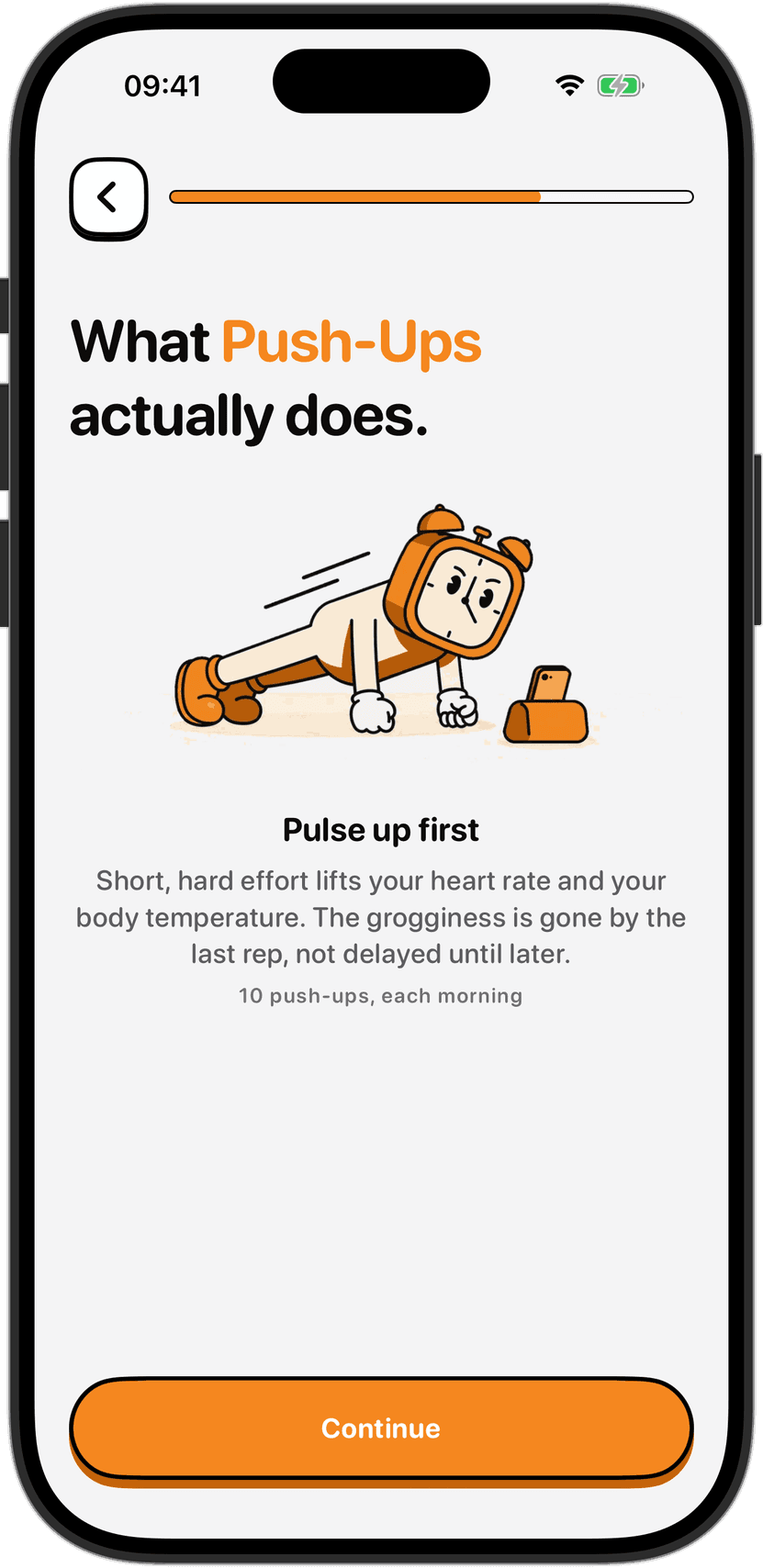
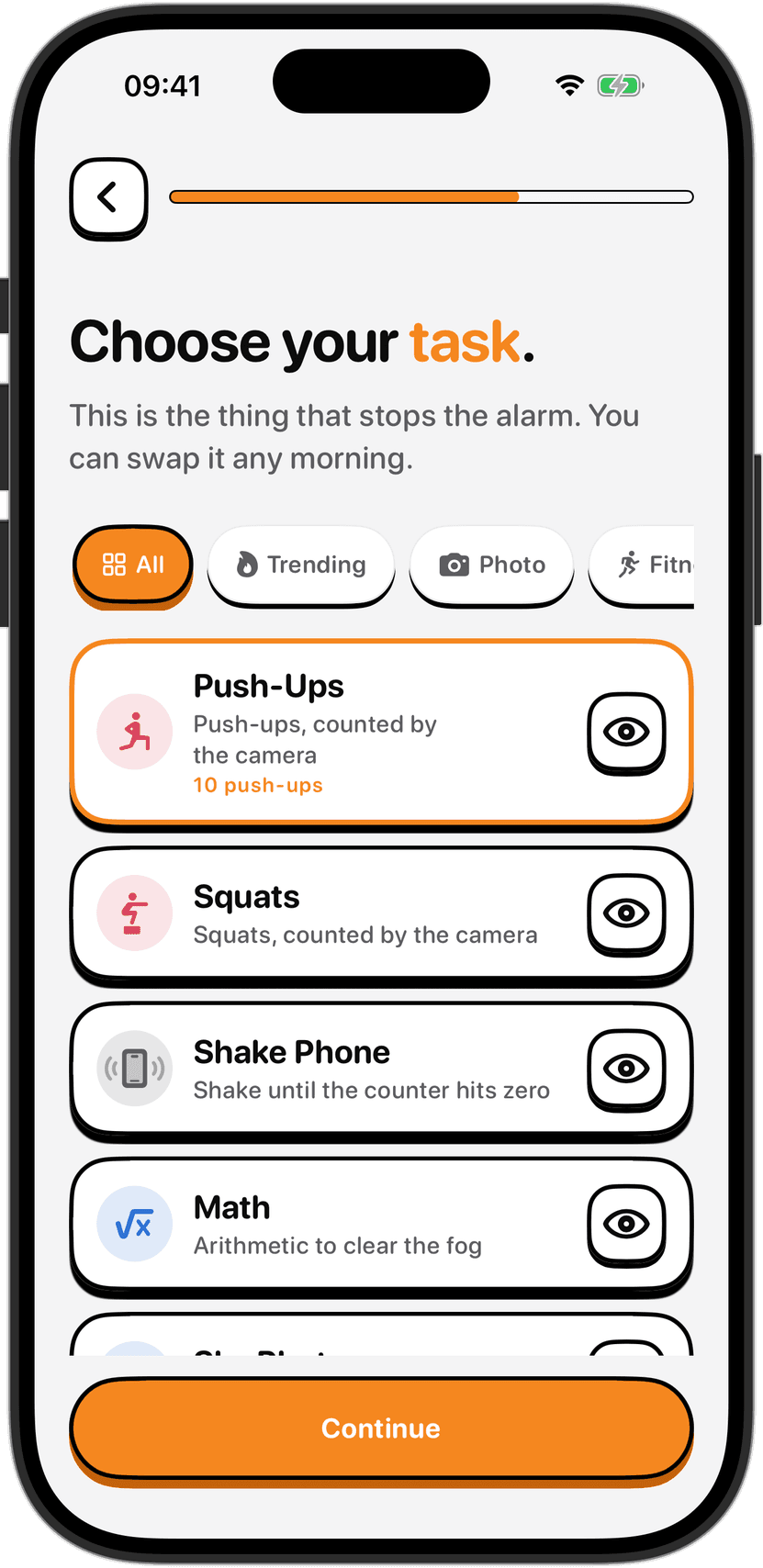
If your early workout routine involves push-ups or squats right after waking, be aware that exercising first thing when you are still groggy carries a small injury risk. If you have a condition that makes loaded exercise risky early in the day, or if you are unsure whether push-ups or squats are safe for you, pick a different task or talk to your doctor. Math, shaking your phone, or a photo works just as well for building habit strength.
Early workouts can shift in October or any month once the habit crosses from effortful to automatic. Before that threshold, a single missed session can be the beginning of the end. After it, a missed session is an exception, not a pattern. The difference is not strength. It is invisibility. Once a 6 a.m. workout is just what your body expects, stopping becomes the hard thing.
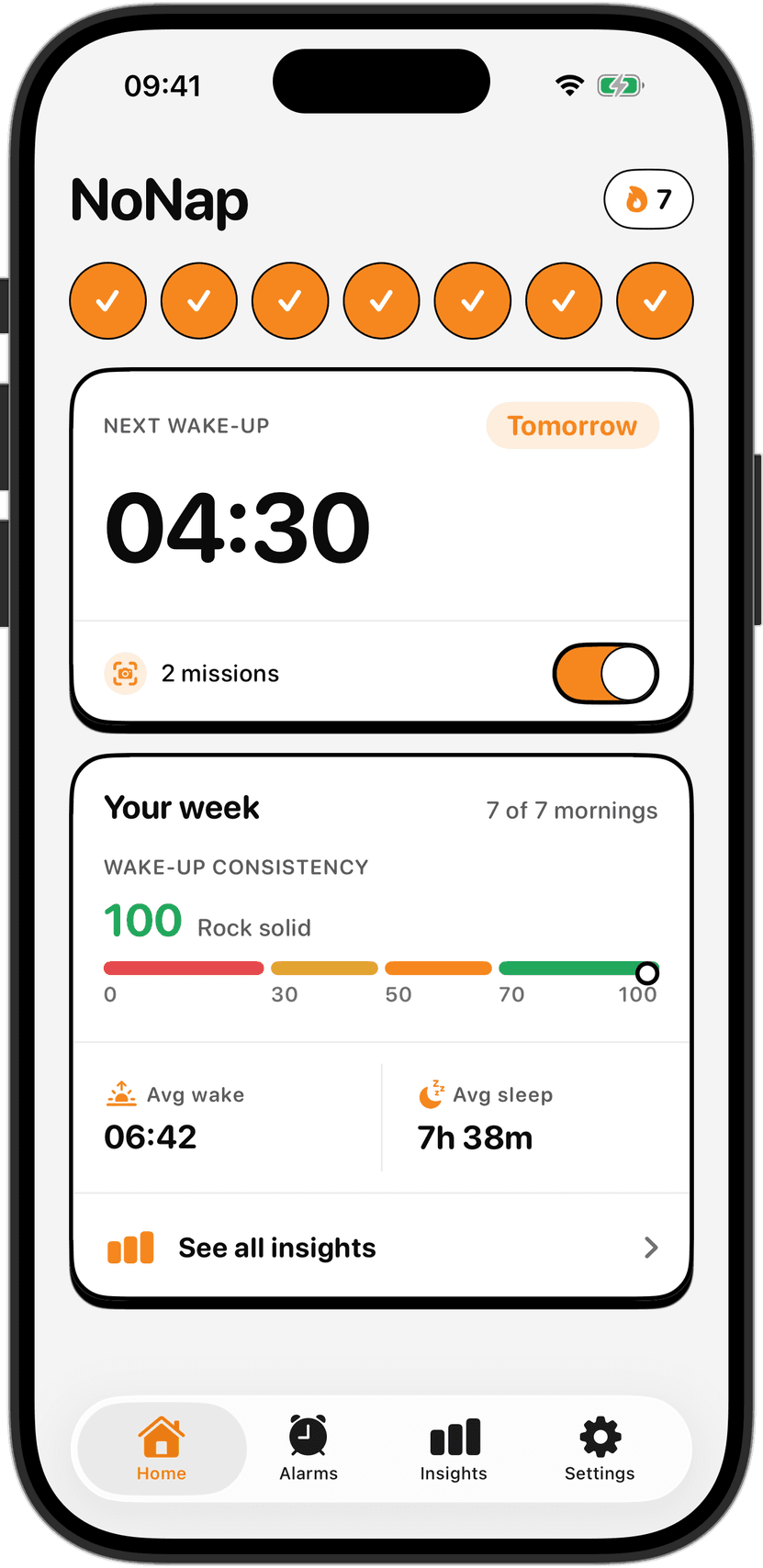
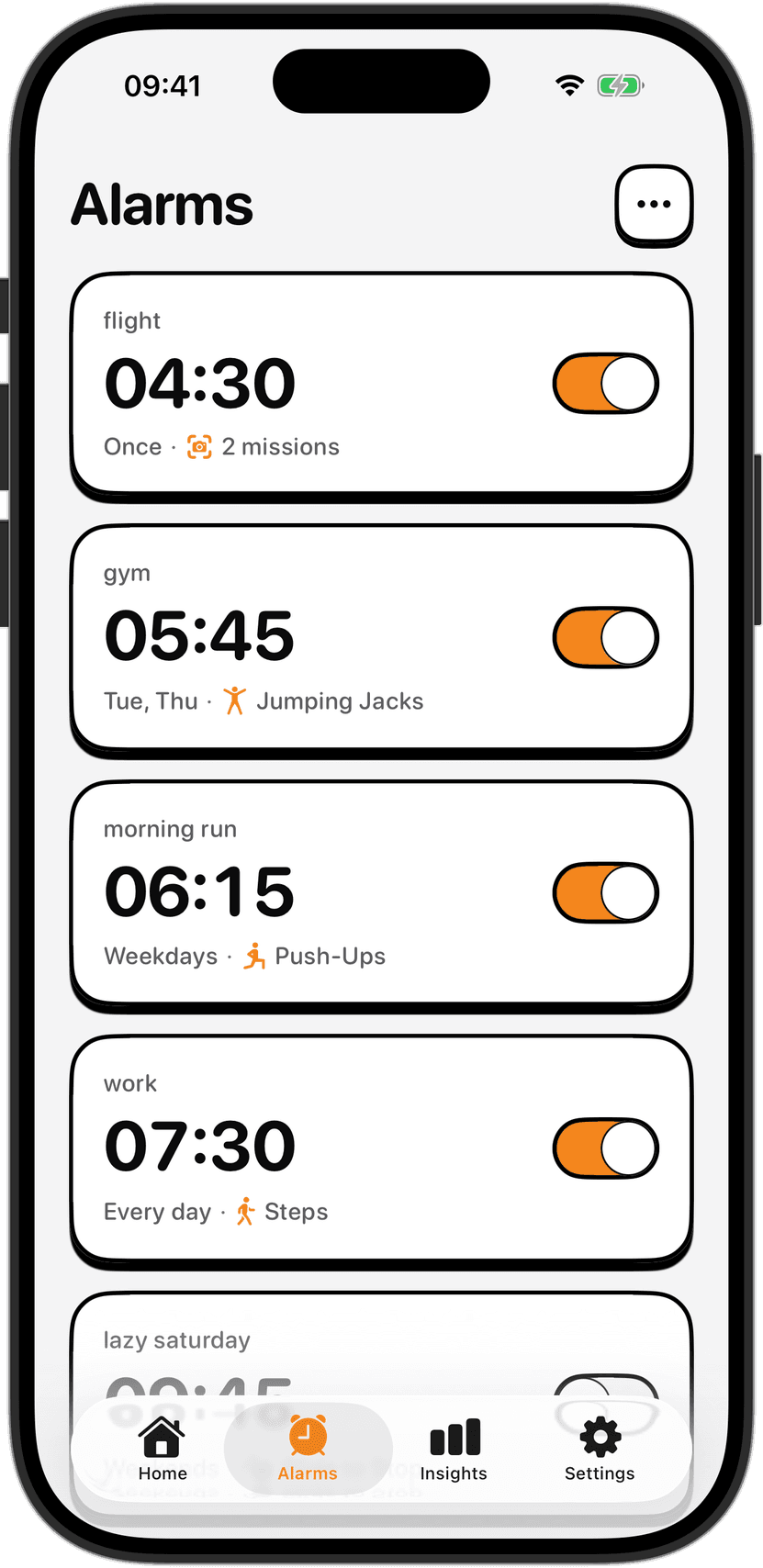
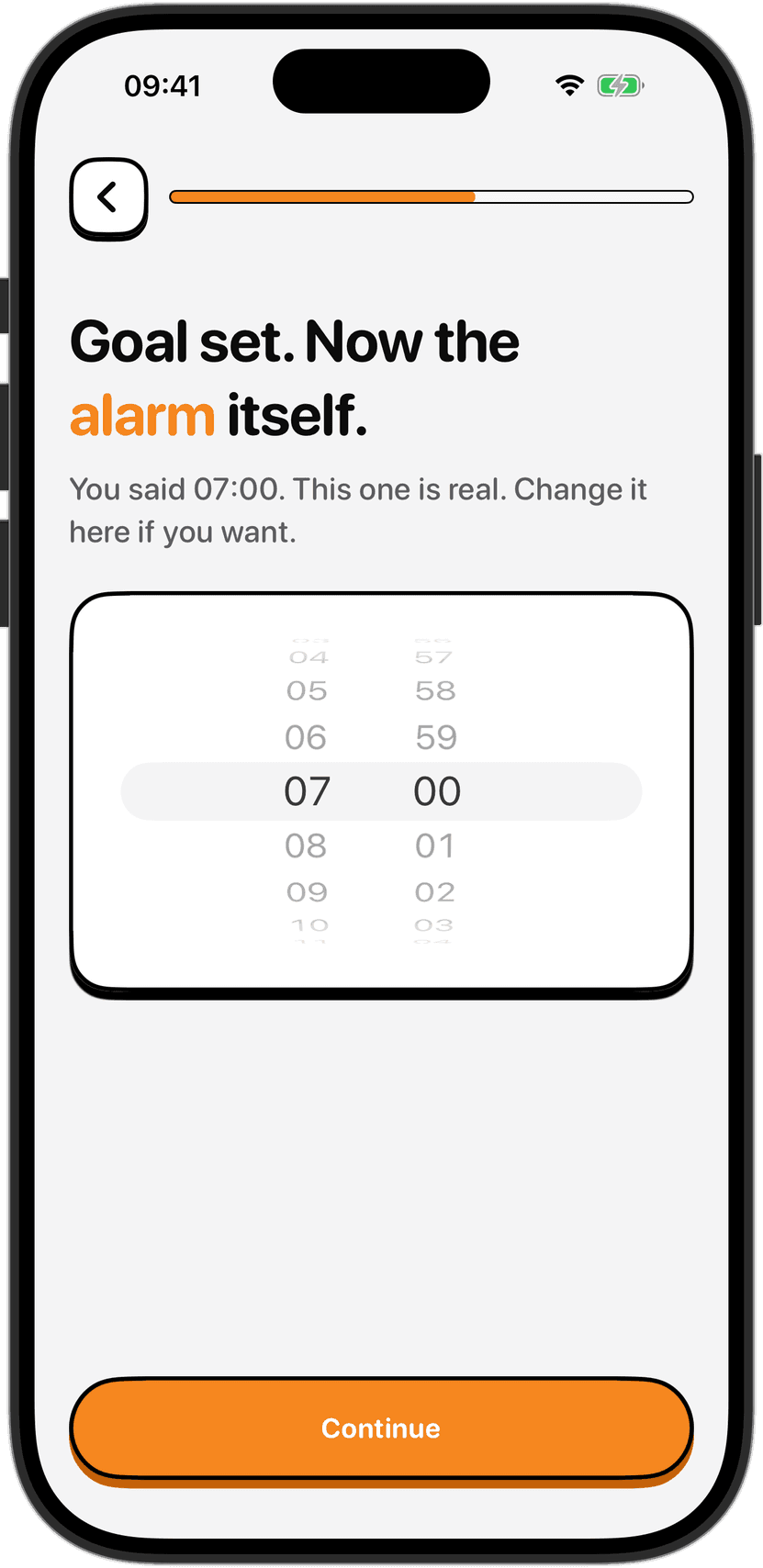
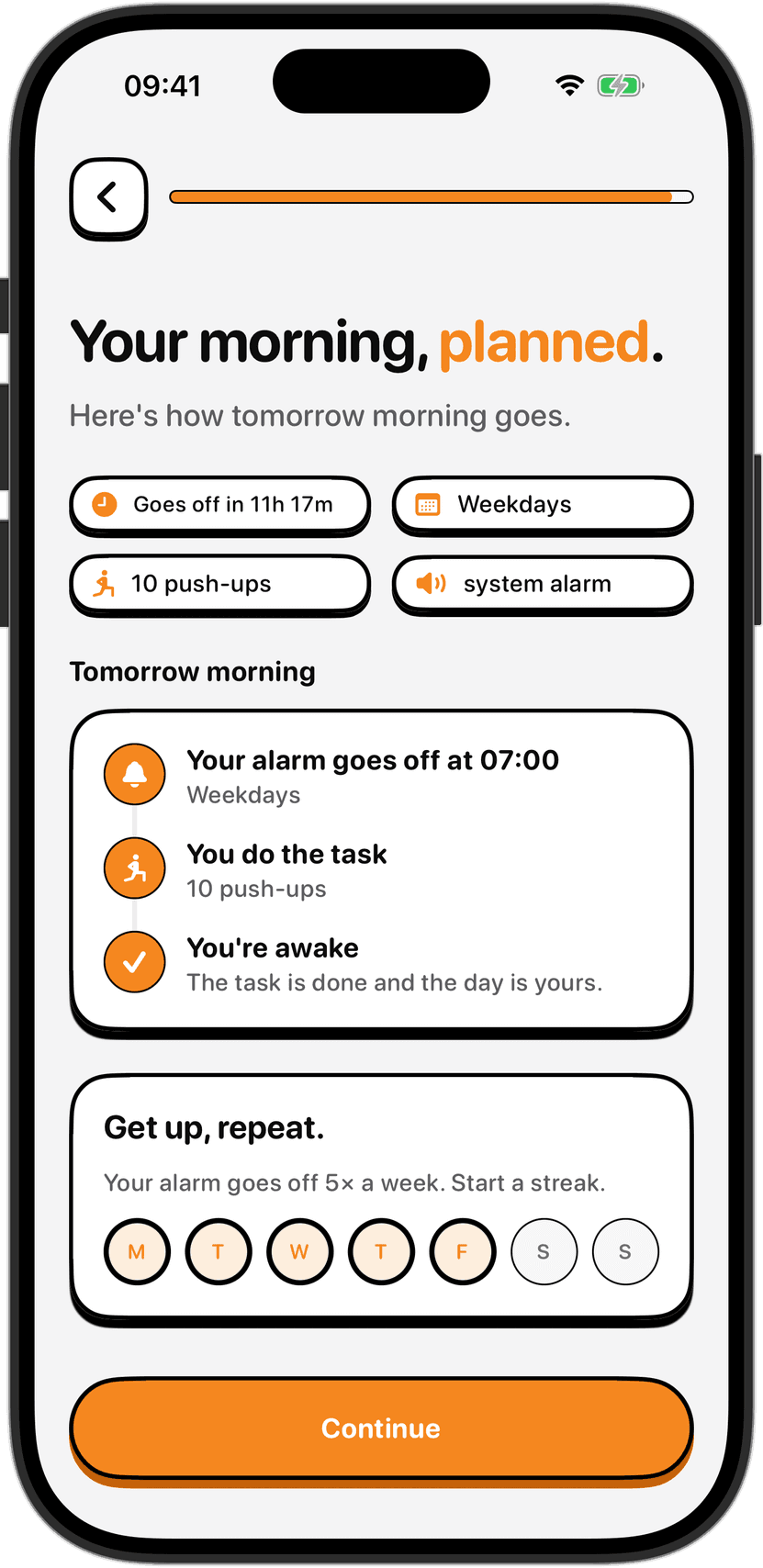
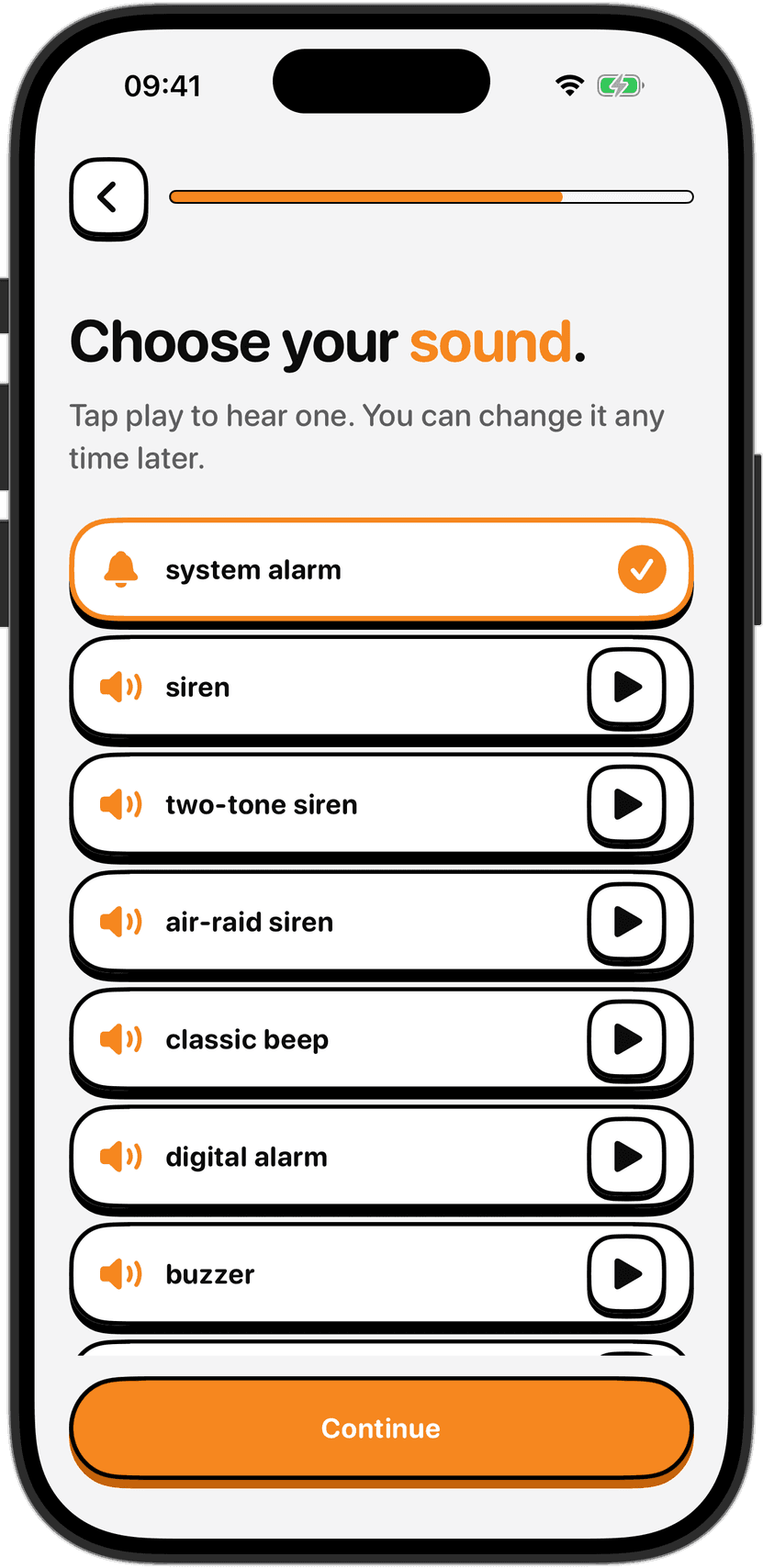
NoNap helps by removing the decision point at wake time itself. The alarm goes off at 6, and the only way to stop it is to finish a task you chose the night before. For early workouts, you pick the push-ups, squats, or another activity when you are still thinking clearly. At 6 a.m., when sleep inertia is high, you just follow what yesterday's you decided. That shift from decision to habit is what makes the difference between a January goal and an October routine. See how it works.
Sources
Lally, P., Van Jaarsveld, C. H. M., Potts, H. W. W., and Wardle, J. (2010). How are habits formed: Modelling habit formation in the real world. European Journal of Social Psychology, 40(6), 998-1009.
Goldberg, M., Pairot de Fontenay, B., Blache, Y., and Debarnot, U. (2023). Effects of morning and evening physical exercise on subjective and objective sleep quality: an ecological study. Journal of Sleep Research, 33(1), e13996.
Zhu, L., Tao, Y., Zhou, B., Ma, H., Kaushal, N., Ma, X., Guo, Y., Zhao, R., Oguntuase, S. B., Li, H., and Zhang, L. (2026). Not all cues are equal: A systematic review and three-level meta-analysis of context consistency, physical activity and habit strength. Applied Psychology: Health and Well-Being, 18(4), e70204.
McAlpine, T., Liddelow, C., Charlesworth, J., Mergelsberg, E., Green, A., Novoradovskaya, E., Franz, T., Haywood, D., Baughman, F. D., Breare, H., and Mullan, B. (2026). A Longitudinal Study Examining Physical Activity Habit Formation. Behavioral Sciences, 16(4), 535.
Image credits
Cover photo on Pexels (pexels.com/photo/purple-and-blue-dawn-millennium-bridge-london-220769), used under the Pexels License, which permits commercial use without payment or attribution.