Does your menstrual cycle change how you sleep?
What overnight sleep studies show about the menstrual cycle: more waking and less deep sleep in the luteal phase, and why the evidence is still limited.
Visana Studios
6 min read
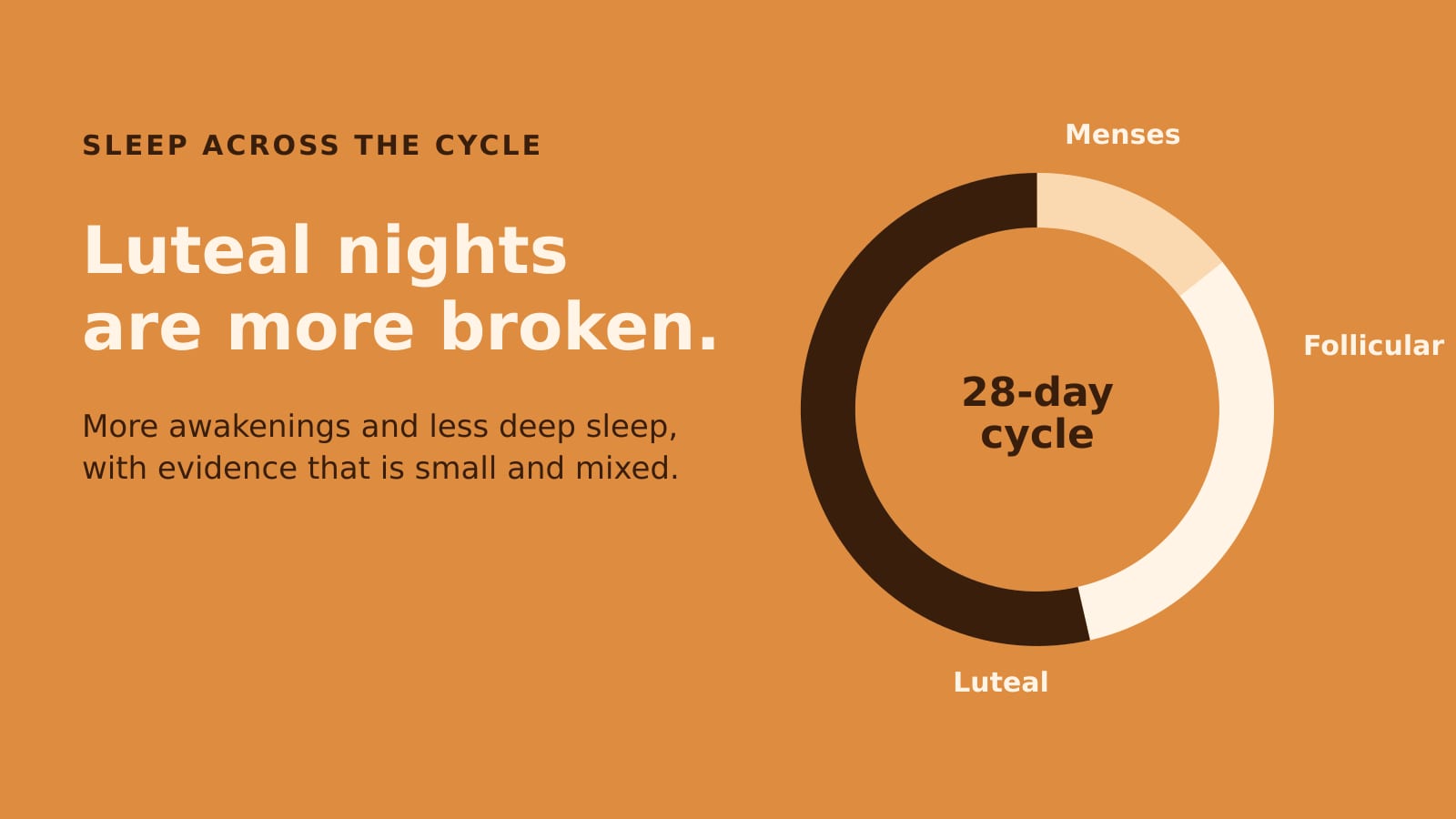
Many women describe lighter, more broken sleep in the week or two before a period. Overnight recordings back up part of that picture. A 2015 study found more waking and less deep sleep in the luteal phase, the stretch after ovulation. The effects are modest, though, and the studies are small, so the full story is less tidy than most forum threads suggest.
Two phases matter here. The follicular phase runs from the start of a period until ovulation. The luteal phase follows ovulation, when progesterone rises and then falls, unless pregnancy follows. Sleep researchers have spent years asking what that hormonal shift does to the brain at night.
What changes across the cycle
A 2018 review by Baker and Lee summarises the field. Its abstract says sleep changes both subjectively and objectively across the cycle, and that the phase should be considered when a woman reports a sleep problem. The luteal phase brings a blunted daily temperature rhythm and somewhat less REM sleep, according to the same review.
The clearest change shows up in sleep spindles, the short bursts of fast brain activity that mark lighter non-REM sleep. Spindle activity rises from the follicular phase to the luteal phase. The review links that rise to progesterone or its breakdown products. It presents the link as a possibility, not a settled mechanism.
What overnight recordings found
A 2015 polysomnography study by de Zambotti and colleagues recorded 20 women in the early menopausal transition, with a mean age of 48.8. Each woman had one night of recording in the follicular phase and one in the luteal phase. Eleven had insomnia and nine did not.
Progesterone rose from about 0.7 ng/mL to between 8 and 10 ng/mL in the luteal phase. The awakening index rose from 2.5 to 3.3 an hour in women without insomnia, and from 3.1 to 3.9 an hour in women with it. Deep sleep, the N3 stage, fell from 12.6 to 10.0 percent of sleep time in the first group and from 12.4 to 10.5 percent in the second. Spindles were denser and longer. The authors concluded that sleep was more fragmented in the luteal phase whether or not the women had insomnia.
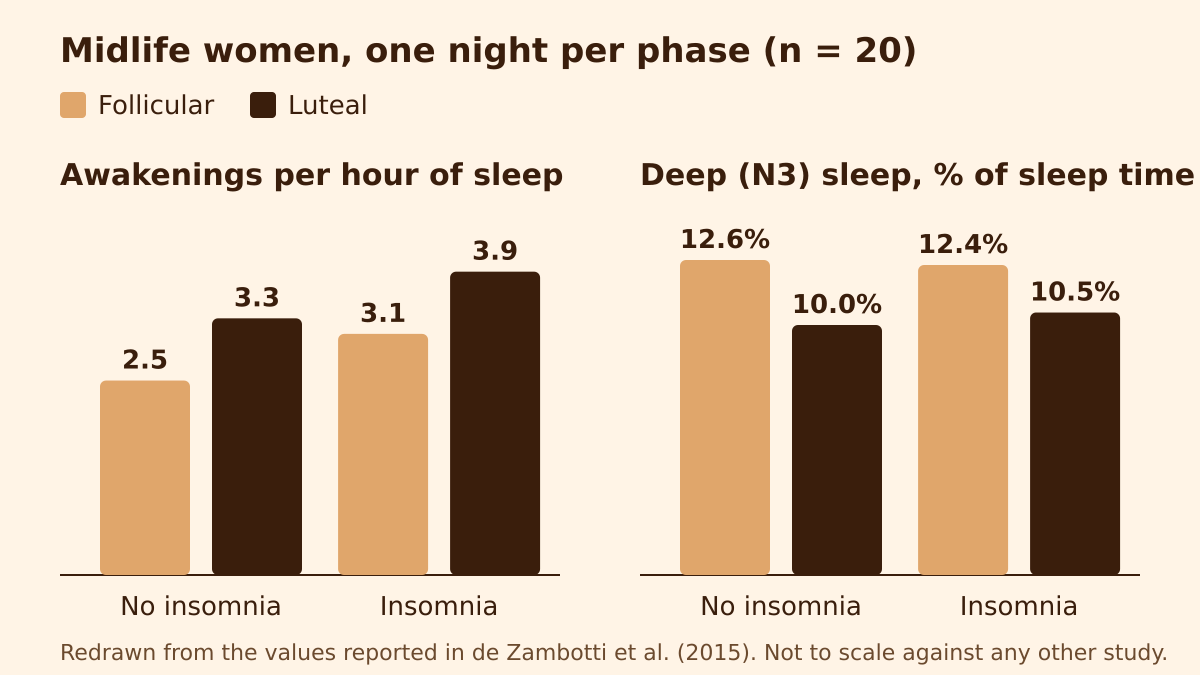
Group averages can hide a lot of individual variation, so one night of your own tells you little. The study also looked at women whose cycles were already changing, so its findings may not carry over to every woman in her twenties or thirties.
A 2007 study in the journal Sleep took a different approach. Baker, Kahan, Trinder and Colrain recorded nine women with premenstrual syndrome or premenstrual dysphoric disorder, and 12 women without symptoms, across two cycle phases. Women with PMS rated their sleep as worse in the late luteal phase than in the follicular phase. The control group rated theirs about the same across phases.
The recordings were less tidy. Both groups showed more sigma activity in the late luteal phase, and both had more waking after sleep onset and a higher arousal index then. REM sleep as a percentage of the night did not change significantly across phases. Women with PMS also took longer to reach REM sleep than controls, in both phases.
Why how you feel and what the recording shows can differ
The 2007 study shows why this topic is hard to pin down. The women who reported worse sleep were not clearly different on the recordings from women without symptoms, apart from the longer time to REM sleep. Baker and Lee note that poorer sleep quality in the premenstrual phase and during menstruation is common in women with premenstrual symptoms or painful cramps. Both are real experiences, and these studies do not explain why they happen.
Both cycle studies are small. The 2007 work had 21 participants across two groups, and the 2015 work had 20 women. Results like these are good reasons to look for a pattern over several months, and poor reasons to draw firm conclusions about any one person.
Insomnia and the wider picture
Insomnia is more common in women than in men, a gap that shows up across many studies. Zhang and Wing's 2006 meta-analysis reported a risk ratio of 1.41 for women compared with men, with a 95 percent confidence interval of 1.28 to 1.55. A 2020 meta-analysis by Zeng and colleagues covered 13 studies and 326,908 participants and found an odds ratio of 1.58, with a 95 percent confidence interval of 1.35 to 1.85.
The cycle research sits inside that larger pattern. In the 2015 study, the insomnia group slept less than the other group in both phases, with about 375 minutes in the follicular phase and about 368 in the luteal phase, against about 417 and 405 minutes for the group without insomnia. The gap was the same in both phases. A monthly rhythm in how you sleep is worth noticing, but it does not replace a proper look at persistent sleep trouble.
What to do with this
The evidence supports a few plain habits rather than a special routine. Keep your wake time steady. A fixed wake time is a practical way to hold the body clock in place, whatever the cycle is doing. Get daylight in the first part of the morning, as you would in any month, and see morning light and the body clock for the reasoning. Mark your harder mornings on a calendar for two or three cycles. A pattern is much easier to act on than a vague sense that things feel worse.
If your luteal-phase mornings are harder, plan for them. Pick a wake task you can finish half-asleep, and keep the demanding one for days when you feel sharp. The wake task guide explains how to match a task to your body. NoNap works on the same principle: you choose the task ahead of time, and you can change it any morning. The app does not track your sleep, so it cannot tell you what your nights look like.
See a doctor if the pattern is severe. That includes premenstrual symptoms that stop you from working or sleeping, pain that keeps you awake, heavy bleeding, or insomnia that does not follow a predictable part of the month. Persistent daytime sleepiness deserves the same attention, and the excessive daytime sleepiness post covers when to get it checked. This article does not diagnose anything and does not cover hormone treatment or supplements.
Sources
Baker FC, Kahan TL, Trinder J, Colrain IM. Sleep quality and the sleep electroencephalogram in women with severe premenstrual syndrome. Sleep. 2007;30(10):1283-1291. doi:10.1093/sleep/30.10.1283
de Zambotti M, Willoughby AR, Sassoon SA, Colrain IM, Baker FC. Menstrual cycle-related variation in physiological sleep in women in the early menopausal transition. The Journal of Clinical Endocrinology and Metabolism. 2015. doi:10.1210/jc.2015-1844. https://pmc.ncbi.nlm.nih.gov/articles/PMC4524984
Baker FC, Lee KA. Menstrual cycle effects on sleep. Sleep Medicine Clinics. 2018;13(3):283-294. doi:10.1016/j.jsmc.2018.04.002. https://www.em-consulte.com/article/1237364/article/menstrual-cycle-effects-on-sleep
Zeng LN, Zong QQ, Yang Y, Zhang L, Xiang YF, Ng CH, Chen LG, Xiang YT. Gender difference in the prevalence of insomnia: a meta-analysis of observational studies. Frontiers in Psychiatry. 2020;11:577429. doi:10.3389/fpsyt.2020.577429. https://pmc.ncbi.nlm.nih.gov/articles/PMC7714764/
Zhang B, Wing YK. Sex differences in insomnia: a meta-analysis. Sleep. 2006;29(1):85-93. Cited here as reported in Zeng et al. (2020).
Image credits
The cover and the chart were made for this post as original SVG graphics, with no photographs or third-party images. The chart is redrawn from the values reported in de Zambotti et al. (2015).