From knocker-uppers to AlarmKit: a short history of waking people up
Levi Hutchins in 1787, Britain's knocker-uppers, the real story behind the 9-minute snooze, and how Apple's AlarmKit changed the iPhone alarm in 2025.
Visana Studios
8 min read
In the early 1900s, a woman named Mary Smith walked the docklands of East London before sunrise, firing dried peas at bedroom windows with a shooter to rouse the workers inside. She charged sixpence a week per customer and woke around 600 people a day, a job she kept until she retired in 1934. She was a knocker-up, and for a stretch of the Industrial Revolution, people like her were the alarm clock.
Getting a whole city out of bed on time is a surprisingly recent problem, and the tools built to solve it tell a stranger story than the tidy version usually repeated online.
Before the clock could do it alone
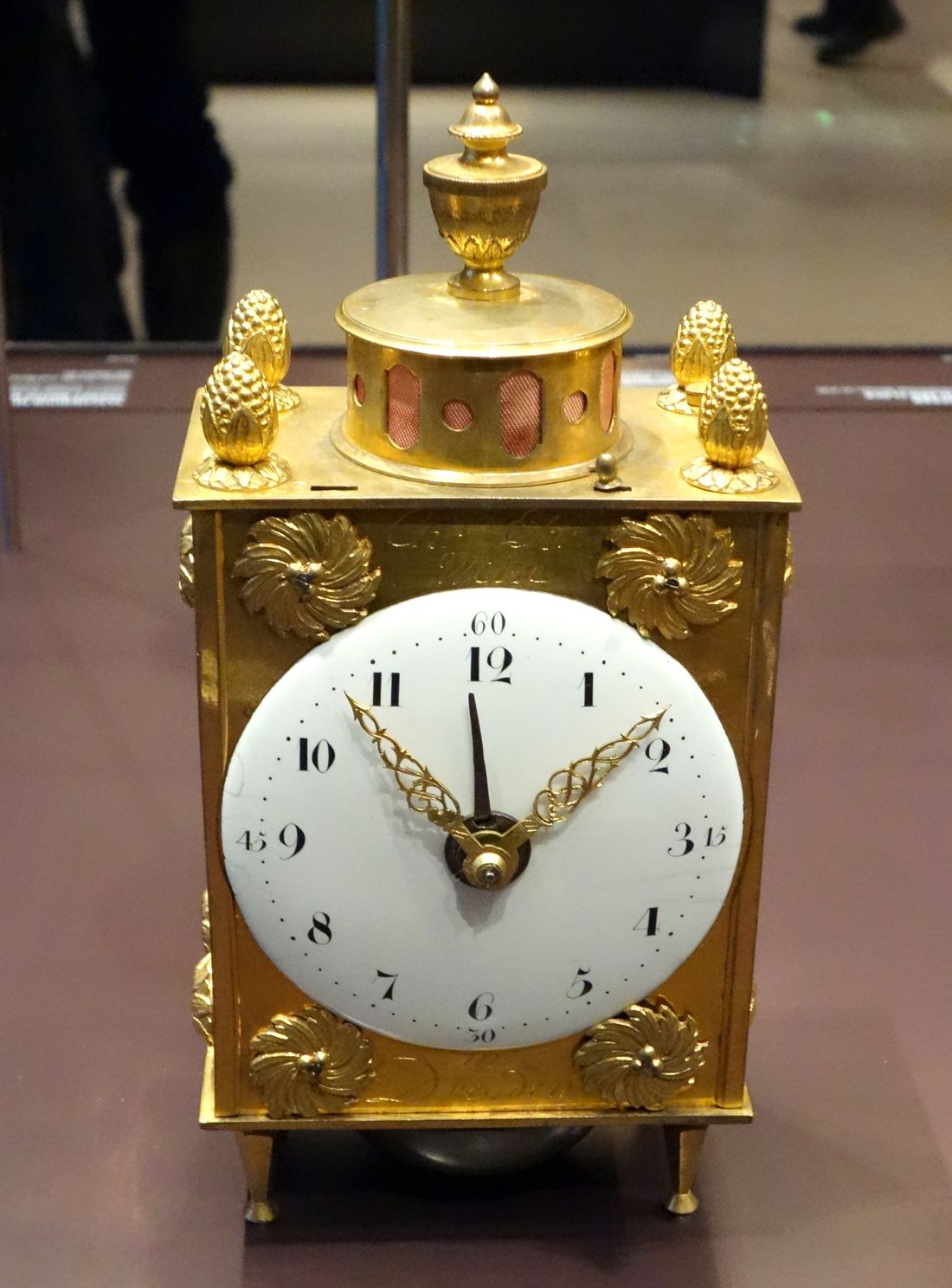
Mechanical alarms go back further than most people assume. Water clocks with alarm signals are described in ancient Greece, and alarm mechanisms show up in striking clocks across medieval Damascus, China and Europe. What didn't exist for a long time was a small, affordable clock built for one ordinary person's bedside.
The first American alarm clock, by most accounts, was one man's personal fix. Levi Hutchins, a clockmaker in Concord, New Hampshire, built himself a clock in 1787 that would ring a bell at exactly 4 a.m., the hour he needed to be up for work. The clock sat in a wooden cabinet about 29 by 14 inches, with a mirror set into the door. Hutchins never patented it or sold copies, and it rang at that one hour and nothing else, a personal tool rather than a product.
Adjustability came from somewhere else first. French inventor Antoine Redier patented the first mechanical alarm clock that could be set to different wake times in 1847. His patent didn't extend to the United States, so American manufacturers built their own path to the same idea.
The human alarm clocks of industrial Britain
While clockmakers worked out mechanisms, most working people in industrial Britain still couldn't afford one, so they paid a person instead. The knocker-up trade grew alongside factory shift work in the 1800s, mostly in northern mill towns and London's docklands, where tides rather than clocks decided when a shift started. Elderly men and women did most of the work, sometimes alongside constables picking up extra pay on their morning rounds.
The tools varied by street and trade. A long stick, often bamboo, reached upper windows. Some knocker-ups carried rattles or soft hammers. In the mining village of Ferryhill in County Durham, miners chalked their shift times onto slate boards fixed to their houses so the local knocker-up would know exactly when to come by. Mary Smith's pea shooter, learned from her son before he died in the First World War, was distinctive enough that a 1931 photograph of her at work became one of the iconic images of the trade. The job faded through the 1940s and 1950s as cheap alarm clocks spread, though a few knocker-ups reportedly worked into the early 1970s in pockets of industrial England.
A clock company finds the mass market
Back in the United States, Seth Thomas, a Connecticut clockmaking company founded by the elder Seth Thomas, put its own stamp on the idea. On October 24, 1876, Seth E. Thomas received U.S. Patent No. 183725 for an improved clock case, built specifically to hold the back-winding alarm mechanism that was becoming standard. That wasn't a patent on the alarm idea itself, but on making the alarm cheap and compact enough to sit on an ordinary nightstand, and the company built a real business selling exactly that.
By the early 20th century, the wind-up bedside alarm clock, twin bells on top, a single loud spring-driven ring, had become a fixture of American bedrooms. The design barely changed for decades, mostly because it didn't need to. It worked.
Radio, then the button that changed everything
Radio and the alarm clock merged sometime in the 1940s, though the exact history is fuzzy enough that even the U.S. Patent Office has no clean record of it. TIME magazine credits James F. Reynolds and Paul L. Schroth Sr. with building an early version after Reynolds' own windup clock alarm broke, wiring the clock's winding key to a radio's volume knob so the radio itself became the alarm. What's clear is that clock radios were common household objects by the 1950s.
The bigger shift in how people actually wake up came from General Electric-Telechron in 1956 with a clock called the Snooz-Alarm, marketed as "the world's most humane alarm clock." This was the first clock built with a second chance in mind: press a button, and the alarm goes quiet for a while before ringing again.
Here's where the popular history usually gets it wrong. A widely repeated story claims GE's engineers wanted a clean ten-minute snooze but the clock's internal gears couldn't align for anything shorter than nine minutes and a few seconds, so nine became the standard by mechanical accident. That's a tidy story, and the evidence doesn't back it up. Jay Kennan, a Telechron collector who has tested original Snooz-Alarm units, found their actual snooze period ran closer to fifteen to seventeen minutes, nowhere near nine. Period advertising backs that up: early ads promised "about ten minutes" or vaguely "a luxurious extra 40 winks," never a precise number. GE-Telechron apparently found fifteen minutes too generous and redesigned the mechanism to shorten it, but nothing in the historical record explains why nine specifically won out over eight or ten. You may also see the snooze button credited to Ben-Hur author Lew Wallace. That one is easy to rule out: Wallace died in 1905, fifty-one years before the Snooz-Alarm existed.
Sleep inertia, the grogginess that makes snoozing tempting in the first place, is a real and well-studied phenomenon. The nine-minute number that generations of snoozers have lived by, though, looks more like an unexplained design choice that stuck than a solved engineering problem.
From the nightstand to the pocket
Digital displays arrived in the 1970s and 80s, and by the 1990s, alarms had quietly migrated into a device most people already carried. Nokia's mass-market phones, the 5110, the 8810, the 6210, built a basic alarm clock into the same handset as text messaging and Snake. Once smartphones took over in the following decade, the standalone alarm clock became something close to optional. Almost everyone was already sleeping next to a phone that could wake them up.
That convenience came with a tradeoff sleep researchers still bring up: phones are also notification machines, email inboxes and social feeds, sitting on the nightstand doing double duty. Phones in the bedroom carry a mixed research record for that reason, separate from anything to do with the alarm function itself.
The system finally catches up
For years, third-party alarm apps on the iPhone had a real limitation: iOS reserved the strongest wake-up permissions, the kind that ignore the Ring/Silent switch and Focus modes, for Apple's own Clock app. An alarm built by anyone else could get muted by a setting the user forgot they'd turned on.
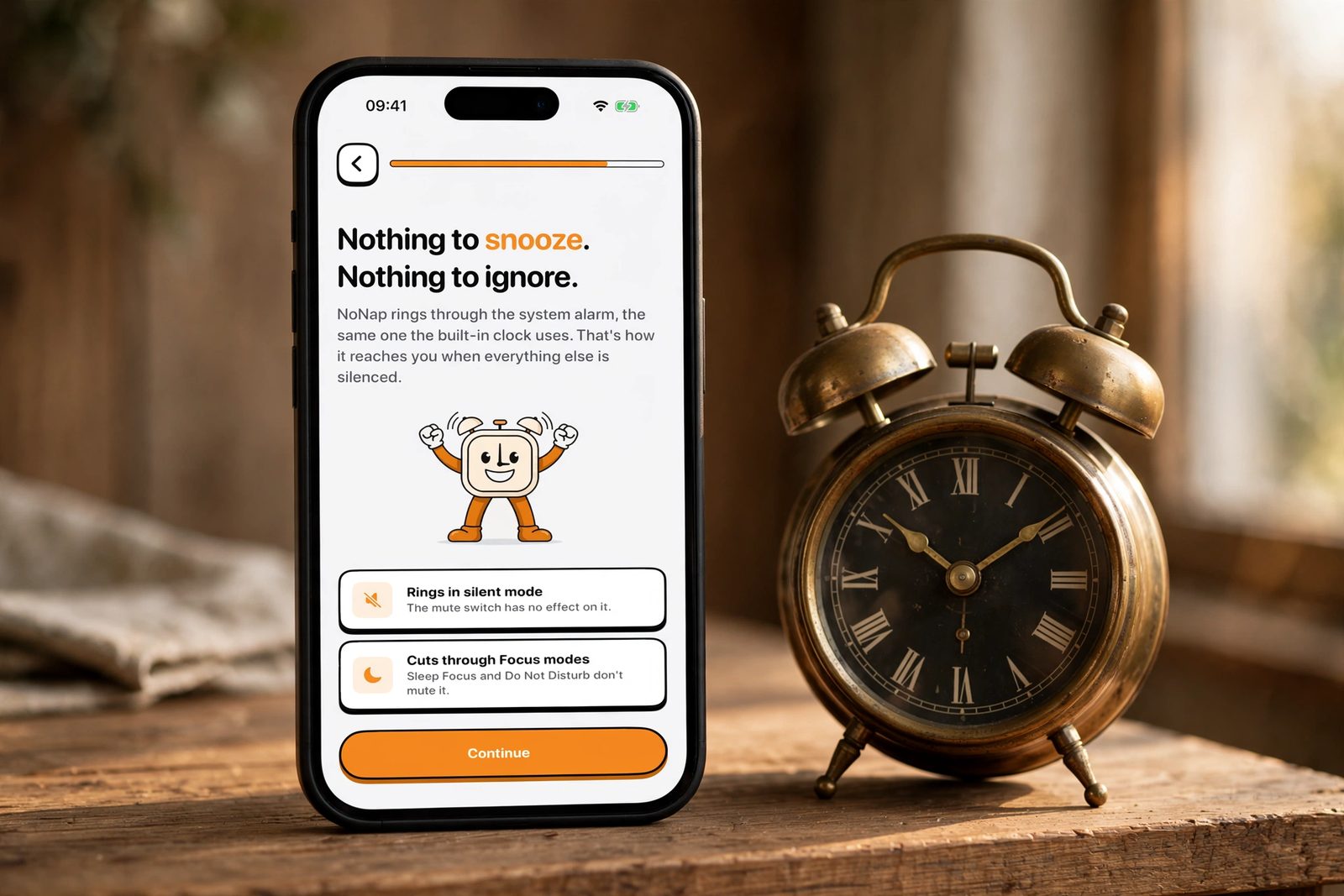
That changed with AlarmKit, a framework Apple introduced at WWDC in June 2025 and shipped with iOS 26 that September. AlarmKit gives third-party apps the same system-level alarm access Apple's Clock app has always had: alerts that fire through Silent mode and Focus modes, full-screen lock screen alerts, and Dynamic Island support, instead of the workaround permissions developers had been stuck with before.
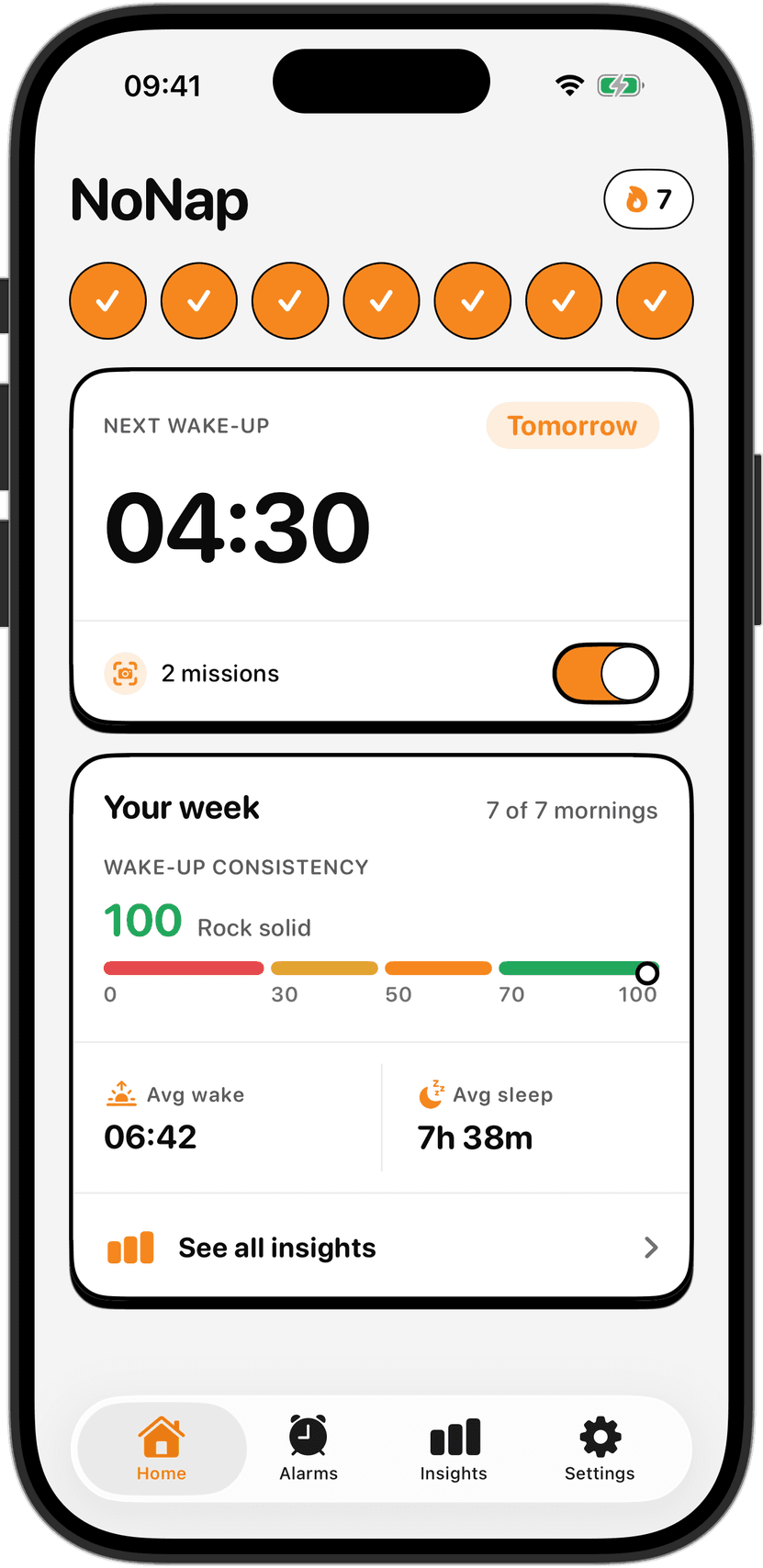
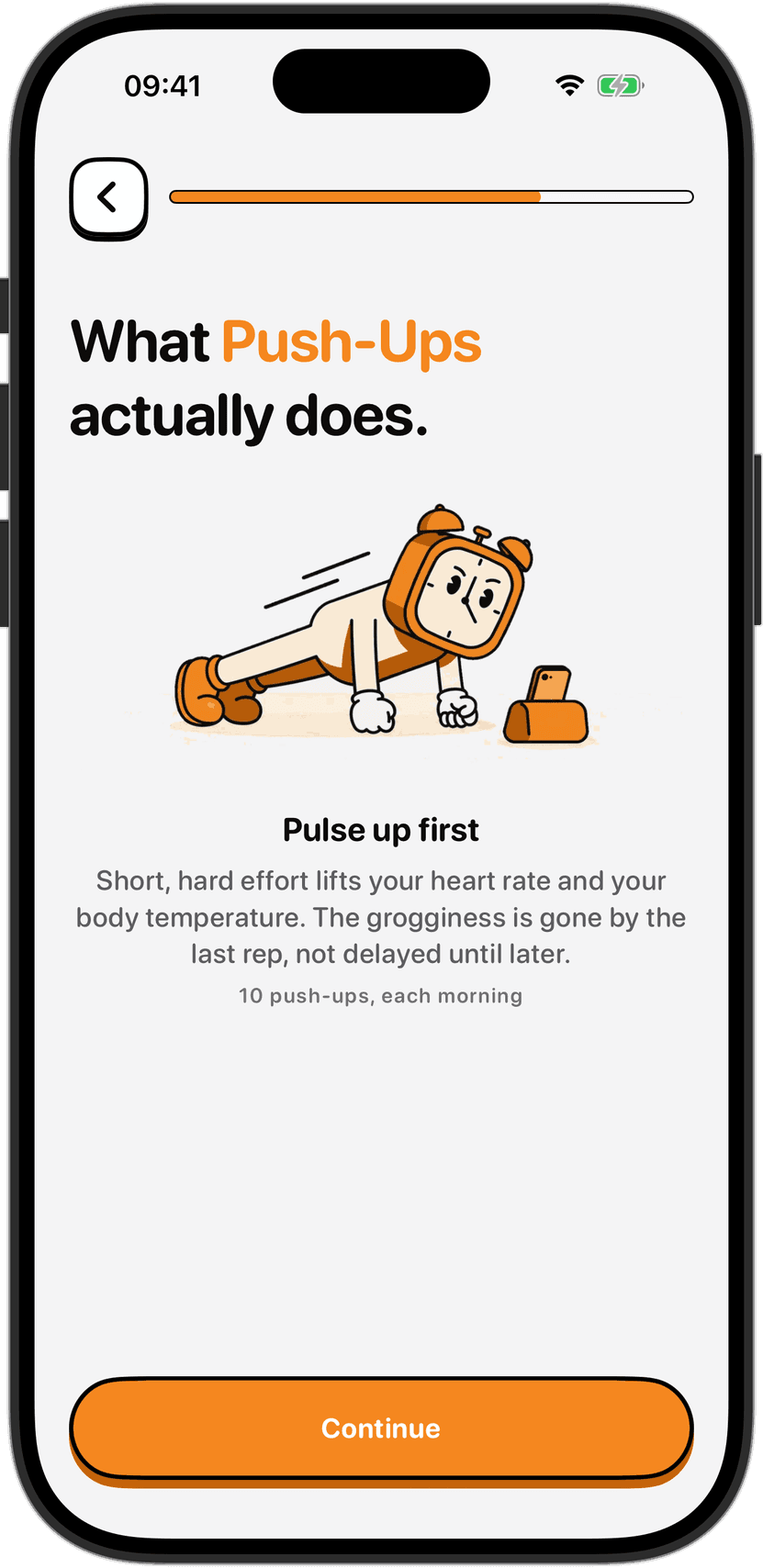
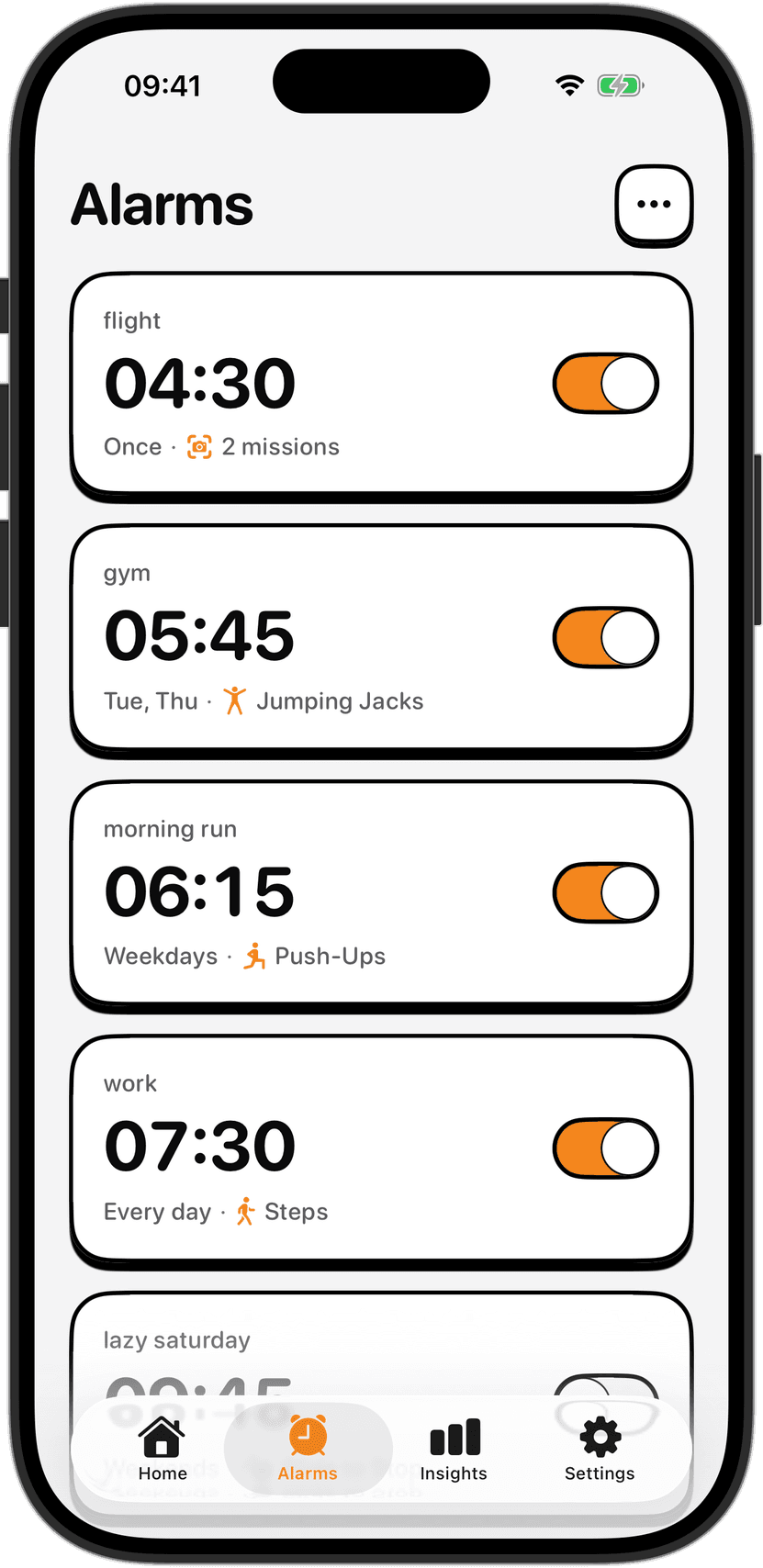
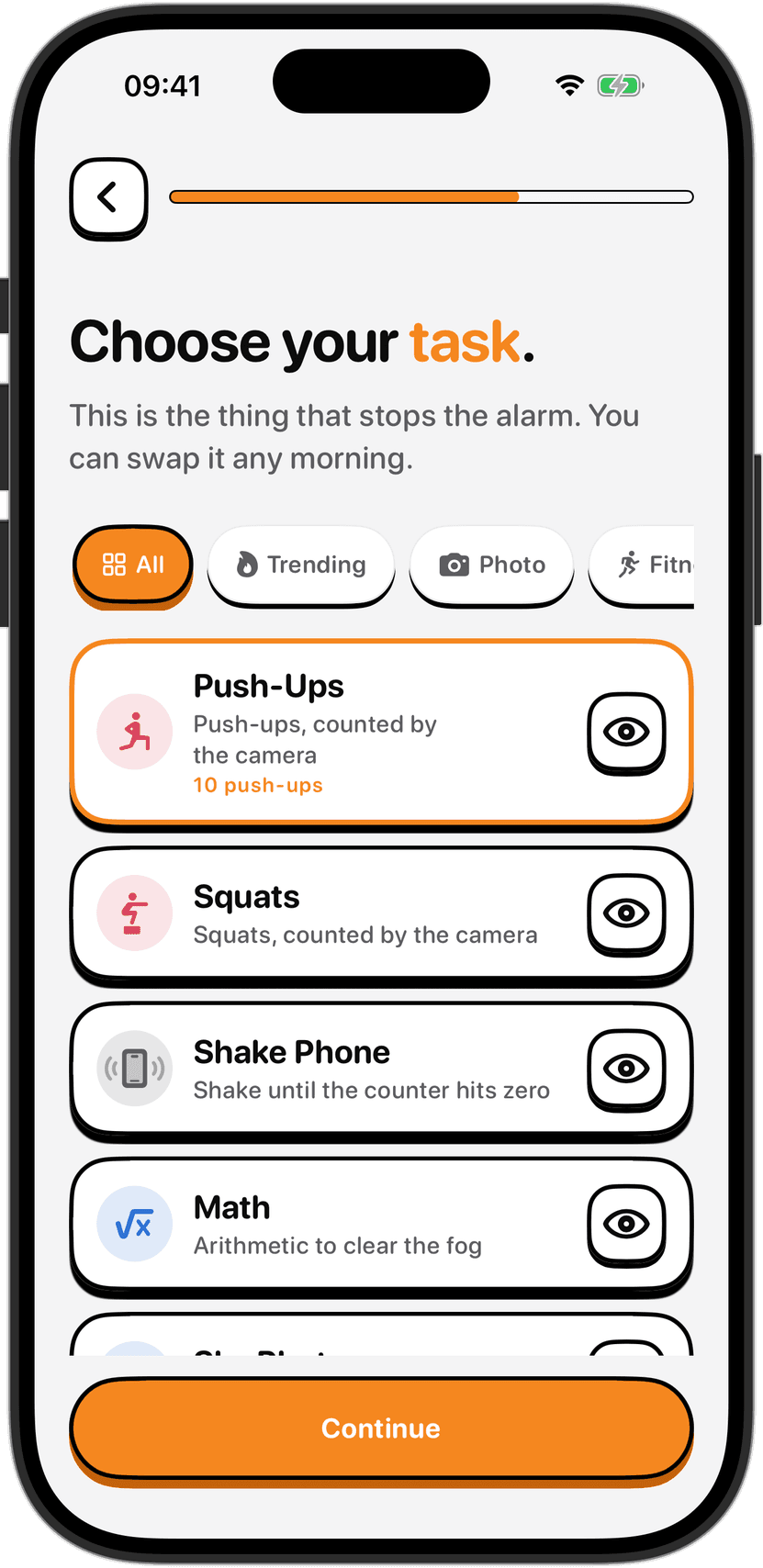
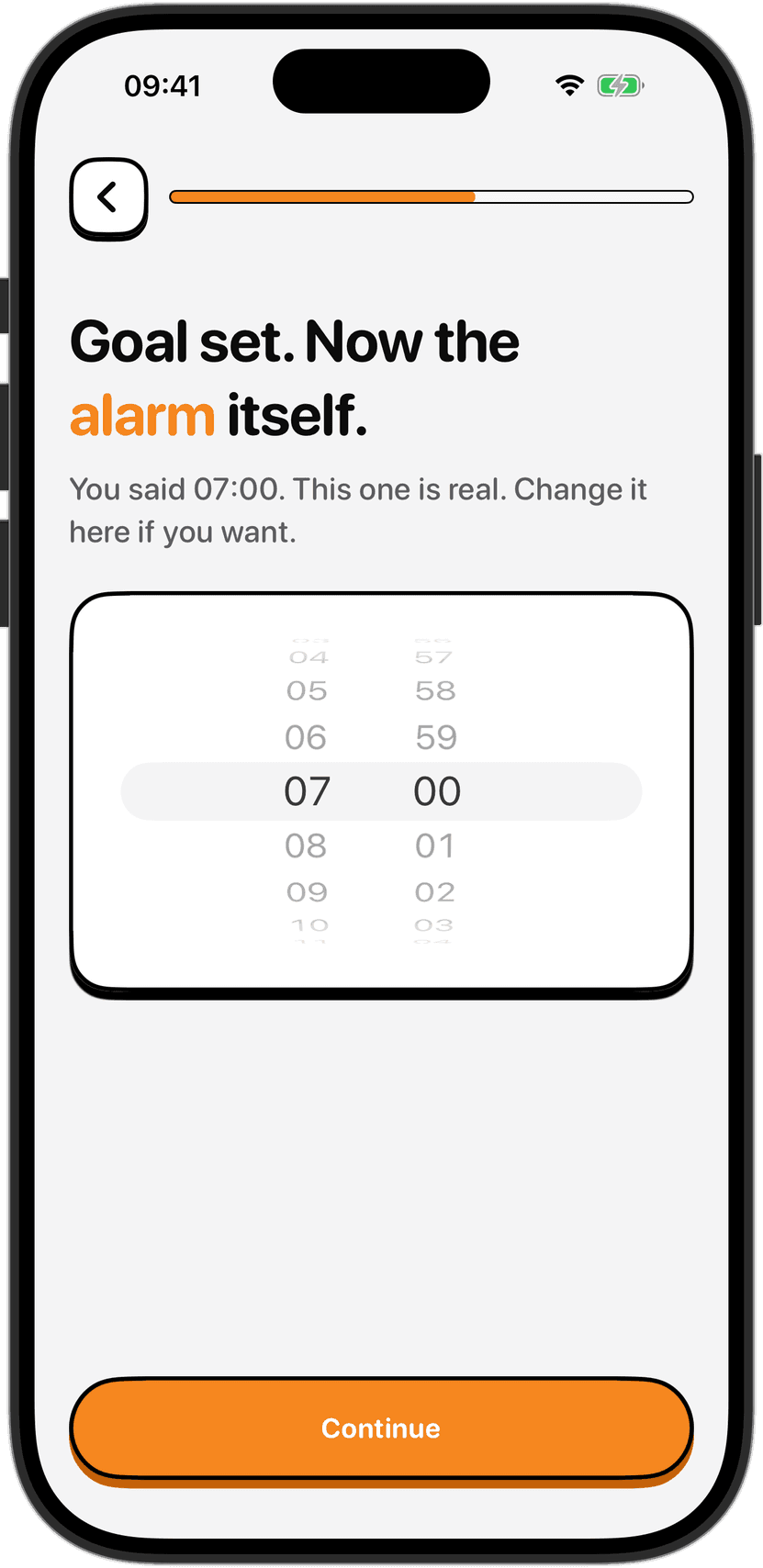
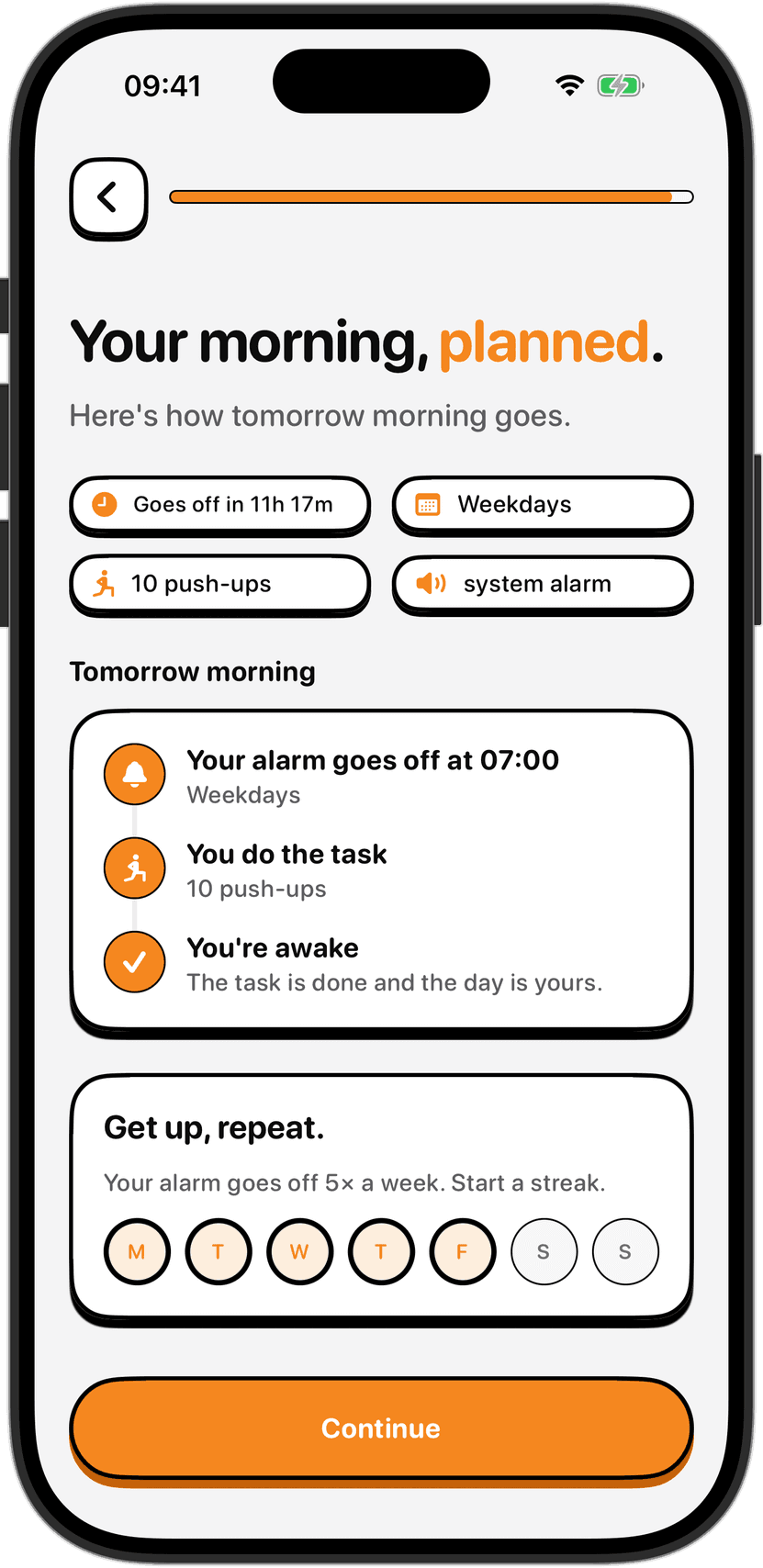
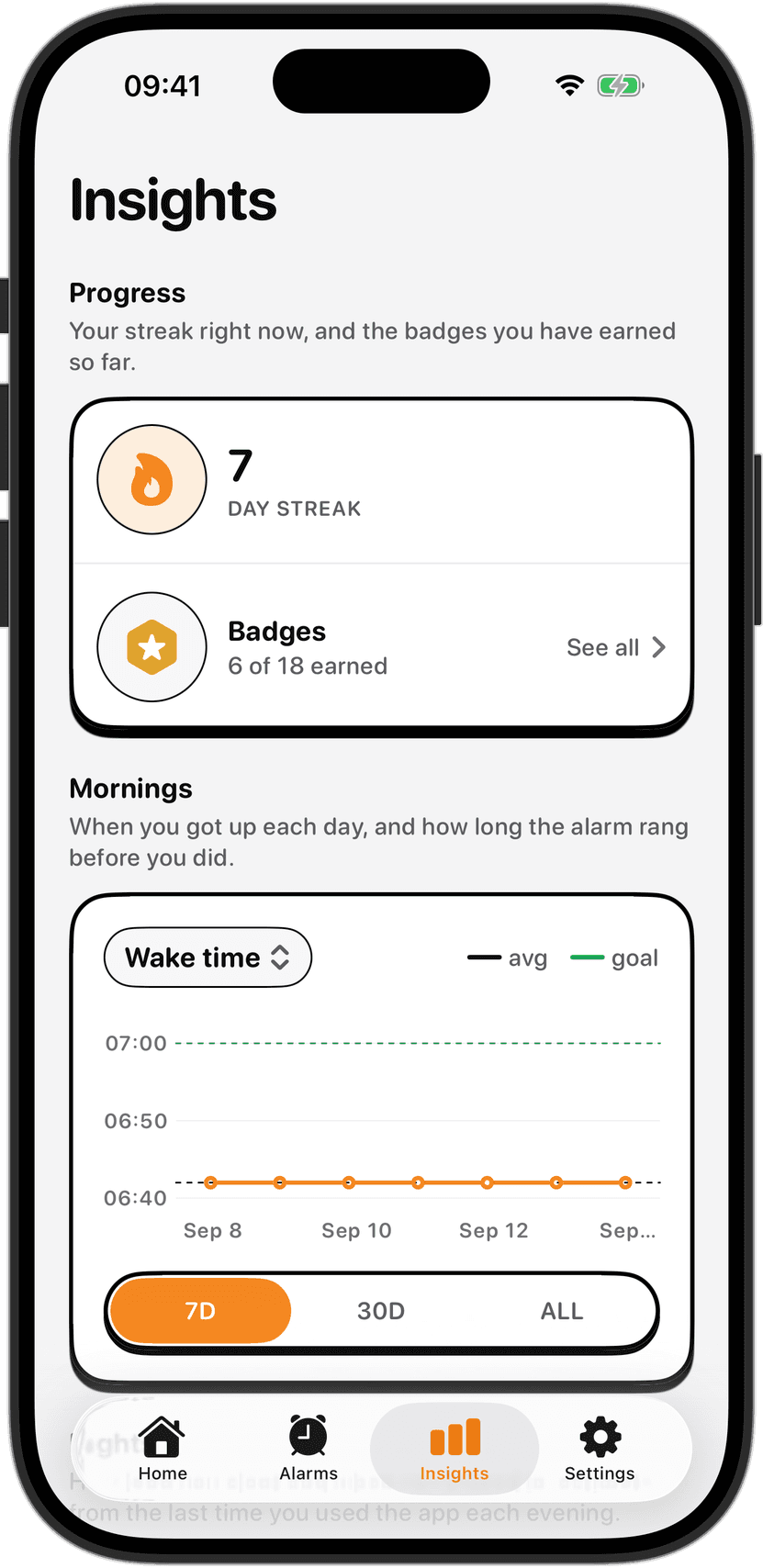
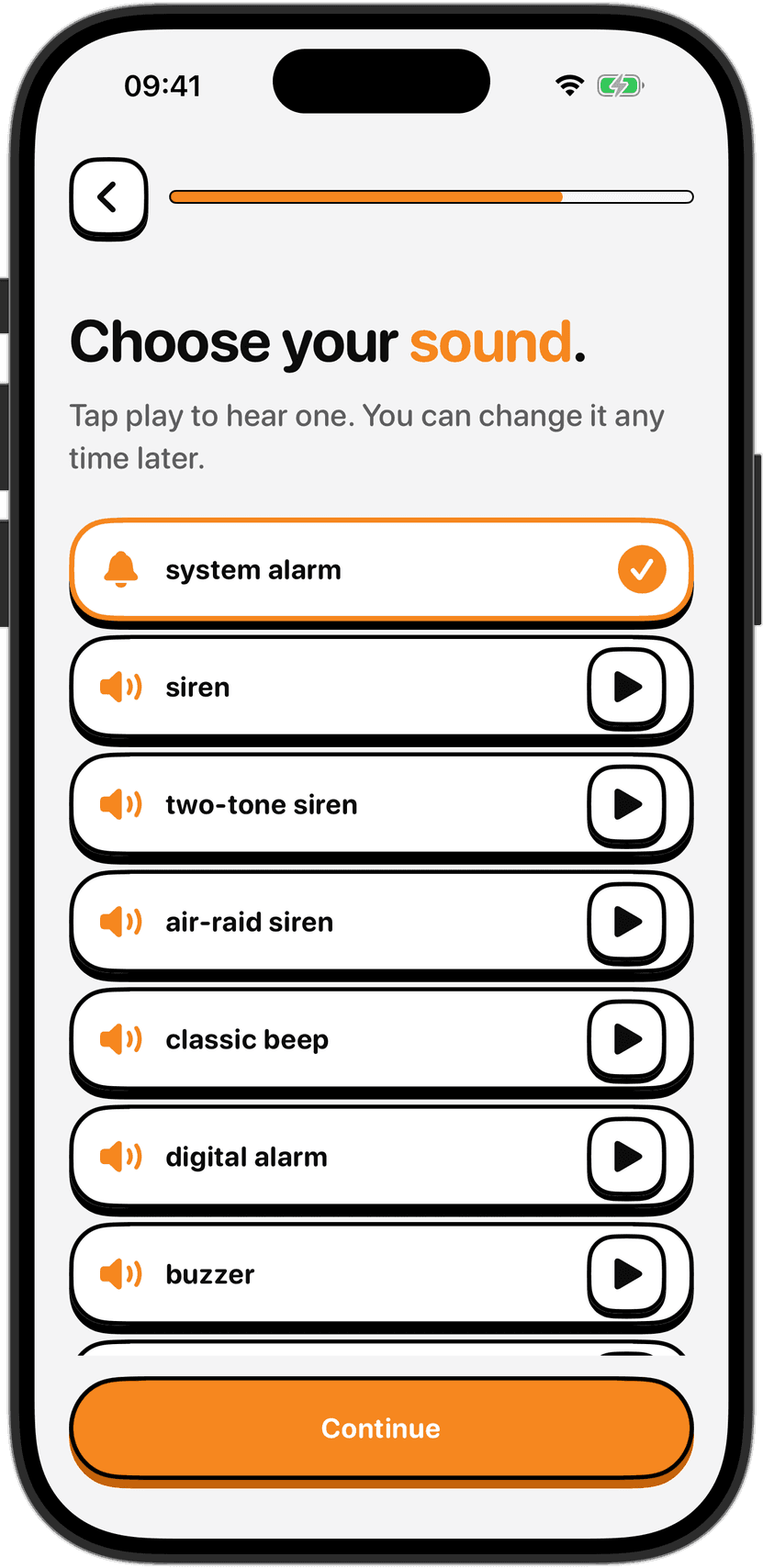
NoNap, an iPhone alarm app from Visana Studios, is built on AlarmKit: one alarm, no snooze button, using the same system alarm the Clock app relies on, so the Ring/Silent switch and Focus modes don't touch it. Stopping it means finishing a wake task chosen the night before, push-ups or squats counted by the camera, shaking the phone, a math problem, a photo, or getting out of bed. Skip the push-ups or squats if that kind of movement isn't safe for you first thing in the morning; the other tasks work just as well. See the full list on the features page. This is a fairly direct descendant of Levi Hutchins' 4 a.m. bell: still just one alarm, still no negotiating once it starts.
None of this means the alarm clock is a solved problem. Nearly 250 years after Hutchins built himself a bell that rang at 4 a.m., the actual challenge, getting a groggy brain to act on a decision it made the night before, hasn't changed much at all. What's changed is who or what does the waking: a person with a stick and a pocketful of peas, a spring-loaded bell, a radio, a phone in your hand, and now a piece of code that Apple trusts as much as its own Clock app.
Sources
Wikipedia. Levi Hutchins. Accessed August 2026. en.wikipedia.org/wiki/Levi_Hutchins
Wikipedia. Alarm clock. Accessed August 2026. en.wikipedia.org/wiki/Alarm_clock
Wikipedia. Knocker-up. Accessed August 2026. en.wikipedia.org/wiki/Knocker-up
Wikipedia. Mary Smith (knocker upper). Accessed August 2026. en.wikipedia.org/wiki/Mary_Smith_(knocker_upper)
US Patent 183725. Seth E. Thomas, Improvement in Clock-Cases. Granted October 24, 1876. patents.google.com/patent/US183725A/en
TIME. Clock Radio. All-TIME 100 Gadgets. content.time.com/time/specials/packages/article/0,28804,2023689_2026093_2023751,00.html
Kennan, Jay. 7H241 The Snooz-Alarm. Telechron.net, Escapements of Distinction, accessed August 2026. telechron.net/eod/7h241.htm
SlashGear. Why Is Snooze 9 Minutes? Everyone's Been Getting It Wrong, And Here's Why. slashgear.com/1845969/why-alarm-clock-snooze-nine-minutes/
General Lew Wallace Study and Museum. Lew and the Snooze Button. ben-hur.com/lew-and-the-snooze-button/
MacRumors. iOS 26 Makes Third-Party Alarm and Timer Apps Better. June 11, 2025. macrumors.com/2025/06/11/ios-26-third-party-alarm-apps/
Apple Developer. Wake up to the AlarmKit API. WWDC25 session video. developer.apple.com/videos/play/wwdc2025/230/
Image credits
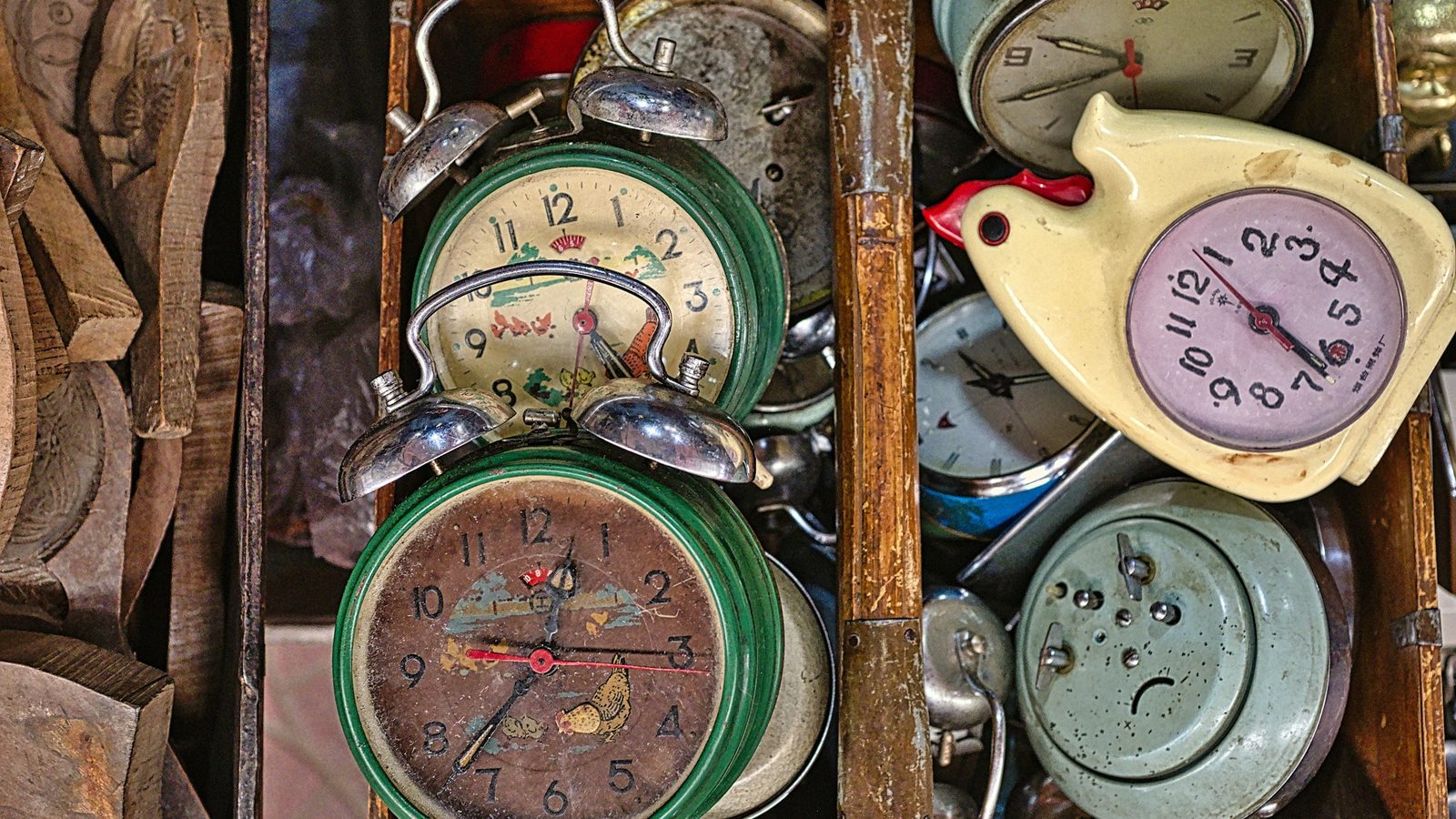
Cover photo of a crate of vintage twin-bell alarm clocks at an antique market by Eric Prouzet on Unsplash (unsplash.com/photos/clock-lot-WTteoDYo4do), used under the Unsplash License, which permits commercial use without attribution. The travel alarm clock photo, made by Christian Ehregott Weisse of Dresden around 1785 and photographed on display at the Mathematisch-Physikalischer Salon in Dresden, is dedicated to the public domain under CC0 1.0 by its photographer, via Wikimedia Commons (commons.wikimedia.org/wiki/File:Travel_alarm_clock,_Christian_Ehregott_Weisse,_Dresden,_c.1785-_Mathematisch-Physikalischer_Salon,Dresden-_DSC07958.JPG).