How to Stop Hitting Snooze for Good
Practical steps to stop hitting the snooze button, from moving your alarm across the room to picking one wake task, backed by sleep and habit research.
Visana Studios
5 min read
Most people who snooze do not have a discipline problem. They have a system that makes hitting snooze the easiest possible choice at the worst possible moment. Fix the system and the habit mostly takes care of itself.
Why snoozing wins by default
The first minutes after an alarm are handled by a brain that is still partly asleep. Reaction time is slow, judgment is worse than usual, and the part of the brain that weighs consequences comes back online later than the part that just wants the noise to stop. Snoozing needs one motion in the dark. Getting up needs a decision, and decisions are exactly what a half-awake brain is bad at. We covered the mechanics of that gap, called sleep inertia, in an earlier piece on the snooze button.
None of this means one snoozed morning ruins your day. Tina Sundelin, Shane Landry and John Axelsson surveyed 1,732 adults and then brought 31 habitual snoozers into a sleep lab for two mornings each. On the morning they were allowed thirty minutes of snoozing, they lost only a little actual sleep, nobody was pulled out of deep sleep by the extra alarms, and mood, sleepiness and cortisol the next hour looked about the same as the morning they got up immediately. On a couple of cognitive tests the snoozers even did slightly better. So the occasional snoozed morning is not the enemy here.
The habit is. Twenty-two minutes a day, which was the average snooze time in that same study, adds up to more than two and a half hours a week spent neither asleep nor properly awake. Worse, an alarm you can dismiss without consequence teaches your brain that the first alarm, and often the second, is optional. That is how six alarms happen. Nobody sets six alarms on purpose. They arrive one at a time, each one a patch for the last one failing.
Take the decision away from 6am you
You cannot out-willpower a groggy brain at the exact moment it is worst equipped to resist. What works instead is deciding the outcome the night before, when your judgment is intact, and building the morning so there is nothing left to negotiate.
Psychologists call this an implementation intention: a specific if-then plan made in advance, rather than a vague goal. Peter Gollwitzer's research on the technique, later pooled across 94 studies with more than 8,000 people by Gollwitzer and Paschal Sheeran, found that people who made a concrete plan ("when my alarm goes off, I put both feet on the floor before I touch the phone") followed through noticeably more often than people who just intended to get up earlier. The plan does the thinking that your groggy morning self cannot be trusted to do.
The most reliable version of this plan is physical: put the phone or alarm clock somewhere you cannot reach from bed. Across the room, on a shelf, plugged in far from the pillow. If turning it off requires standing up, you have already done the hardest part of getting up before you are fully aware you are doing it.
Give yourself one job instead of one choice
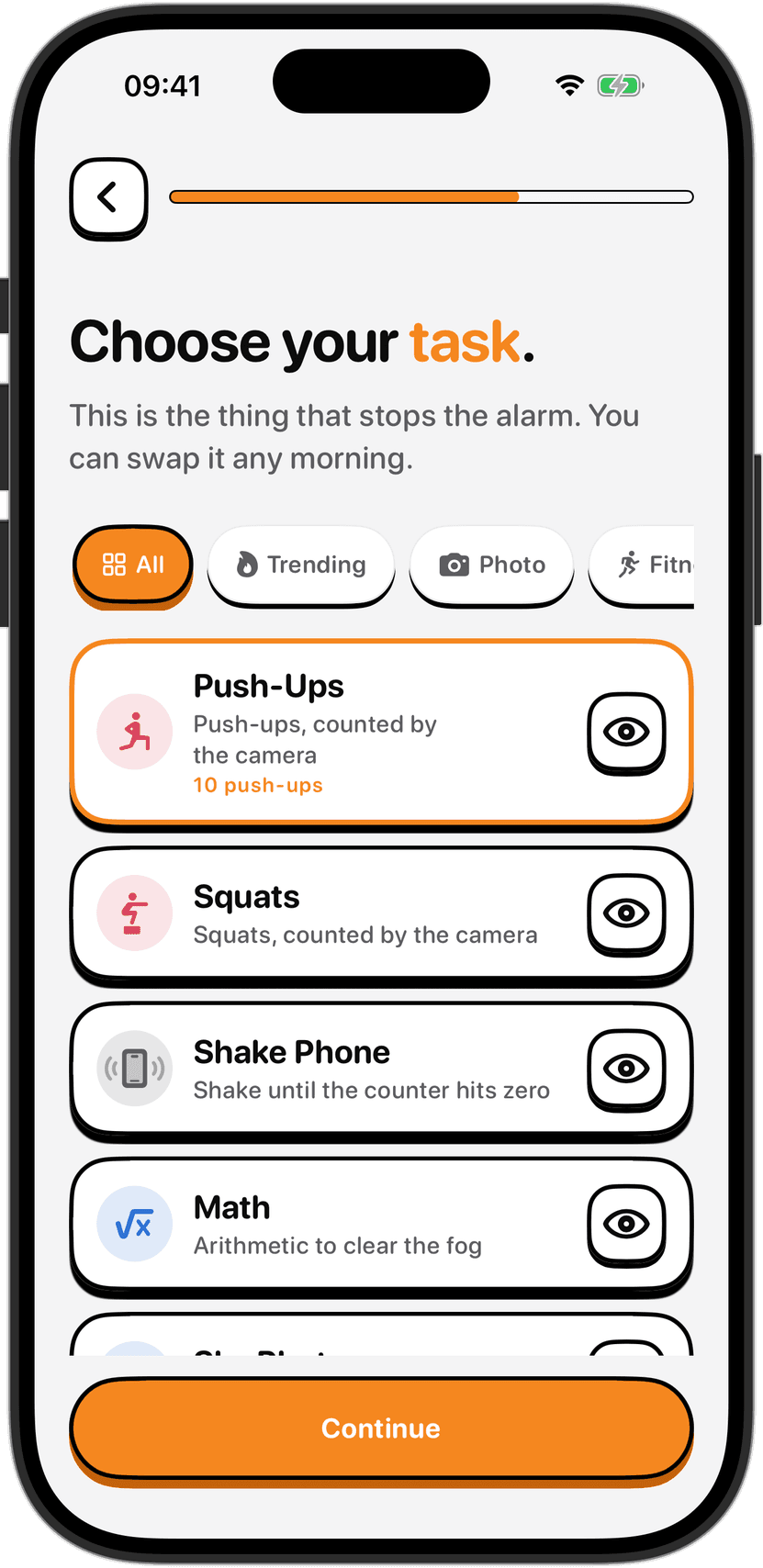
A groggy brain handles a single, simple instruction far better than an open decision. This is the idea behind wake tasks: instead of a phone screen offering "snooze" or "dismiss," you get one thing to actually finish, and the alarm keeps going until you do.
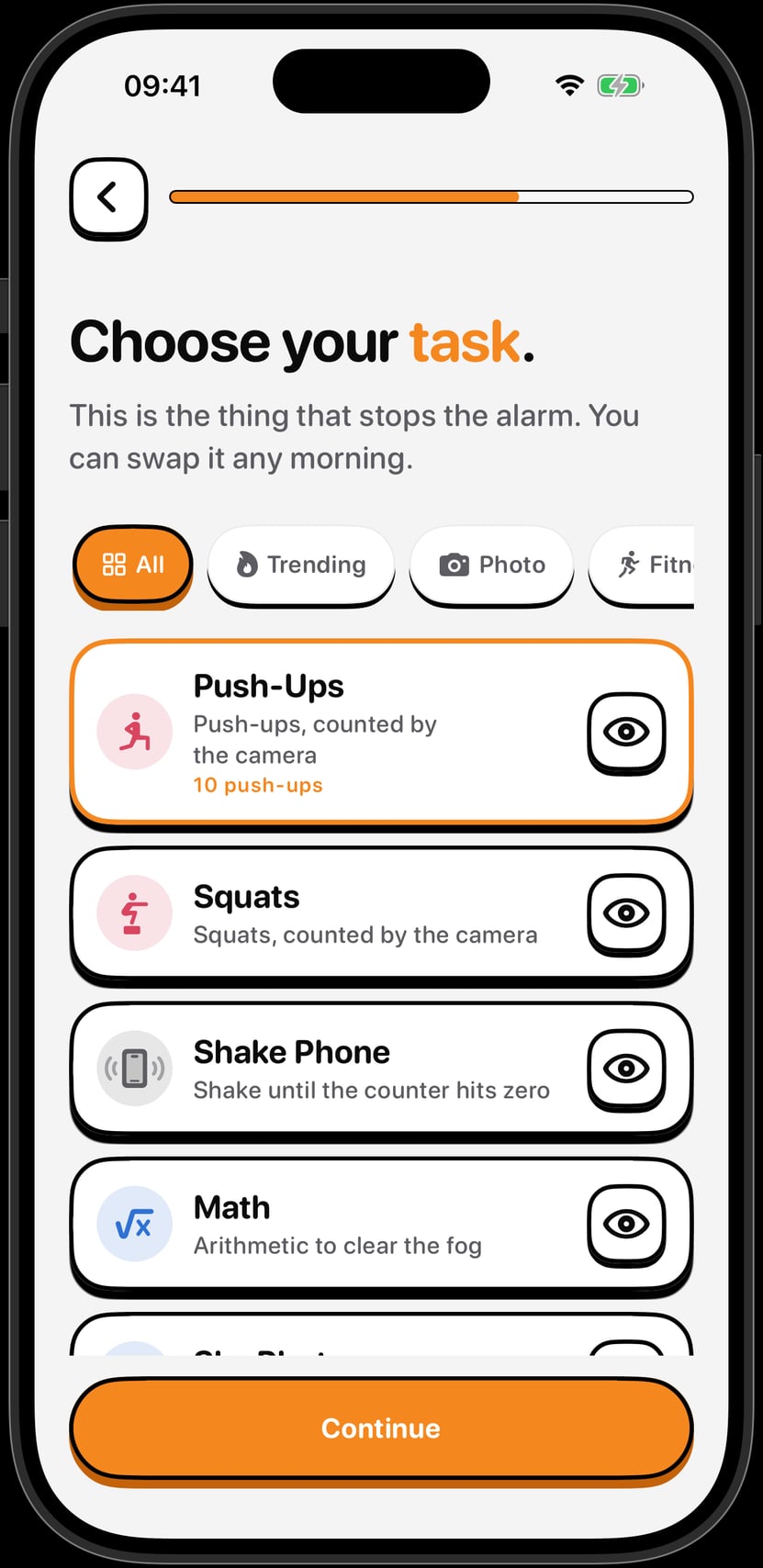
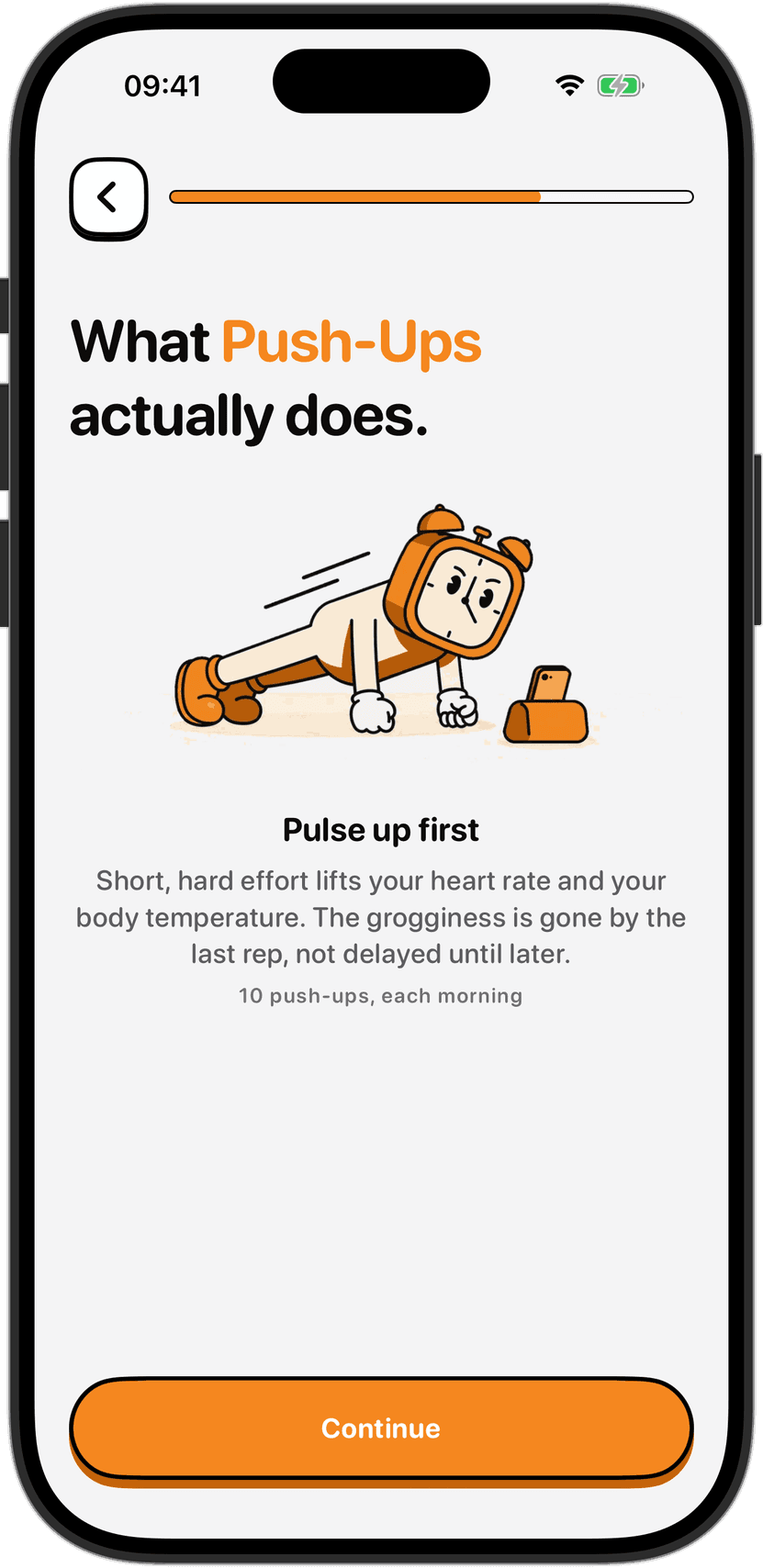
Pick something that matches your mornings rather than your ambitions. A few push-ups or squats work well because short, hard effort raises your heart rate and body temperature, both of which climb naturally as your alertness comes up over the following hour. If movement is off the table, a math problem forces enough attention that going back to sleep mid-problem is hard. The point is not the specific task. It is that there is exactly one thing to do, decided in advance, with no button that quietly makes the problem go away for nine more minutes.
Whatever you choose, keep only one alarm at that one task. A backup alarm five minutes later just rebuilds the stack you are trying to get rid of.
Anchor everything to one wake time
CDC guidance on sleep aimed at shift workers and people under heavy schedule pressure puts it plainly: go to bed and get up at about the same times every day, including your days off. A wake time that moves by two hours between Tuesday and Saturday keeps your body clock permanently unsettled, and an unsettled body clock is groggier at every single alarm, which makes snoozing more tempting on more mornings, not fewer.
Pick a wake time you can actually hold, not the one you wish were true. A target that assumes a perfect night, every night, will fail on the first bad one, and a single failure is often enough to talk yourself out of the whole plan. The same CDC guidance also points at two things that make the target easier to hit: some exercise during the day, even a short walk, and bright light exposure, ideally outdoors and in the morning. Both push your circadian rhythm toward being alert earlier, so the wake time you picked stops feeling like a fight every day.
Expect it to take longer than a week
Phillippa Lally and colleagues at UCL tracked 96 people trying to build a daily habit over twelve weeks and found the median time to reach automatic, no-longer-a-struggle behavior was 66 days, with a huge range from 18 days to well over half a year depending on the person and the habit. Getting up on the first alarm is not an exception to that. Expect several weeks of it still feeling effortful, and do not read a rough Tuesday as proof the plan failed. The plan is failing only if you go back to the phone on the nightstand and the second alarm five minutes later.
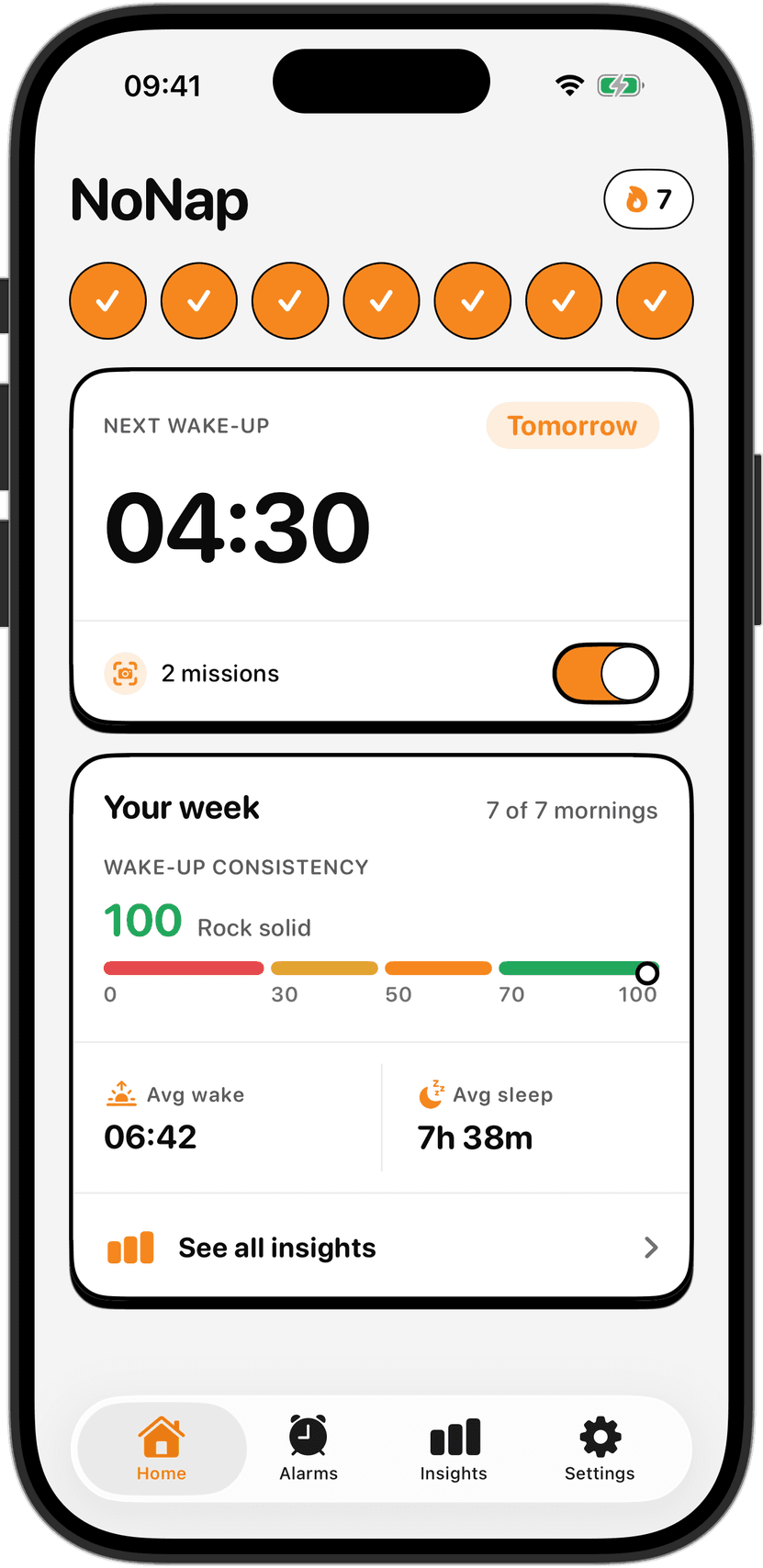
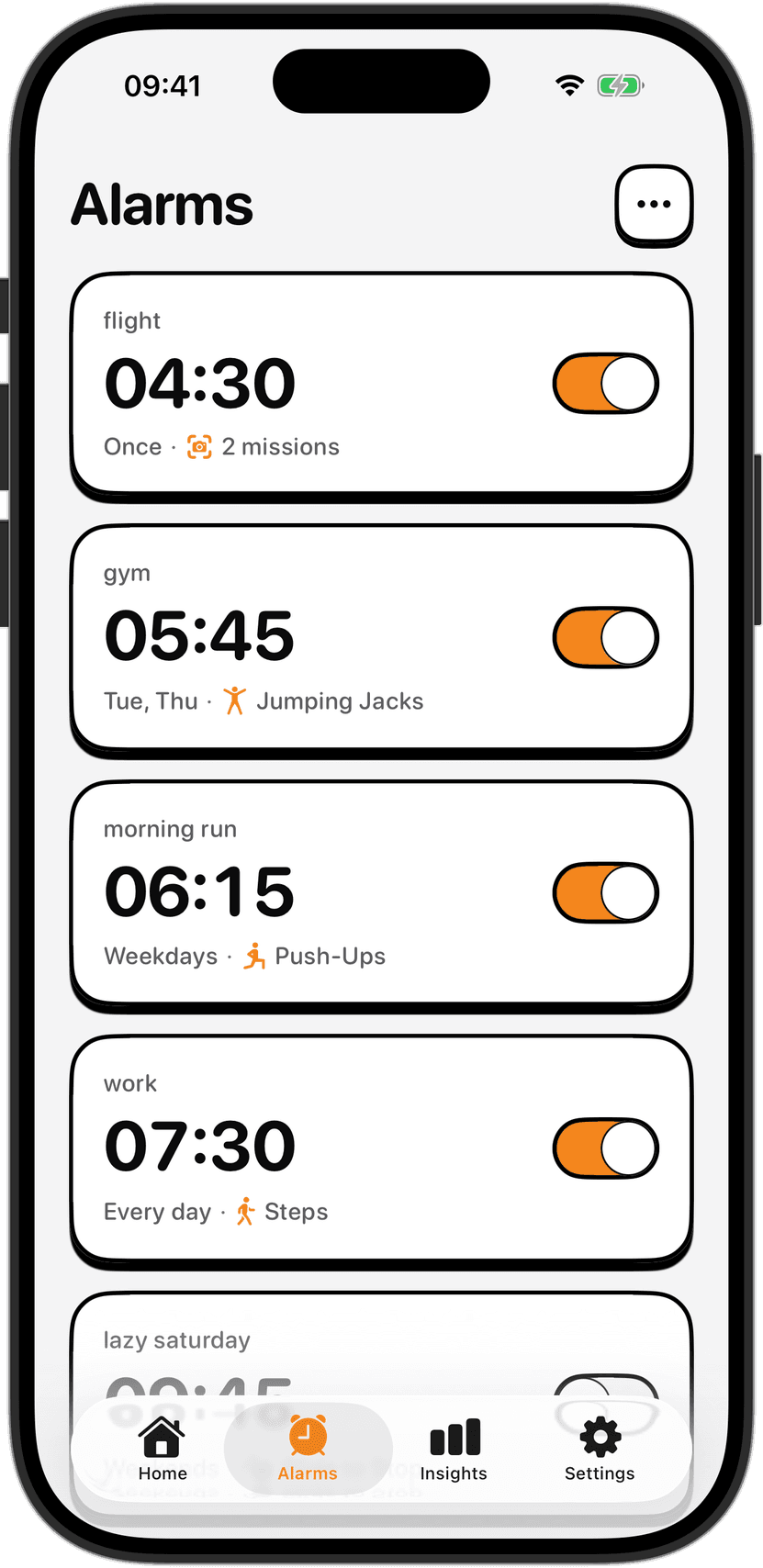
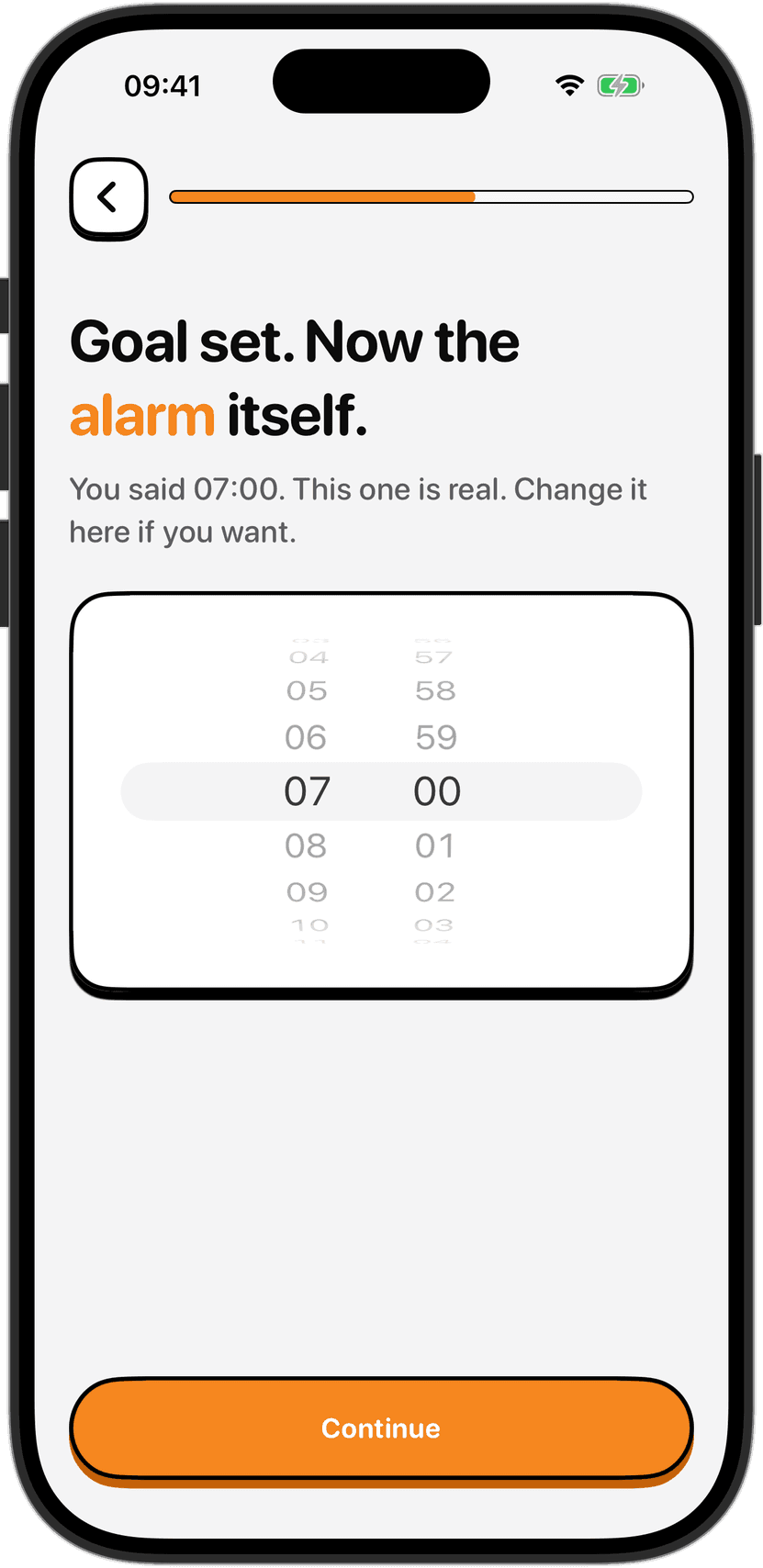
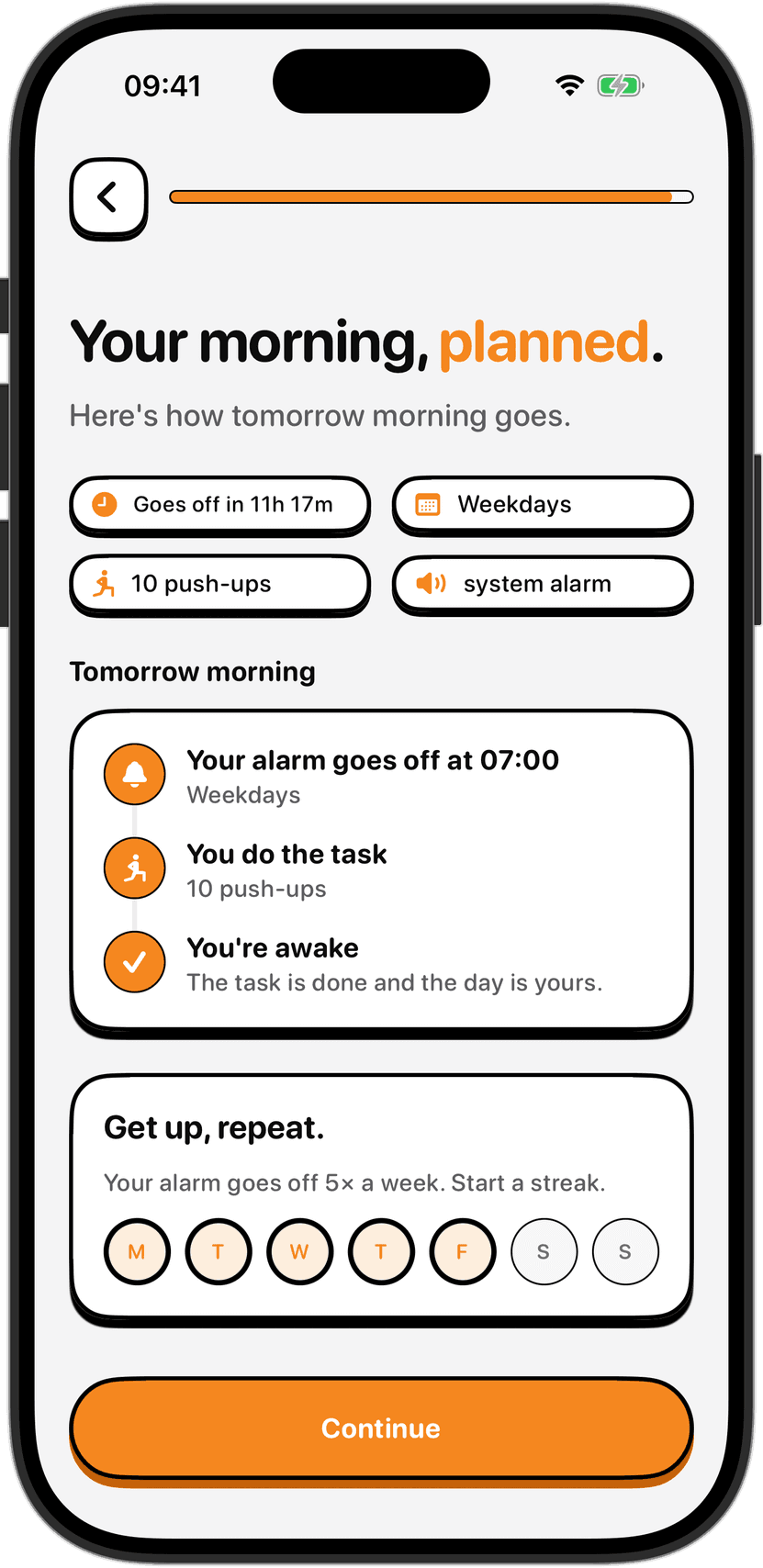
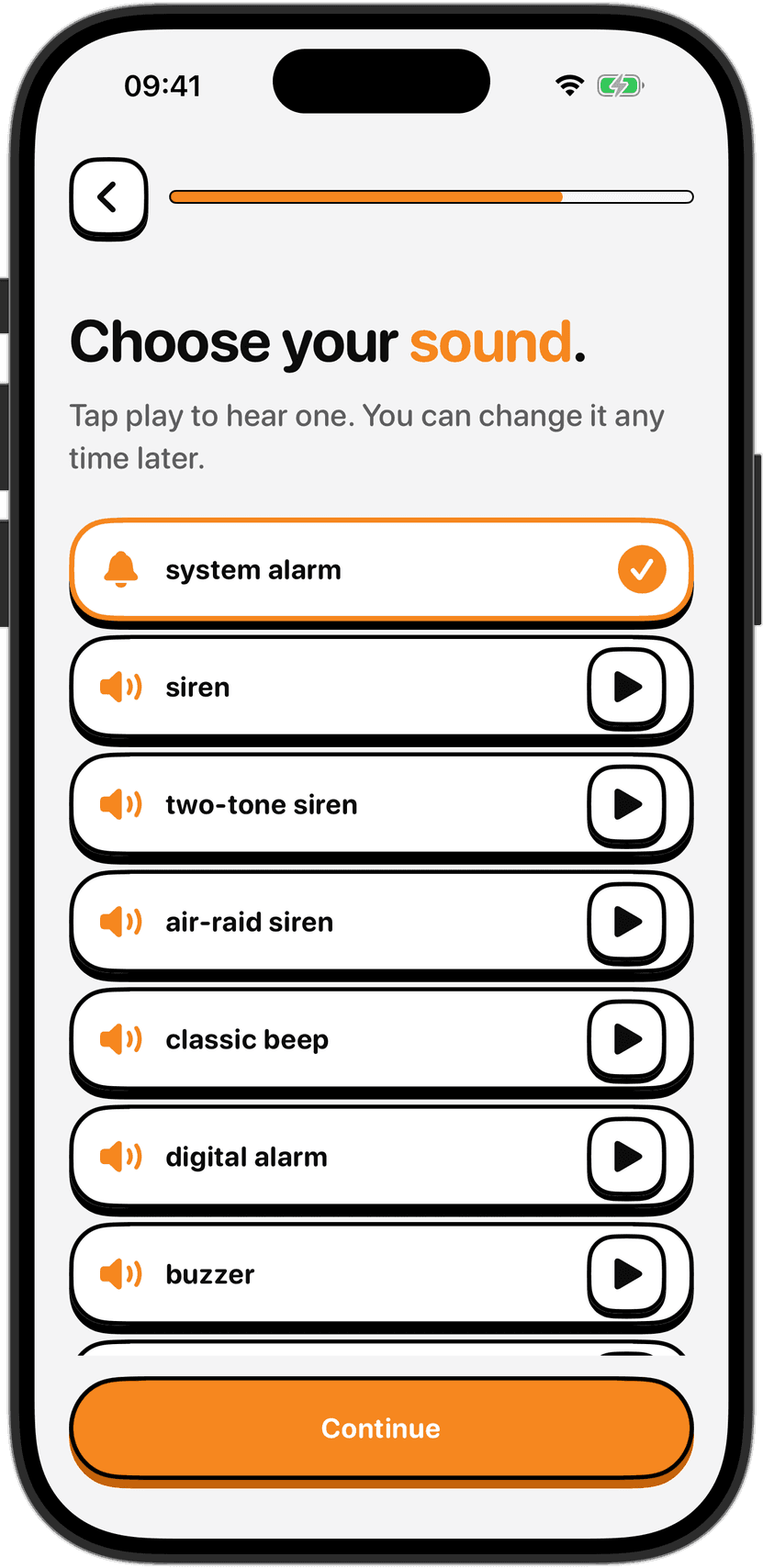
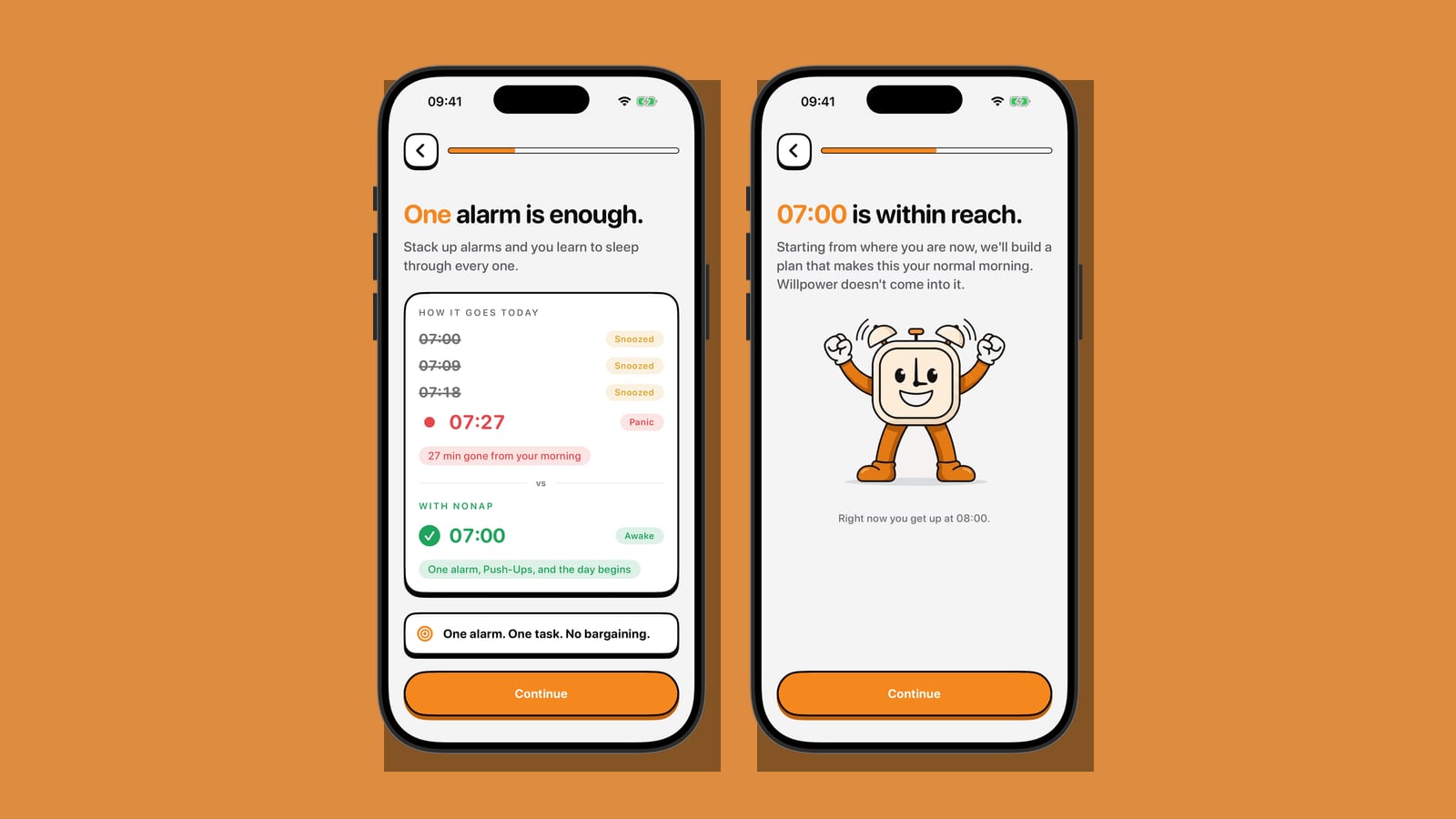
NoNap exists for people who would rather remove the negotiation than keep having it. One alarm, one task chosen the night before, and it rings through silent mode and Focus so there is no quiet way around it. It will not fix a bad night's sleep, but it can make sure the decision about getting up was already made when you were thinking clearly.
Sources
Sundelin, T., Landry, S., and Axelsson, J. (2023). Is snoozing losing? Why intermittent morning alarms are used and how they affect sleep, cognition, cortisol, and mood. Journal of Sleep Research. https://doi.org/10.1111/jsr.14054
Gollwitzer, P. M., and Sheeran, P. (2006). Implementation intentions and goal achievement: a meta-analysis of effects and processes. Advances in Experimental Social Psychology, 38, 69-119.
CDC, National Institute for Occupational Safety and Health (2020). Improve Sleep: Tips to Improve Your Sleep When Times Are Tough. NIOSH Science Bulletin. https://www.cdc.gov/niosh/bulletin/2020/sleep.html
Lally, P., van Jaarsveld, C. H. M., Potts, H. W. W., and Wardle, J. (2010). How are habits formed: modelling habit formation in the real world. European Journal of Social Psychology, 40(6), 998-1009.