Does lack of sleep raise your blood sugar?
Two lab studies found that short nights blunt how the body handles glucose and insulin, even in healthy adults. Here is what they measured and where they stop.
Visana Studios
4 min read
In controlled studies, short nights make the body handle sugar less well. The effect is real, but the evidence is narrower than many headlines suggest. Two studies carry most of the weight. One followed young men through six nights of four hours' sleep. The other measured what changed after a single restricted night in healthy adults.
The 1999 study on four-hour nights
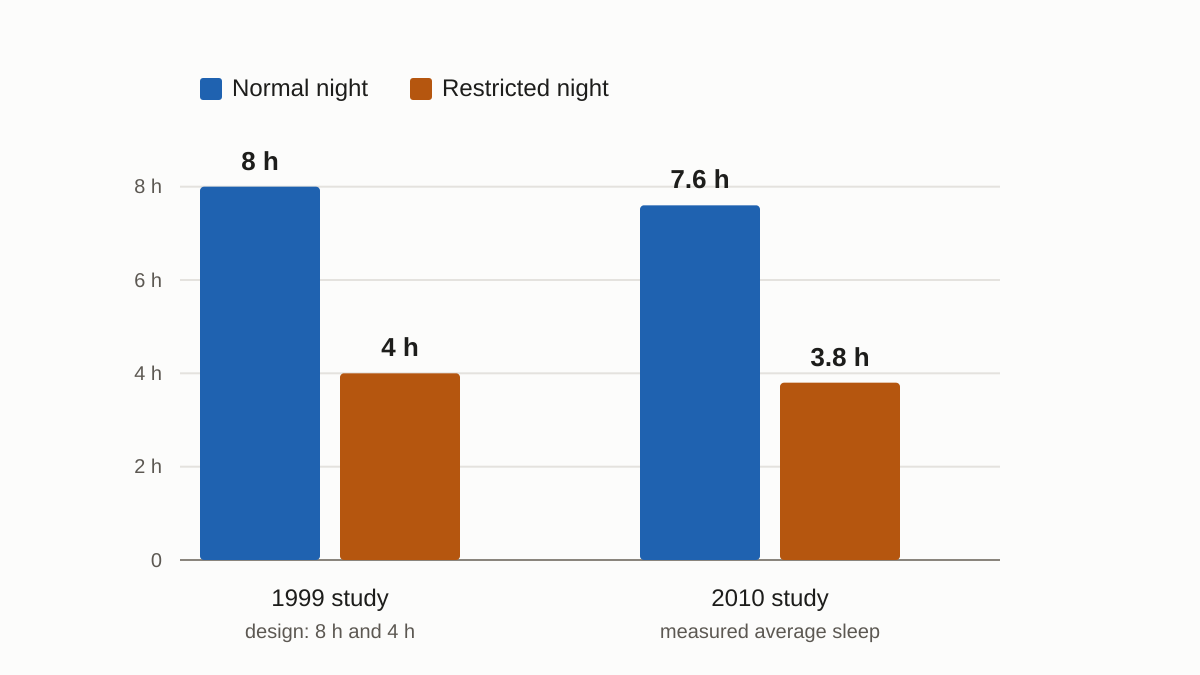
Spiegel and colleagues at the University of Chicago recruited 11 healthy young men. For three nights they were allowed eight hours in bed, from 11 p.m. to 7 a.m. For the next six nights, the window shrank to four hours, from 1 a.m. to 5 a.m.
The results were striking. After the short nights, the men took about 40 percent longer than usual to bring their blood sugar back under control after a high-carbohydrate meal. Their ability to secrete insulin, and to respond to it, fell by roughly 30 percent. Those figures are the ones the university reported about the work, so treat them as the study's headline numbers rather than the full picture.
Eleven men is a small group, and all of them were young. Still, the comparison was made within the same people, which makes the change easier to read than it would be in a survey of different sleepers.
One restricted night is enough to show up
A 2010 study asked how quickly the change appears. Donga and colleagues tested nine healthy adults, five men and four women, on two separate nights. On one night, sleep was allowed from 11 p.m. to 7:30 a.m. On the other, it was allowed from 1 a.m. to 5 a.m. Actual sleep averaged 454 minutes after the normal night and 226 minutes after the restricted one.
The team measured insulin sensitivity with an insulin clamp, a laboratory method that tracks how quickly the body clears glucose from the blood while insulin is held at a set level. After the short night, the rate of glucose clearance fell from 40.7 to 32.5 in the study's units. Glucose output from the liver also rose, from 3.6 to 4.4.
The authors describe this as insulin resistance in several metabolic pathways, the liver included, after a single night. Insulin resistance means the same amount of insulin does less work. In these nine people, one short night was enough to shift it.
What the studies cannot tell you
Both studies are small. The first had 11 men and the second had nine people, and in both the researchers set the sleep times rather than letting people sleep as they normally would. Neither tested people with diabetes. The 2010 authors suggest the results may matter for blood sugar control in people with type 1 and type 2 diabetes, but that is a suggestion, not a finding.
The bigger gap is time. Neither study asks whether years of short sleep change long-term blood sugar or diabetes risk. That is a different question, and these two papers do not answer it.
A short night in a lab is not a diagnosis of anything, and nothing here should change a medication or a treatment plan. If you have diabetes, or symptoms such as constant thirst or frequent urination, see a doctor rather than adjusting your sleep alone.
What this means for a normal week
The practical reading is modest. A night of short sleep has a measurable effect on how the body handles sugar, even in healthy adults, and that effect appeared within a single night in one study. That is reason enough to treat the sleep you protect each night as more than a matter of feeling rested.
If short nights keep coming, the schedule is the thing to look at first. For the morning side of the same problem, the post on how one bad night of sleep ruins your next morning covers alertness and reaction time.
NoNap is an alarm app for iPhone. It asks you to finish a wake task you chose, such as push-ups counted by the camera, so the morning does not start with a tap on snooze. It does not track sleep, and it cannot measure blood sugar or anything else about your body. What it can do is hold your wake time steady from one morning to the next, which is the part of sleep an alarm actually controls.
Sources
Spiegel K, Leproult R, Van Cauter E. Impact of sleep debt on metabolic and endocrine function. Lancet. 1999;354:1435-1439. doi:10.1016/S0140-6736(99)01376-8. The design and figures in this post are taken from the University of Chicago Medicine's 1999 account of the study: https://www.uchicagomedicine.org/forefront/news/1999/october/lack-of-sleep-alters-hormones-metabolism-simulates-effects-of-aging
Donga E, et al. A single night of partial sleep deprivation induces insulin resistance in multiple metabolic pathways in healthy subjects. J Clin Endocrinol Metab. 2010;95(6):2963-2968. doi:10.1210/jc.2009-2430. Sample size, sleep durations, glucose disposal, hepatic glucose output and the authors' conclusions are taken from the journal page: https://academic.oup.com/jcem/article/95/6/2963/2598601
Image credits: The cover uses two of NoNap's own app screenshots, and the chart was made for this post from the sleep durations reported in the two studies.