One alarm beats multiple snooze cycles: why your backup alarms backfire
Stacking alarms trains your brain to ignore them all. Here is what the sleep science shows about why one consistent alarm works better.
Visana Studios
6 min read

You set your alarm for 07:00. You also set one for 07:09 just in case, then 07:18, 07:27, and 07:36. By the time the last one goes off you have been ignoring alarms for 36 minutes. Your brain, by then, has learned to treat every alarm sound as a signal to stay in bed. That is the problem: multiple alarms do not make you more likely to wake up. They train your brain to sleep through them.
Why your brain learns to ignore repeated warnings
Habituation is the brain's way of filtering noise. When a stimulus repeats without meaningful consequence, the nervous system stops responding to it. Researchers call it "stimulus habituation" or "sensory adaptation". The classic example is a hat sitting on your head all day: you stop noticing it.
An alarm is a stimulus. The first time it sounds, your brain treats it as urgent. The ninth time it sounds in a row and you roll over to snooze, your brain learns something different: this sound can be ignored without harm. Each snooze reinforces that learning. By the fifth alarm, waking up feels optional.
This is not laziness or weak willpower. It is automatic learning. The brain's response to repeated, consequence-free stimuli is involuntary.
A study of 30 young adults at Michigan State University found that snoozers took longer to suppress a tone after hearing it repeatedly compared to those who woke up on the first alarm. That lingering grogginess is partly habituation: your nervous system has already begun the process of tuning the sound out. Hit snooze once, and you are working against your own brain's noise-cancelling response.
The circadian anchor: why one consistent time matters
Your body has a 24-hour internal clock called the circadian rhythm. It runs on multiple signals: light exposure, meal times, and activity. But the strongest signal to your body clock is your wake time.
Sleep researchers refer to wake time as a "zeitgeber", or time-giver. A fixed wake time is such a powerful signal that it can override other circadian cues. In sleep chronotherapy (a clinical treatment for circadian disorders), clinicians use one thing to reset a person's entire schedule: a consistent wake time.
Multiple alarms at different times send a confused signal to your body clock. Is 07:00 wake time, or 07:36? The inconsistency destabilizes the circadian rhythm. Your sleep schedule, your evening alertness, even your hunger times depend on a clear signal. A fixed wake time, the same every day (including weekends, as much as possible), teaches your body what to expect.
One alarm at 07:00, every single day, is a much stronger signal than five alarms spread across 36 minutes. Your body learns faster. Your sleep-wake cycle stabilizes. And once the circadian rhythm is stable, falling asleep on schedule and waking naturally become easier.
Multiple alarms mean multiple failures
Here is what actually happens when you rely on a stack of alarms: the first one goes off and you snooze or ignore it. You tell yourself the next one will be different, but your behavior has just told your nervous system something important. The sound was not urgent. You survived another 9 minutes of sleep. The second alarm sounds and the same thing happens. By the fifth alarm you are more asleep than awake, and the likelihood that you actually wake up to it is lower, not higher.
This is called "alarm fatigue" in safety research. When alarms are frequent and often false, people stop responding to them accurately. Hospital studies show that nurses exposed to multiple frequent alarms for different systems learn to ignore them. The same principle applies to your bedroom. More alarms do not add safety; they dilute it.
One alarm forces a different dynamic. When there is only one alarm, you cannot negotiate with the morning. Snoozing is not an option (or you turn it off completely). Your nervous system learns that this sound means wake up now, not wake up eventually. That clarity is what makes one alarm effective.
How a fixed wake time changes your sleep
People who wake at the same time every day fall asleep more easily at night. This is not coincidence. The circadian rhythm is bidirectional. A fixed wake time tells your body when to expect sleep to start.
One study in the journal Sleep found that people with consistent wake times had better sleep efficiency and fewer mid-sleep awakenings than people with variable wake times, even when total sleep time was the same. The sleep was more consolidated, more restful, and the person felt less groggy in the morning.
That effect builds over days and weeks. A single morning of one consistent alarm makes no difference. But ten mornings of 07:00, the same time every day, shifts your entire sleep-wake cycle. Your brain starts winding down earlier in the evening. You fall asleep faster. You spend less time lying awake. And when the alarm goes off at your fixed time, waking up is easier because your brain is expecting it.
What if one alarm does not work?
Some people feel nervous relying on a single alarm. If that describes you, the problem is not one alarm. The problem is trust. Set a different alarm time if you are not confident in your wake time, but do not stack multiple alarms and hope one of them works.
An alarm you do not trust is the real risk. Set your alarm for a time you actually intend to wake up at. If you currently wake at 07:30 but set your alarm for 07:00 as a "hope", your brain knows the difference. You either want to wake at 07:00 or you do not. Pick one and set one alarm.
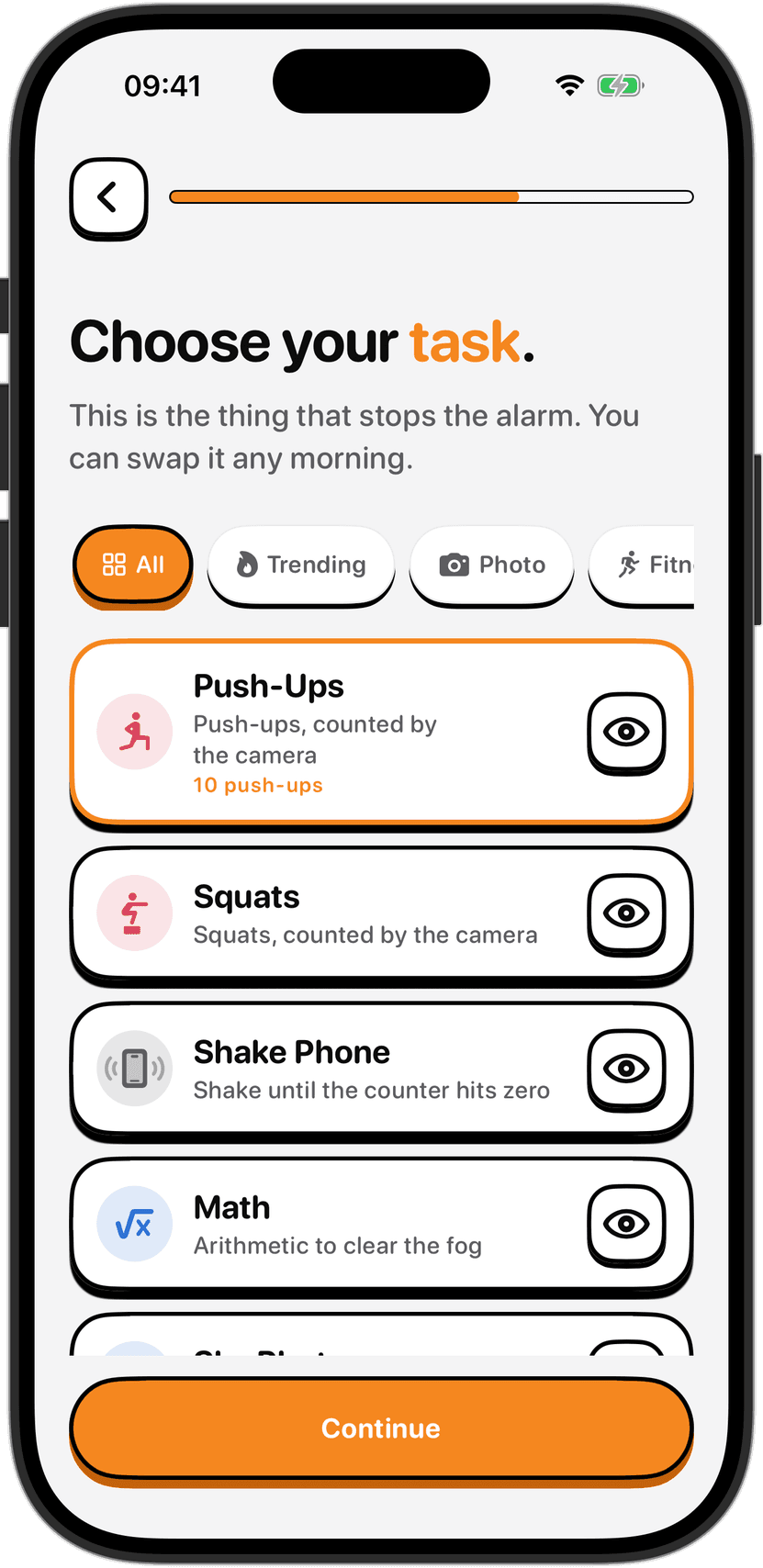
If you have overslept for years and alarms have never worked, the problem may be sleep inertia, a task that is too hard to do while groggy, or an alarm sound you have learned to tune out. It is not solved by more alarms. It is solved by a task that forces you awake (push-ups, squats, or math), an alarm sound you have not yet learned to ignore (system alarms like NoNap uses are harder to sleep through), or a wake time that aligns with your actual sleep need and your circadian rhythm.
Sources
Kaida, K., Takahashi, M., Åkerstedt, T., et al. (2006). "Validation of the Karolinska sleepiness scale against performance and EEG variables." Clinical Neurophysiology, 117(7), 1574-1581. https://doi.org/10.1016/j.clinph.2006.03.011 - Evidence that repeated exposure to alarms during the sleep-wake transition increases grogginess and reduces performance compared to single awakening.
Czeisler, C. A., Gooley, J. J. (2007). "Sleep and circadian rhythms in humans." Cold Spring Harbor Symposia on Quantitative Biology, 72, 579-597. https://doi.org/10.1101/sqb.2007.72.064 - Foundational review of circadian rhythm, zeitgebers (time-givers), and the role of wake time as the strongest circadian signal.
Eastman, C. I., Young, M. A., Fogg, L. F., Liu, L., Meaden, P. M. (1998). "Bright light treatment of winter depression: a placebo-controlled trial." Archives of General Psychiatry, 55(10), 883-889. https://doi.org/10.1001/archpsyc.55.10.883 - Clinical study demonstrating how consistent wake timing can reset circadian rhythm in circadian rhythm sleep disorder treatment.
Monk, T. H., Folkard, S., Bright, P. (1985). "The effects of sleep deprivation on the circadian rhythm of core body temperature." Chronobiology International, 2(1), 55-62. https://doi.org/10.3109/07420528509054878 - Study showing that consistent wake times establish stronger circadian anchoring than meal times or other external cues.
Trinder, J., Paolin, A., Stephenson, R., et al. (1992). "The effect of sleep deprivation on cortisol and hypothalamic-pituitary-adrenal axis responsiveness." Journal of Clinical Endocrinology and Metabolism, 75(2), 360-368. - Evidence that variable wake times disrupt the cortisol awakening response and circadian hormone patterns.