Why you forget your dreams when you wake up
Dreams fade within minutes of waking because of how the brain handles memory during REM sleep. What the awakening studies show, and how to keep one.
Visana Studios
4 min read
You had a dream a minute ago, and now you have a fragment about a train and nothing else. Most of us have lost a dream this way. The reason has more to do with what the brain was doing while the dream happened than with how much the dream mattered.
Dreams mostly come from REM sleep
Nir and Tononi's 2010 review in Trends in Cognitive Sciences draws on the early awakening studies. In those, 74 to 80 percent of awakenings from REM sleep produced vivid dream recall, against only 7 to 9 percent of awakenings from NREM sleep.
Researchers test this by waking people in a sleep lab and asking what they were experiencing. The wording matters, and the gap shrinks when the question changes. When researchers asked people to say anything that was going through their mind just before they woke, NREM reports ranged from 23 to 74 percent across studies.
So dreaming is not confined to REM, but REM is where the vivid, story-like dreams tend to come from. Recall numbers depend heavily on how the question is asked, so treat any single percentage with some caution.
Why the memory fades
The review says that dream memory "often vanishes rapidly unless written down or recorded." That is odd on its face. The hippocampus and nearby medial temporal circuits, which help store new memories, are highly active during REM, and the authors say it is unclear why a dream still fades so quickly.
One suggestion involves the prefrontal cortex, which plays a part in memory and is less active during dreaming. A second model ties dream amnesia to brain chemistry. During REM, acetylcholine keeps the brain switched on while the monoamine chemicals linked to waking are largely quiet. These are competing hypotheses, not a settled answer.
A simpler account is on the table too. Dreams have few anchors in the outside world, such as a room you can see or a clock on the wall, so there is little to hang the memory on.
Time matters as well. Researchers collect dream reports after waking, and the review notes that delayed reports may suffer passive forgetting and interference from whatever comes next. Your own morning has the same problem. The shower, a message, the alarm still going: each minute adds something new on top of the dream.
Why the alarm so often catches a dream
REM takes up about a quarter of adult sleep, according to the Sleep Foundation's stages page, last updated in July 2025. You usually don't enter REM until about 90 minutes after falling asleep, and REM periods lengthen as the night goes on. The longest ones come in the second half of the night, so a morning alarm often lands in a long REM period.
That also helps explain why the same wake-up time can produce a clear dream on one morning and a blank on the next. The alarm rings at a fixed clock time, but the stage it interrupts changes from night to night, depending on when your sleep cycles happen to fall.
The chart below shows one made-up night with this pattern. It is an illustration, not a measurement of anyone's sleep.
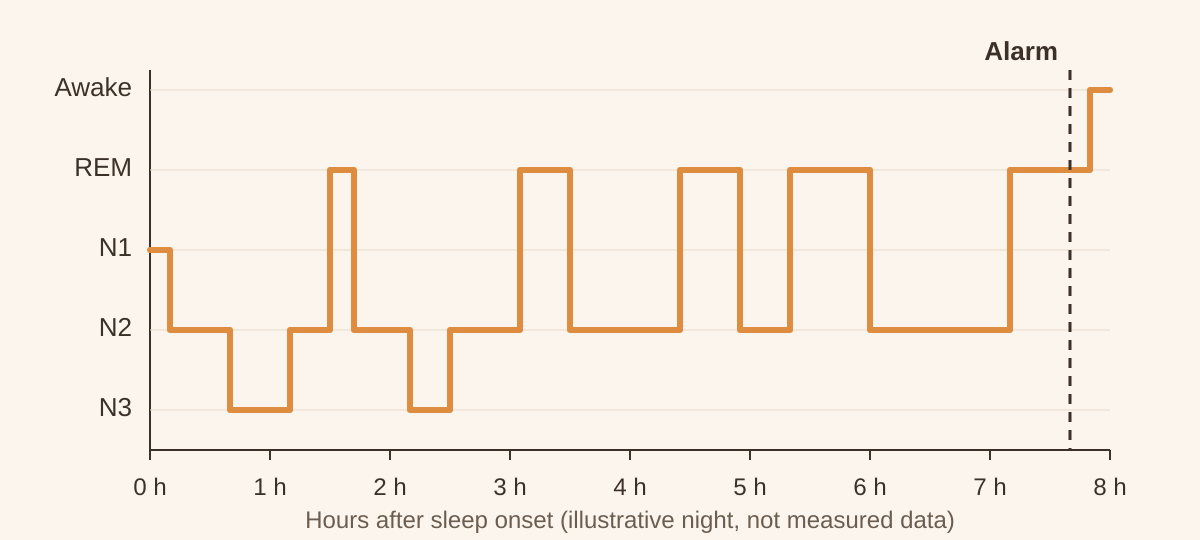
An alarm does not choose which stage it interrupts. Some mornings it breaks a dream, and other mornings it breaks deep sleep, where the report is patchier. The review also notes that reports from deep NREM sleep are harder to evaluate, partly because of the disorientation of sleep inertia, the heavy grogginess that follows waking. More on that in the sleep inertia post.
Holding on to a dream
The research suggests a simple habit. A dream memory fades quickly unless it is written down or recorded, so write it or record a voice note as soon as you can, before the shower and before the first message.
A few words are enough. Write the one image or feeling that stands out, not the full plot. A short note gives you something to return to later in the day, and it is easier to write at 7am than a whole story. Keep it somewhere you already reach for in the morning, such as a notes app, so you are not hunting for a pen with your eyes half shut.
If your dreams are frightening, come back often, or lead you to move while you sleep, speak to a doctor. Frequent distressing dreams can have causes that are worth checking.
NoNap does not have a dream journal. It is an alarm. It rings through silent mode and stays on until you finish the wake task you chose in advance, such as Push-Ups, Math, Shake Phone or Photo. Those tasks get you out of bed, but they won't hold a dream for you. A notes app or voice memo does that job better, and it works best in the first minute after you wake.
Sources
Nir Y, Tononi G. Dreaming and the brain: from phenomenology to neurophysiology. Trends in Cognitive Sciences. 2010;14(2):88-100. doi:10.1016/j.tics.2009.12.001. https://pmc.ncbi.nlm.nih.gov/articles/PMC2814941
Sleep Foundation. Stages of sleep. Last updated July 25, 2025. https://www.sleepfoundation.org/stages-of-sleep (A secondary source, used only for background on REM's share of sleep and how REM periods change across the night.)